Showing posts with label pollution. Show all posts

7.6.25

Do we want to live under a cloud of drones?

Drone can now deliver hot coffee and fast food from shopping centres to the suburbs. An ‘instant now culture’ makes it possible that the highly processed soggy food is directly delivered to your couch. Immediate access to everything, every commodity on-demand can be gratified by drone delivery. Soon tens of thousands of unmanned aerial vehicles will fill the sky over Australia.

The humming noise of the flying machines will hardy be noticed among the cacophony of noise and vibrations from vehicles, mowers, slashers and chainsaws. One is already well accustomed to ubiquitous fossil fuel generated noise pollution.


New information and communication technologies are not perceived as spying machines posing a significant privacy issue.

Should a neighbour object to the disruptive and irritating noise, security risks and privacy invasion then the first line of defence is always the Australian mantra:

“No-one has ever complained about it” and

“Have you spoken to your council?” 

Thereafter one encounters an array of Kafkaesque institutional labyrinths where no instance/ agency is responsible for anything. For complainants it is “a morass of laws and buck-passing.” (source)

The decisions to populate the sky with more machines have already been made. The precautionary principle is foreign lingo while the airspace over cities and suburbia is already humming with drones. The slow creep of the ‘outdoor lab’ is gradually and almost imperceptibly becoming a monster interchange in the sky with all the associated impacts.

”The Department of Infrastructure, which has taken control of drone regulation, wants to see expansion in the sector. A political discussion about the desirability of drone delivery services has yet to take place.” (source)

95% of Earth's land surface displays some form of human impact, much of it is human infrastructure. The ocean habitats and many rivers have been turned into shipping and boating highways. Now it is time for the 'highway in the skies’. A full-service logistics will fill the blue sky with heavy aerial traffic.

“The companies involved in drone delivery pilots want the sky for themselves.." The vision is to architect highway infrastructure across our skyscape.” (source)
 

Time to fast track a sky-highway for business. There is no time to waste for the assessment of emerging technologies.

 A disenfranchised public can only look up to the congested, automated and privatised sky highway. "The regulation is moving in a way that effectively gets rid of opportunities for people to have a political say.” (source)

Defaunation of terrestrial and aquatic ecosystems seems of no concern to humanity. Wildlife that call the sky and the atmosphere their home are classified as ‘obstacles’ to human progress.

Drones are seen as a panacea for data collection on wildlife such as koalas. They can buzz through their canopy 24/7. Human crowds can also be controlled in real-time. (source) Ultra-high-resolution overhead surveillance of citizens is already in operation. (source)

As a means of destruction unmanned aerial vehicles are widely used for asymmetric warfare in hit-and-run ambushes in the battlefield of the numerous war zones. In the Ukraine combat zones birds now incorporate nests from fiber optic cable from FPV kamikaze drones.

The sky's the limit.


Image: Curated by Bellingen Area Blog, J. M. W. Turner and ChatGPT

Drone deliveries aren't attracting many complaints but experts say that's not a sign of public endorsement. ABC

Do we want to live under a cloud of drones? The Conversation

11.12.23

Bellingen's new footpath along Waterfall Way: From the CBD to the Butter Factory

When I hear Waterfall Way (drive) in Bellingen, I think road building, road widening, giant fossil fuel machinery, yet another upgrade, congestion, aggro motorists, speeding drivers, 'accidents', dead motorists and roadkill.

WFW is the main road into the SUV-centric town with either no or very few footpaths and cycle paths. A little town where time stands still, where climate change and extinctions are foreign gobbledygook.

As the population growth outpaces local infrastructure, ongoing 'upgrades' are taking place. The latest is to sink a footpath/cyclepath along WFW, on the tree lined Heritage Avenue between the Butter Factory and the CBD. Trouble is, the 'living heritage' has to go. Anyway, these old trees "reached the natural conclusion of their life cycles" They clashed with the “proposed footpath alignment and infrastructure of power lines and road widening” added to their demise. Many trees will have to go so we can “breathe new life into this important entry statement for Bellingen township.”

Standing in the traffic jam motorists seem oblivious to the numerous fossil fuel machines slowing traffic and engulfing wood ducks and people in dust and pollution.

After the 'living heritage' is ripped out, chopped or mulched, the construction of the 2.5-meter-wide shared cement path for pedestrians, cyclists, and wheelchairs is taking place.

A thick layer of 'the most destructive material on Earth' is smeared over the soil. Carbon dioxide emissions, climate change, topsoil and urban heat were off the agenda in this mobility design. 


Of course there will be an offset for the lost canopy/habitat elsewhere. Where is the energy consumption balance sheet for all the fossil fuel machinery, the concrete, the idling vehicles to make walkability and 'connectivity' possible? Why were permeable surfaces not considered?

I can see golf carts racing along the footpath now and 'enhanced safety' in “the pedestrian-vehicle conflicts near sporting fields," by just parking on the new footpath.

25.11.23

Australian dolphins have the world’s highest concentrations of ‘forever chemicals’

'Dolphins are the “canary in the coal mine' for coastal ecosystems. Australian dolphins have the world’s highest concentrations of ‘forever chemicals’ (source)

Hepatic concentrations of per- and polyfluoroalkyl substances (PFAS) in dolphins from south-east Australia: Highest reported globally. (source)

24.11.23

Toxic Contamination and Dead Mangroves at Boambee Creek

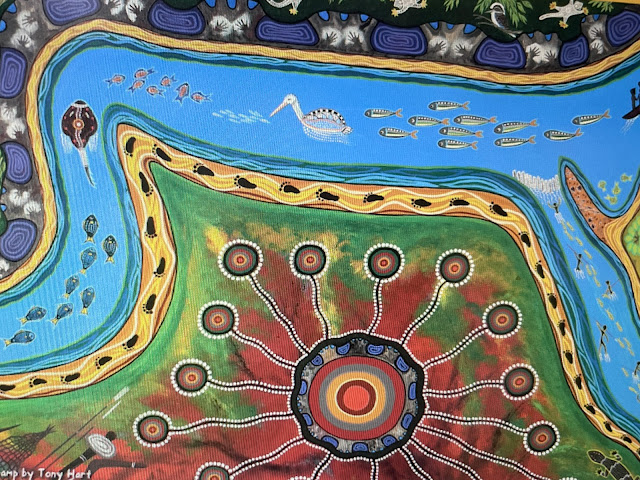
Mural, Solitary Island Coastal Walk, Bonville creek

Recently we observed  'A Cooked Intertidal Ecosystem at Sawtell Beach'. Today's local paper (Coffs Coast News of the Area) reports about 'Dead Mangroves at Boambee Creek'

The Boambee Creek Estuary is just north of Sawtell and south of Coffs Harbour airport. The creek traverses the suburbs of Boambee, Sawtell and Toormina, many roads and highways, industrial estates and resorts till finally it reaches the Pacific ocean.

The shoreline of the Boambee Creek Estuary and Boambee Beach is used as a playground for fishermen, dog owners and SUV owners.

Recently Kirsten Benkendorff (Professor at the National Marine Science Centre, Southern Cross University) and a Gumbaynggirr ranger of the Traditional Owners (Indigenous Protected Area Sea Country program) discovered the dead mangroves and neurotoxic contaminants at Boambee Creek.

"Most of the mangroves were rotting and the mud underneath was black and stinking and no live forms were visible. There was a smell of sulphur and petrol." 

"There was a range of toxic chemicals in the rotting mangrove roots, including carbon disulphide and petrochemicals like naphthalene, furan, xylene and cresol...Many are neurotoxic to the eyes, skin and lung."

"The site is not safe for people or aquatic life." (Coffs Coast News of the Area, 24.11.2023)

Update:

New research led by Southern Cross University has found a cocktail of nasty pesticides in oysters and water from one of the NSW North Coast’s dominant rivers. 12.12.2023
https://www.scimex.org/newsfeed/that-really-shucks-pesticide-pollution-threatens-shellfish-safety 

Pesticide residue from farms and towns is ending up in fresh oysters, 13.12.2023

https://theconversation.com/pesticide-residue-from-farms-and-towns-is-ending-up-in-fresh-oysters-219395

The old camp mural, Coffs Harbour, (no longer exists)dl


16.11.23

A Cooked Intertidal Ecosystem at Sawtell Beach

Along Sawtell beach to the north, just before the Murrays Beach stairs is a big pipe socialising the terrestrial runoff from suburbia. The coastal pollution leads to some rocks on the beach making up the intertidal ecosystem. As a tough rocky interface between the sea, the land and the sky they provided rich pickings for pied oystercatchers and other shorebirds.

Run off pipe with eyes

The eutrophication from land leads to algae blooms covering the intertidal rocks. Green slime smothers the area. Adding the thermal stress of 'the hottest October on record', the intertidal animals, such as barnacles, limpets and tube worms were all cooked.


At the horizon a fisherman is gathering bait.

15.2.19

The Bellinger River Snapping Turtles déjà vu


The Bellinger River Snapping Turtles were almost wiped out in 2015. What is the state of health of their home catchment today ?

"Water quality testing on the Bellinger, Kalang and Never Never Rivers earlier in January found elevated phosphate and low levels of dissolved oxygen at 9 out of 15 sites.

A combination of low rainfall, hot weather and nutrient run-off from fertilizers and animal waste (including humans).

The Australian standard is for available phosphate levels to be under 0.06mg/L but water testing near Gleniffer Hall on Tuesday revealed current levels are 0.37mg/L, which is six times higher." (Post-holiday season 'tourist drive' without toilets?)

Riverwatch testing finds high phosphate levels, The Bellingen Shire Courier-Sun, 14.02.2019
Bellinger Landcare Inc

Image:
Adolf Von Hildebrand, Boy drinking, 1870/1873

6.11.18

The Bellinger River Virus and the endangered freshwater snapping turtle


The "Bellinger River Virus" has been identified as the causative agent for the large scale mortalities in the endangered Bellinger River snapping turtles
in 2015.

Identification of a novel nidovirus as a potential cause of large scale mortalities in the endangered Bellinger River snapping turtle (Myuchelys georgesi) PLOS

Bellinger River virus found 06.11.2018 The Bellingen Courier-Sun 

A diverse suite of pharmaceuticals contaminates stream and riparian food webs, Nature, 6.11.2018

24.3.17

Cattle in the Riparian Zones in the Bellinger Valley


Has anything changed for the critically endangered Bellinger River Snapping Turtles in the Bellinger River catchment? 

 
Managing Stock on Waterways and in Wetlands in the Bellinger Valley (pdf)

Why exclude stock from riparian zones? (pdf)


Cattle grazing in arid environments leads to desertification. "Humans as Agents in the Termination of the African Humid Period" (source)

See also:
Healthy Riverbanks Booklet: The Turtle, The Cattle and The Indian Myna (here)

Images:
Turtle and wildlife in clean river, Coffs Harbour mural
Bellinger River banks with cattle, March 2017

10.3.17

Cover In-Pram Children from Car Exhaust Emissions


Children are particularly vulnerable to even low levels of pollution. Psychiatric disorders in children and adolescents are linked to traffic pollution. (source) Air pollution generally demands sacrifices in lives and economic costs. (source) Pollution from combustion (diesel) vehicles/ motors, fires (back-burning) and wood heaters are just a few that shorten lives prematurely.

Now parents are advised to use covers on their prams during toxic school runs to protect their infants from air pollution:
 “Fine particles show larger health impacts compared to their larger counterparts and at the young age children are more susceptible to particulate pollution, suggesting a clear need for precautionary measures to limit their exposure during their transport along the busy roadsides…Children could be at risk of breathing in some nasty and harmful chemical species…One of the simplest ways to combat this is to use a barrier between the in-pram children and the exhaust emissions, especially at pollution hotspots such as traffic intersections, so parents should use pram covers if at all possible.” (Source)


Links:
Use buggy covers to combat air pollution danger, parents warned, The Guardian, 10.03.2017
Exposure of in-pram babies to airborne particles during morning drop-in and afternoon pick-up of school children, Environmental Pollution 06.03.2017

Top tips to avoid getting metal pollution in your brain, New Scientist, 5 September 2016

NICU treatments for improving neurodevelopmental outcomes rely heavily on touch. On the somatosensory scaffolding of later perceptual, cognitive, and social development. Touch is a cornerstone of interpersonal interactions and sensory-cognitive development. Current Biology, DOI: http://dx.doi.org/10.1016/j.cub.2017.02.036

Update:
Air quality concerns spur anti-idling push at schools. Parents who leave their cars idling in school pick-up zones urged to switch off.  abc 12.04.2017


Images:
Mother and child getting poisoned by cars, Street art EU
Plastic covered prams of North Shore jogging mums, Sydney
Tyre Adventure Playground, Bellingen

18.1.17

Healthy Riverbanks Booklet: The Turtle, The Cattle and The Indian Myna


After the mass kill event in 2015 of the critically endangered Bellinger River Snapping Turtle, various authorities have now resorted to making information and activities available to property owners and other stakeholders in the catchment area.

The Bellinger River System Landholder Booklet (pdf) is also available in the dead tree version.

It seems that the introduced Indian Myna (pdf) is symbiotic with the cattle business and roads as they spread along with the precooked ungulates standing mostly without shade in severe heatwave conditions.

Meanwhile the drought continues...

23.2.16

The hills around Bellingen could burn for a year...


NSW Forestry Corporation will log, bulldoze and burn Tarkeeth State Forest. “Residents have been told by Forestry Corporation that waste vegetation would be bulldozed into windrows and burnt over a period of a year or more...Imagine the smoke pollution right across the Valley." (source)

Study indicates 'biomass burning' may play larger role in climate change than previously realized. "Based on aircraft observations, satellite data and models, the findings indicate 'biomass burning' may need to be addressed with future regulations. Following closely after COP21, the results could suggest a need to look at other sources of greenhouse gas emissions, in addition to industrial activities and fossil fuel combustion in industrialized nations." (source)

Smoke - "Globally around 340,000 deaths per year are thought to be attributable to the additional pollution from landscape fires. Ending deforestation by burning would have many benefits, not only for global climate and biodiversity but for human health too." (source)

Measuring air quality/ NSW clean air legislation EPA NSW

Smoke and dust sensors. Open source technology for citizens:
Low-cost sensors to measure air quality. Monitor the air you breathe. Nature 09.01.2015


Links:
The hills around Bellingen could 'burn for a year', Bellingen Courier, 22.02.2016

University of Maryland. "Fires burning in Africa, Asia cause high ozone in tropical Pacific: Study indicates 'biomass burning' may play larger role in climate change than previously realized." ScienceDaily, 13.01.2016. 

World Pollutionwatch: Wildfires can kill – far from the flames, Guardian, 31.08.2015

 Hazard reduction burning kills 

Updates:
Tracking forest degradation regarding carbon emissions. Amazon Satellite alerts track deforestation in real time, nature 23.02.2016 

How Forest Loss Is Leading To a Rise in Human Disease, Yale Environment 360, 23.02.2016

Land-clearing surge in Queensland set to wipe out Direct Action gains – report Guardian 29.02.2016

'Like a scene from a doomsday sci-fi movie': Flames burn through Tarkeeth Forest, Bellingen Courier, 24.04.2017

Image:
Eugene von Guérard, Bush fire between Mount Elephant and Timboon, 1857

22.2.16

Freshwater Ecosystems and Cattle

"Today it's simply socially unacceptable to let stock in rivers; people view it in the same way as it's unacceptable to smoke in restaurants"  Conservation group raises alarm over river protection, 22.02.2016  

Image:
Bellingen graffiti: Cattle standing in the Bellinger river

Livestock grazing of riparian vegetation #1

11.9.15

Car Racing in the Home of the Koala

The koala calls the North Coast forests of NSW its home. Coastal sprawl and deforestation fragment and thin their habitat. The path to the next yummy canopy becomes ever longer and more dangerous. Settlers and their industry demand roads that bulldoze their way through forests 'dripping with koalas'. Many animals are injured and killed by motorists in this process. Their packs of roaming dogs hunt and maul the threatened species. Record-breaking temperatures, "extreme weather events, such as killer heat waves, devastating droughts and intense, flooding rains" unleashed by us will not enhance the life of the koala or any other being.

This weekend it is time again to roar racing cars through Coffs Coast subtropical hinterland. The wonder of 'sustainable' motor racing will take place on forest roads between the Nambucca and the Orara river valleys. Motor 'sport' "is a glorious, lovely thing, all noise and violence and sliding sideways between trees at 100 mph." (source) Dust and noise pollution is generated in abundance.

1400 people donate their free labour to showcase this motor spectacle over four days. Wardens "will use airhorns to scare" the marsupials up the trees. "The numbers of animals that get run over are very low" we are told. (source)


"Population numbers on the East Coast fell by 40% between 1990 and 2010, and in other areas like the Pilliga Forest, the population has crashed by 70% in 10 years." (source)

According to the criteria of the Office of Environment and Heritage, NSW this event does not seem to constitute an 'activity to assist a threatened species'.


Koala, threatened species profile 

Car ploughs into spectators at Rally Championship
 
Staging Car Races in Nine State Forests of NSW 2014

Celebrating Fossil Fuel Culture on Forest Roads  2013 

Update:
Racing drivers generated a lot of dust in a landscape cracked by drought. They complained that Valla was too hard “to navigate due to excessive dust and inadequate lighting.” Maybe they will refrain from driving with ‘impaired vision’. 16.09.2015

WRC on collision course in forest habitat : Norwegian rally driver, Mads Østberg was admitted to hospital after a collision with a logging truck. FOUR crashes during September's World Rally Championships have sparked calls for a re-think of next year's event. 17.10.2015 coffs coast advocate

Image:
Koala, Brehm's Life of Animals

27.8.15

Microplastic from Clothing is Accumulating on Shorelines Woldwide


60-85 percent of human-made material found on shorelines consists of micro fibers from clothing. (source)

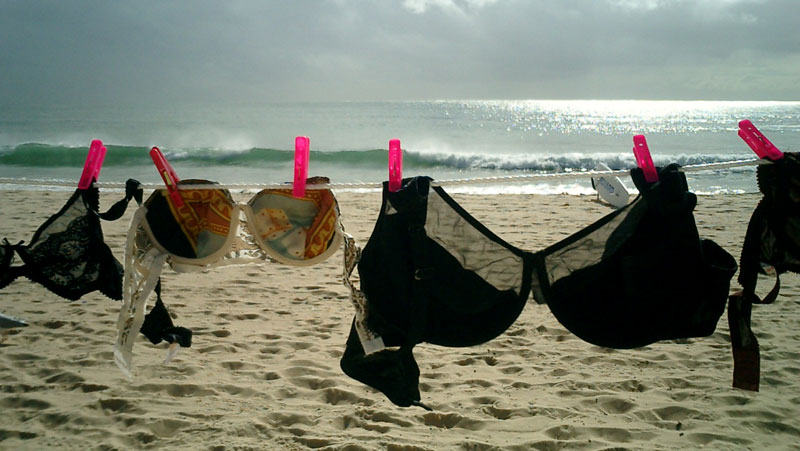
Plastic clothing has become the norm. From lingerie to outdoor gear, synthetic garments fill shops and wardrobes, cling to bodies and households. Synthetic fabrics (polyester, acrylic, nylon, rayon, acetate, spandex, latex, etc) are convenient and just require a quick spin.

The bright, fashionable colours of the season make the textiles obsolete by the time they leave the shop. Mending is out in a throw-away society. Mountains of old rags go into 'landfill' or end up in smelly second hand shops.

Synthetic and some natural fibers are often pickled in chemicals: toxic dyes, flame retardants, nano -silver and other chemicals in stain-proof textiles and waterproof clothing.


Garments that are washed by hand or machine shed fibers and chemicals/detergents into the water. As there is a paucity of sewerage systems in rural areas like Bellingen and the mid north coast, the effluent drains into the catchment. "Wastewater from domestic washing machines demonstrated that a single garment can produce 1900 fibers per wash." (source)

The shed micro fibers reach the shorelines. They are "micron-scale synthetic fibers, mostly polyester and acrylic, in sediments along beaches the world over." (source)

The invisible contamination of soil, water catchment and marine habitat with microplastic enters the food chain of all living creatures.


Natural fibers, untreated and of organic origin produced and tailored under ethical conditions (no land grab or exploitation) is the right choice to make...


Sources:
Accumulation of Microplastic on Shorelines Woldwide: Sources and Sinks
The Damage I Cause When I Wash My Clothes
Chemicals in clothing, Choice
Two-thirds of new clothing is plastic


Updates:

What does micro plastic less than 1mm do to animals?
Linking effects of anthropogenic debris to ecological impacts
Mark Anthony Browne, A. J. Underwood, M. G. Chapman, Rob Williams, Richard C. Thompson, Jan A. van Franeker, Published 22 April 2015.DOI: 10.1098/rspb.2014.2929

Chris Wilcox, Erik Van Sebille, and Britta Denise Hardesty. Threat of plastic pollution to seabirds is global, pervasive, and increasing. PNAS, August 31, 2015 DOI: 10.1073/pnas.1502108112
( 99 per cent of the world's seabirds species will be ingesting plastic by 2050 if current marine pollution trends continue. They starve to death from plastic fibres from synthetic clothes an other 'junk food'.)
or
Almost all seabirds to have plastic in gut by 2050, CSIRO


27.7.15

Sewage discharge and shellfish don't mix. The Bellinger-Kalang rivers.

"One of the more pervasive aspects of European settlement was the pollution of the air and water." (source)
"The indications are that we will not have, inside the Bellinger-Kalang, an oyster industry within the next two years...” (source)

"The Aborigines on the coastal regions feasted on oysters and shell beds can be found in the many kitchen middens along the coast. Some of these middens have been carbon-dated to ten thousand years." (source)

Oyster growers on the NSW Mid North Coast are going to grow Sydney Rock Oysters in land-based tanks now to control water quality. "The Bellinger River was closed for 270 days last year due to heavy rainfall." (source)

Along the Bellinger River catchment and the Kalang River dense settlements sprawl along that are not on any sewer system. The majority of the rural blocks are on an on-site sewage management system (OSMS).

In 2008 sewage bacteria really hit the filter feeding oyster beds. "The NSW Food Authority closed the Kalang River at Urunga in August while a search was made for norovirus, which causes gastroenteritis in humans." (source)

Sewage discharge and shellfish don't mix
"The Bellingen Shire Council says septic systems in the river catchment have been identified as a possible source of the pollution...One of the potential contamination sources are privately operated onsite sewage management systems." (source)


Aquaculture farmers have been waiting for seven years for the Kalang River to reopen to oyster harvesting. "Protracted river testing, analysis and meetings began with riverside septics found to be high on the list of culprits, especially on Newry Island and along Urunga’s Atherton Dr." (source). Additionally the "Urunga sewage treatment plant, holiday cabins, two caravan parks adjacent to the river." were also mentioned as sources of contamination. (source)

After the endemic totem of the river, the Bellinger River turtle has been pushed into extinction, the question of water quality and river health is an acute one for the entire catchment.

Updates:
Dairy growth in north-west Tasmania causing concern for oyster farmers: effluent run-off from farms. abc 13.08.2015


Images:
Beert, Osias, Still life with oysters, c. 1610
Bellingen tiles

24.6.15

Aboriginal Consumption of Estuarine Food Resources and Potential Implications for Health through Trace Metal Exposure; A Study in Gumbaynggirr Country


Many of the Gumbaynggirr community rely on the Nambucca River estuary and coastal marine environment for fish and seafood. A legacy of the 'extract and dump' culture has polluted the environment with "metal-based sprays of arsenic and lead, organochlorine pesticides including DDT, dieldrin, aldrin and organophosphate pesticides...Derelict mines, agriculture, cattle dips, horticulture and banana growing left behind early generation chemical sprays and fertilizers."

Trace metals concentrations have implications for the health of the people engaging in fishing and seafood consumption. Read the details in the original study:

Shaina Russell, Caroline A. Sullivan, Amanda J. Reichelt-Brushett. Aboriginal Consumption of Estuarine Food Resources and Potential Implications for Health through Trace Metal Exposure; A Study in Gumbaynggirr Country, Australia, PLOS ONE, 2015, DOI: 10.1371/journal.pone.0130689 
Fishing and resource use continues to be an essential aspect of life for many Aboriginal communities throughout Australia. It is important for dietary sustenance, and also retains deep social, cultural and economic significance, playing a fundamental role in maintaining group cohesion, transferring cultural knowledge and affirming Indigenous identities. We surveyed approximately 20% of the Gumbaynggirr Aboriginal community of Nambucca Heads, New South Wales, Australia. This paper explores Gumbaynggirr Connection to Country and engagement in cultural practice. It quantifies fishing efforts and consumption of seafood within the community. We found 95% of the sample group fish, with the highest rate of fishing being 2-3 times a week (27%). Furthermore, 98% of participants eat seafood weekly or more frequently, up to more than once a day (24%). Survey results revealed that Myxus elongatus (Sand mullet) and naturally recruited Saccostrea glomerata (Sydney rock oysters) continue to be important wild resources to the Gumbaynggirr community. Trace metals were measured in M. elongatus and S. glomerata samples collected by community participants in this study. Maximum levels prescribed in the Australia New Zealand Food Standards Code were not exceeded in the edible tissue for either species, however both species exceeded the generally expected levels for zinc and copper and S. glomerata samples exceeded the generally expected level for selenium. Furthermore the average dietary exposure to trace metals from consuming seafood was calculated for the surveyed population. Trace metal intake was then compared to the provisional tolerable weekly intake prescribed by the Joint Expert Committee on Food Additives. This process revealed that copper and selenium intake were both within the provisional tolerable weekly intake, while there is no guideline for zinc. Furthermore, participants relying heavily on wild resources from the Nambucca River estuary may exceed the provisional tolerable weekly intake for cadmium. This suggests the need for further investigation of this issue to minimize any possible health risk.

Images:
From the outside walls of the Yarrawarra Aboriginal Cultural Centre, Corindi Beach


8.5.15

Noise Pollution and Vibration in the Bellingen Shire


On the 15th May the Royal Australian Air Force will fly jets day and night until 10.30 pm over the Bellingen Shire. (source)

The morning chorus of rural Bellingen usually consists of chainsaws. During the day the cacophony is enriched by mowers, slashers, lawn trimmers, sweepers, mulchers, chippers, shredders, bulldozers and other fossil fuel powered equipment. Cars speed on unpaved roads, cavalcades of mining and logging trucks thunder through the shire and the scenic little village. Hovering (pesticide spray) helicopters and sightseeing planes ensure that the sky is also abuzz with noise pollution. On weekends gangs of trail bikes rev up. At night the odd out of control ad hoc party distributes its industrial sound waves over the valley. The barking and yapping packs of dogs will be ignored here, as the focus is on machines powered with fossil fuel.
As a special annual event, the Bellingen shire (and Nambucca, Bellingen, Coffs Harbour and Clarence Valley council areas) puts itself on the map by hosting car races. " 200 kilometres of NSW forest roads will be used for a three-day car race." (source)  The fossil fuel burning spectacle is generating a lot of noise and dust. During that time, "the public is being denied access to various state owned forests." (source) Local endemic wildlife better not be near the many roads fragmenting their habitat.

Back to the aerial machines: “Up to 18 aircraft may be involved in these exercises, of which the major part will be conducted further off the coast, however northern NSW residents may notice aircraft activity this week." The aircraft will be the "F/A-18F Super Hornets from RAAF Base Amberley, near Brisbane and F/A-18 Hornet aircraft from RAAF Base Williamtown, near Newcastle." (source)


Ron Brent, Australia's Aircraft Noise Ombudsman, mentioned that the F/A-18s  "when used at full power... are among the noisiest planes we've seen here in Australia". (source)

In other places, aircraft noise has caused 'friction with surrounding residents'. One resident 'recorded jet noises as loud as 100 decibels at home.' "According to the RAAF, at Ludmilla Primary School the average maximum noise of an F/A-18 Hornet taking off from the RAAF Base Darwin is 92.6dB." (source)

A resident reported her experiences: "The whole house literally shakes...It's impossible to conduct conversations. You can't hear the radio...You feel the sound waves hitting your body...The worst part is not being able to predict when the noise will come...You don't know when it's coming. It's Chinese water torture...Then you start to hear it coming and your whole body tenses.." (source)

Celebrating Fossil Fuel Culture on Forest Roads
Staging Car Races in Nine State Forests of NSW

Images
Graffiti in the public sphere

4.3.15

100 Bellinger River turtles have been found dead or dying


(This post has developed into a sporadically updated ’chronology’ of the demise of the Bellinger River Snapping Turtle (Myuchelys georgesi). The river health reveals low dissolved oxygen, degradation of native riparian vegetation and high phosphate levels in the critical reptile habitat.)

100 300 350 400 426 Bellinger River turtles have been found dead or dying in the Bellinger River. Their "eyes, sinus, brain and vascular system have been affected." They have "severe internal symptoms including major organ damage." Many were blind and malnourished.


The Bellinger River Emydura (Emydura macquarii) Recovery Plan states the following threats:

"Water pollution and increased river sediment load resulting from activities including logging of native forests in the catchment upstream of the population and grazing and agricultural activities upstream and in the vicinity of the population;

construction of bridges and fords upstream and in the vicinity of the population;


extraction of river sand and gravel upstream and in the vicinity of the population; and

line fishing."


S o m e   o f   t h e   t i m e l i n e:  (u p d a t e d)

06.03.2017 Coffscoast Advocate,  21 Critically endangered Bellinger River Snapping Turtles have hatched in a captive breeding project. The offspring will be used to rebuilding the population which was wiped out 90% in 2015. But is their habitat, the Bellinger River catchment now less degraded?

07.11.2015 The Bellingen Courier,  "Australian turtles have existed for 50 million years, but in less than 200 years of European settlement they have been driven to the brink of extinction." Go fetch some data on freshwater turtles dead or alive..

30.09.2015 The Bellingen Courier, "The Bellinger River Snapping Turtle is functionally extinct, meaning that without human intervention there would be no hope", Dr Ricky Spencer, Western Sydney University’s School of Science and Health and Hawkesbury Institute for the Environment. Video
-  In more detail: Mating season key as endangered turtles recover from mystery virus, via @emydura5

15.09.2016 The Bellingen Courier,  Bello youth to investigate the degradation of the Bellinger River. After the usual fund raising and a lot of song&dance, young citizen science has found that:
"The river health reveals low dissolved oxygen, poor riparian zone health and high phosphate levels in critical turtle habitat." (source)

09.05.2016 The Bellingen Courier, To prevent the extinction of the Bellinger River Snapping Turtle (Myuchelys georgesi) help comes from far afield - the Abu Dhabi's species conservation fund. The Mohamed Bin Zayed Fund will help to conserve the Australian threatened and endangered species. Research will address certain points about the reptiles' demise.

"However the significant number of dead turtles suggests an inability for the Bellinger River Snapping Turtle to adapt and suggests that something is very wrong with the state of the river." (source) The reduced ecosystem biodiversity is in the hands of the local population...

The recovery of the imperilled Bellinger River Snapping Turtle, Myuchelys georgesi, Mohamed bin Zayed Species project number 162512755


14.03.2016 The Bellingen Courier, One year after the mysterious mass mortality event survey participants trapped and tagged some surviving Bellinger River Snapping Turtles in the Bellinger and Kalang Rivers "although the number of adults found was extremely low"

22.12.2015 The Bellingen Courier,  The mass extinction event of the Bellinger River Snapping Turtle puts Bellingen water quality on the map internationally.

16.11.2015 The Bellingen Courier,  More on logging and clear-felling in the Bellingen Valley catchment area and a culture of silence:
“The NSW Environmental Protection Agency has recently announced a pathetic $15,000 dollar fine for Forestry Corporation’s botched clear felling operation on steep slopes at Tuckers Nob State Forest adjacent to the Never Never River Catchment in late January 2015...Regarding the death of the Georgei snapping river turtles and any relationship between the trashing of the Never Never and the turtle deaths, there has been a rigorous attempt to stop any serious community discourse about the state and condition of the river when the turtles died and all government departments have consistently blamed a “mystery turtle virus"…This neatly removes any responsibility from any Government Department either Forestry Corporation NSW the EPA or the Roads and Maritime Authority who were working at Gordon’s Cutting where a large mass of dead turtles were found."

10.11.2015 The Bellingen Courier,  The turtles were “found to be suffering from an unusual and consistent pattern of severe inflammatory lesions… A novel virus was identified as the likely cause of the outbreak…”  The public is still kept in the dark about the pathogen type.
Dr Spencer: “The Bellinger River snapping turtle – a species over two million years old – was in healthy numbers in January this year, but by March it was close to extinction.. Turtles are top predators and major scavengers and if they disappear like they have in the Bellinger River, then water quality will be affected.”

3.11.2015
The Bellingen Courier, Construction work at Manns Bridge, Darkwood bumps into an endangered species. The giant barred frog halts the excavation work. But already "the machinery has been washed down in chlorine.."
"As a component of such works council is required by legislation to undertake environmental assessments and prepare an environmental management plan prior to the commencement of works. In addition to these requirements as a result of the Bellinger Snapping turtle mortality the Office of Environment and Heritage (OEH) has established a decontamination procedure for all equipment working near the waterways to reduce the risk of spreading pathogens to other ecosystems in the catchment. Council includes this practice when undertaking works near these waterways."


20.10.2015 Coffs Coast Advocate, The DPI published a report on the mass death event of the turtles. The Bellinger River Snapping Turtle Mortality Event 2015 Epidemiology report. "The turtle disease event may be symptomatic of environmental changes with a series of floods late last year and earlier this year."

24.09.2015 DPI alert: Enhanced surveillance for disease in turtles PDF. “A disease syndrome” has affected the turtles. "They were found dead or beached on banks or emaciated with swollen inflamed eyes and lids. On post mortem examination, there have been gross changes to the eyes, with extension in some animals into the sinus and brain. Changes have also been seen in the liver, kidney, heart and spleen, with varying degrees of inflammation. These effects appear to have occurred over approximately 4-10 days."
Human leisure activities along the 60 kilometre section of the Bellinger River and biosecurity: PDF

21.09.2015 Coffs Coast Advocate, There will be searches for Bellinger River Snapping Turtle survivors in the coming weeks. They will also check if other turtles have been affected by the recently identified virus that remains unknown for the public.
No information can be found whether the home of the turtle/s, the Bellinger River (catchment), has undergone any audits for aquatic ecosystem integrity or improvements...

Bellinger River Snapping Turtle, Myuchelys georgesi -
proposed  c r i t i c a l l y   e n d a n g e r e d   s p e c i e s  listing (PDBellRiverSnapTurtle.pdf 59 KB) - On public exhibition Friday 28 August 2015 – 23/10/2015
Point 9 of the PDF has more on the taxonomy of the turtle and the mortality event of 426 turtles. Point 10 is on the habitat degradation and removal or degradation of riparian vegetation. The reference section has many links. 08.09.2015

02.09.2015 abc The mystery virus killing rare freshwater turtles has been identified, but the virus remains a mystery to the public. "There have been no live turtles seen in the river since the initial mortality incident." Bellinger Shire Council


31.08.2015 The Bellingen Courier Sun, Breakthrough news after nearly a year: It is a (nameless) virus. "A single causative agent was responsible."
But why did the Bellinger River's snapping turtle get the virus?


Ro McFarlane, Patterns of Ecological Change and Emerging Infectious Disease in the Australasian Region, PDF
"A series of transdisciplinary studies is reviewed that test the hypothesis that specific ecological change accounts for a significant component of the rise in emerging infectious diseases (EIDs) in the Australasian region. Amongst the range of mechanisms, factors such as wildlife adaptation to changing landscapes and selection for antimicrobial resistance appear to be of major significance. However, exploring multi-scale complex relationships is a challenge to epidemiology."
The role and significance of wildlife–livestock interfaces in disease ecology has largely been neglected... See Global trends in infectious diseases at the wildlife–livestock interface, PNAS, 13.08.2015

And of course there is a petition to 'Save the Bellinger River Snapping Turtle from Possible Extinction'. It appears that many people from overseas seem to want to keep the unique turtle alive.

06.08.2015 A new parasite in the western long-necked turtle

16.07.2015 The Guardian, It is noteworthy that freshwater turtles subjected to the illegal wildlife trade, living in “terrible conditions", deprived of “food or water for about six months, destined for the pet and food markets in Hong Kong and China” also suffered from eye ulcers and other health problems.


16.07.2015 The Guardian, 10 Australian species at extreme risk of extinction: can they be saved? Unfortunately the Bellinger River snapping turtle has made it into the '10 Australian species list' that are about to be pushed off the planet. "Freshwater turtles are crucial to river ecosystems because they eat dead and decaying matter." The end of a "permanent grin" and clean water.

02.06.2015 Bellingen Courier Sun, Roads to Ruin... or 'Oil slick raises concerns'. Finally the spotlight is on water quality. The 'blind spot' in the inquiry might be overcome and behind the obscuration lurks a "potential contamination from road run-off into the river system...Dorrigo Quarry upgrade and the subsequent increased number of trucks driving up and down the mountain. There are claims that " the oil slick from the road’s surface is making its way into the waterway...The slick on the river appears on a regular basis and it’s coming from vehicles"

"The “results of the water testing indicated that the level of hydrocarbons and BTEX (volatile organic compounds found in petrol) in the water meet Australian fresh and marine water guidelines." Said Council’s general manager. NB Links are not in the original article. 

More on Pacific Highway 'upgrade'. Or straight to Bill Laurance, Roads to ruin.


Saving the Bellinger River turtles through IVF?


23.05.2015 abc/video  'Mystery illness' gives birth to the first wildlife biosecurity team in NSW. They set up quarantine facilities (in Sydney) to save the Bellinger River turtles from extinction. Should there not be biosecurity warning signs up and down the river?


23.05.2015 Guardian, "Turtle on edge of extinction after sudden attack by mystery disease
A species of turtle has been pushed to the brink of extinction over the course of just one month after a mystery disease swept through its habitat in New South Wales...“For this to occur over the period of a month is very alarming. It’s a mystery event never seen in Australia before. It may take years before we find out what’s happened here...“What we do know is that it kills and it kills rapidly. Within a month, the turtles have gone from not threatened to endangered or critically endangered. The problem is that they only exist in the Bellinger river and nowhere else in the world, so a population crash here means extinction.”....
The alarming decline, revealed on what is world turtle day, is the latest woe faced by a freshwater turtle species. According to the IUCN, 62% of the world’s freshwater turtle species are either threatened or endangered.
Freshwater turtles are considered crucial to the health of river ecosystems because they eat dead and decaying matter and help recycle nutrients."
23.05.2015 abc  'Scientists race against time /Scientists are scratching their heads.' Lawrence Orel, from the NSW Office of Environment and Heritage: "Unfortunate as it is for that species, we've not been able to detect any other impact on other species or turtles in the river, or other fauna in the river."

23.05.2015 abc AM "The incident has baffled scientists...

Zoologist Dr Ricky Spencer: Their whole range could be affected by now; we don't know that. We basically had to go in before winter and recover what we could. And if their whole range is affected, then there may be no other turtles out there.
We know that it wipes them out very, very quickly. Individuals get lesions - and particularly around their eye - but throughout their whole body there are these lesions that basically kill them and it has a 100 per cent mortality rate.

...It's not a population crash, it's an extinction event."

05.05.2015 Australian Geographic  The Bellinger River snapping turtle is on a bleak trajectory toward extinction. "ONCE (1788?) AN UNTOUCHED wilderness (?) of hills, valleys and waterfalls, the Bellinger River National Park is now (2015!) a graveyard for river turtles infected by a mysterious and deadly illness..."

28.04.2015 abc  A mystery virus has swept through more than 90 percent of known habitat in the Bellinger Catchment, killing every Bellinger River Snapping turtle it has infected. Since mid-February vets have been working on identifying the 'mystery virus'.  17 healthy turtles were removed from their habitat and put on a breeding in captivity program. An interplay between extinction and hope...

07.04.2015 Coffs Coast Advocate The Raising Awareness stage: A forest of signs has been installed by Bellingen Shire Council warning the Snapping Turtles of human impacts. "Diagnostic testing is still underway to try to identify the cause of this epidemic in the Bellinger River Snapping Turtles."

05.04.2015 Bellingen Shire Council Updates: Bellinger River Snapping Turtle Deaths

abc 29.03.2015  A sharp decline in turtle numbers in the Riverland of South Australia. Authorities estimate the freshwater turtle population has dropped by as much as 90 per cent over the past four decades.

26.03.2015 NSW gov. Bellinger River Snapping Turtles #4 (PDF)  “We have not yet found evidence of a highly pathogenic organism, but the investigation continues” Dr Karrie Rose, from the Australian Registry of Wildlife Health at the Taronga Conservation Society


The Conversation 25.03.2015, Ricky Spencer, Turtle extinction event bodes ill for our waterways
"Turtles are an evolutionary success story, having persisted for over 220 million years...

They are also long-lived and turtles can bio-accumulate toxins in their shells. Regular sampling (shell or nails) of marked individuals can be used to monitor long-term exposure to toxins and pollutants in the river – something that snapshot monitoring of water quality may miss.
The current disease threatening to drive the Bellinger River Snapping Turtle to extinction is a potential window into a long-term breakdown of ecosystem services. The possible extinction of a long-lived ancient species that has survived several million years might be a significant warning sign of the current state of our freshwater environments.

Yet the peril of this one turtle species is more than an isolated issue. It gives us a window into the health of the entire ecosystem around the Bellinger River, and suggests something is very wrong."

ABC 25.03.2015  Mystery! "We may never know what the cause of this outbreak has been...But certainly, we'll be taking steps to ensure the population is conserved as best we can." Geoff Ross, Incident Management Controller


Zilch outcome, zero news on the pathogen ecology (that is outside the turtles' bodies)  - An emerging infectious disease (EID) ?

Bellingen Courier 24.03.2015   "There is little more the Incident Management Team (IMT) can achieve.... More than 315 turtles, about 10 per cent of the population, have been found dead or dying as a result of contracting the disease and experts said “there is an intensive ongoing effort to determine the cause of the mortalities, involving at least seven specialist institutions. A number of serious pathogens have been excluded, and work is ongoing. Novel pathogens can be frustrating to elucidate and require significant time”."

- On the impacts of the road maintenance practices in the area. Boggy Creek (riparian area) and heavy machinery.

NSW government PDF factsheet/ map 03.2015 Bellinger river turtle deaths

ABC Coffs Coast 24.03.2015. "Officials from the Incident Management Team said the kill was unprecedented. Never before has a species been affected so dramatically in such a short time."

18.03.2015 abc When the habitat is degraded - artificial breeding is the answer. To repopulate the Bellinger River with snapping turtles again could take 100 years.
 
18.03.2015  Bellingen Courier Bellinger River Snapping Turtles (Myuchelys georgesi) mortality update:  An "unexplained mortality event" in the Bellinger River. "Surveys indicate that turtles along 42km of the Bellinger River between Bishops Creek at Darkwood and Lavenders Bridge in Bellingen are affected."

16.03.2015 abc Quarantine measures considered to ensure survival of Bellinger River turtles. Nearly 20 percent of the species may have now been lost to the unknown 'mystery' pathogen.

14.03.2015  Coffs coast advocate (Update) Bellinger turtles response team forms. "Only Bellinger River Snapping Turtles are affected, with almost 300 severely affected or dead turtles found to date with severe internal symptoms including major organ damage."

Bellingen Council,  Bellinger River Snapping Turtle Deaths, factsheets


10.03.2015 Bellingen Courier (Update)   Message: Stay clear of the waterways. "New England National Park’s upper catchment, including Brinerville, has been closed until further notice as wildlife officers discover more dead turtles higher up the Bellinger River...Though there’s nothing to explain why affected turtles are found suffering blindness, leading to inability to feed and subsequent starvation, the vacuum in scientific data been filled by locals’ theorising everything from long-term environmental degradation of the Bellingen River, the 2014 drought followed by the recent rains, to a claim that chemicals from an ice drug lab have polluted the waterway."

 
06.03.2015 env.gov.au  (Update) Bellinger River turtle mortality update: #2 Incident Controller and NPWS Senior Wildlife Management Officer reporting on the pathogen ecology of the area. Images

05.03.2015 Coffs coast Advocate (Update) "Assessment teams will begin monitoring the river upstream of Thora to map exactly as possible the extent of the area where turtles have been affected. Water quality sampling failed to identify contamination including pesticides, organochlorines, organophosphorous and pyrethroids. Results on turtles sent to Sydney for clinical and pathology analysis are expected later this week."

04.03.2015 Courier-Sun  Microorganisms are to blame. "EPA officers also carried out an inspection of road works being carried out by the Roads and Maritime Services (RMS) at Myers Bluff on Waterfall Way. No environmental issues were identified but the EPA requested that RMS carry out a thorough review of its activities to ensure there are no underlining environmental issues which may affect the river."

03.03.15  NPWS-led team investigating 100+ freshwater turtle deaths in Bellinger Rvr. No obvious cause. Possibly viral or fungal

27.02.15 abc  EPA rules out toxic spill as the cause of a large Bellinger River turtle kill. EPA officers took the samples from four key locations along the river including at Myers Bluff and Thora Bridge.

24.02.15  Flood warning for Bellinger River at Thora

12.09.14  Road safety work   Water Fall Way - examined a 40 kilometre stretch of road from Tyringham Street at Dorrigo to the junction of the Pacific Highway . “Work to strengthen and stabilise the slope at Myers Bluff and Gordonsville was also fast tracked to ensure that road safety benefits are in place by the end of 2014.”

 27.08.14  Minor flood warning for Thora


At a slightly different location of the river:

17.12.2014  A semi trailer with 27 tonnes of fertilizer rolled into the Bellingen River along North Bank Rd.
>Pollution in urban and farm runoff in Hawaii is causing tumors in endangered sea turtles. Duke news 2014. “Eutrophication and the dietary promotion of sea turtle tumors,” Kyle S. Van Houtan, Celia M. Smith, Meghan L. Dailer and Migiwa Kawachi, published September 30, 2014 in PeerJ. DOI: 10.7717/peerj.602 via 


Links:
Bellinger River emydura - vulnerable species listing, 1997:

"Threats to Emydura macquarii (Bellinger River form), include extraction of river sand and gravel, construction of bridge and ford crossings upstream of the species location, low intensity grazing and agricultural activities in downstream reaches of the Bellinger River, logging of native forests leading to water pollution and soil degradation, and line fishing as a possible minor threat."


Bellinger River Turtles- A Window to a National Crisis? Some local background on the the Bellinger River Emydura.

2014 Bellingen Shire Council, Implementing the Dairy Effluent Assessment and Planning Project of the Bellinger River

Waterfall Way - Lining the Pacific Highway with Crumbled Mountain  


UPDATE/Readings:

Agricultural insecticides pose a global risk to surface water bodies, PNAS
The first global map (Australia) to be produced on potential insecticide contamination, The Helmholtz Centre for Environmental Research - UFZ, 25.02.2015

Alessio Ippolito, Mira Kattwinkel, Jes J. Rasmussen, Ralf B. Schäfer, Riccardo Fornaroli, Matthias Liess (2015):
Modeling global distribution of agricultural insecticides in surface waters. First global map on insecticide runoff through modelling. Environmental Pollution, Volume 198, March 2015, Pages 54-60, ISSN 0269-7491,
http://dx.doi.org/10.1016/j.envpol.2014.12.016 

1/3 of freshwater shrimp at extinction risk due to invasive species, climate change and agricultural and urban pollution. Dead shrimp blues: Assessing the extinction risk in freshwater shrimps, scimex  26.03.2015

Dead Shrimp Blues - the imperilled status of freshwater shrimps, IUCN, PLOS 25.03.2015

An attack on two fronts: predicting how changes in land use and climate affect the distribution of stream macroinvertebrates Freshwater Biology, 04. 2015

Conservation Biology of Freshwater Turtles and Tortoises, IUCN

Pharmaceutical residues increasingly disrupt aquatic life: A hidden global change Science daily 02.02.2016 Ever larger amounts of pharmaceutical residues, such as female hormones from the contraceptive pill, have been finding their way into the water -- through urination by humans and livestock. ..


Images
1. Turtle, Yarrawarra Aboriginal Cultural Centre at Corindi Beach.
2./3. Turtles, Bellingen tiles
4. Bellingen mural, Cow in river
5. Dragonflies and happy invertebrates on fresh water eu