Showing posts with label BigQuarry. Show all posts

12.1.17

The Cars and Trucks That Ate Bellingen


Bellingen is a small town on Waterfall Way on the Mid North Coast of New South Wales. Waterfall Way runs east-west from the Pacific Highway to the New England Highway at Armidale.

The narrow little town is a 'drive through town'.  The vehicles of locals and out-of-towners scramble for spaces to park. Logging and quarry trucks aim to shoot through the town and Waterfall Way (WFW) delivering the 'vanishing forests' and mountain rocks to ever expanding coastal urbanisation hotspots.

The throughput rate of trucks through the narrow and busy main street and WFW is to be increased to 66 loaded trucks a day.

'The modification requests the daily limit of 20 loaded quarry trucks per day to be increased to a maximum of 66 loaded quarry trucks Monday to Friday and 36 loaded quarry trucks on Saturdays within the approved hours of operation (7.00am to 6.00pm Monday to Friday and 7.00am to 1.00pm Saturdays)." (source)


Crossing the main street is a risky challenge. The fumes and noise in town force users to shorten their visit and get things done as quickly as possible to avoid poisoning or becoming roadkill.

Strings of properties are on the market as WFW is becoming a small highway. Along the Pacific Highway 'Upgrade' many properties within a few kilometers are for sale as it seems to be a big downgrade for residents and wildlife.


Roads blasting their way through the topography
Our ‘infrastructure tsunami’ consumes the Earth rapidly. ”Rampant road building has split the Earth’s land into 600,000 fragments, roadless areas are disappearing” (source).

"Today’s transport systems with their supporting infrastructure entail substantial environmental impacts and consume non-renewable natural resources including our most limited asset: space. With ever more roads and railways being built or upgraded, further encroachment on and disturbance of natural living spaces is inevitable" (Laurance et al. 2014). 

"95 percent of forest destruction... occurs within five and a half kilometers of roads. Once the first cut is made, deforestation spreads, and with it fires, hunting and habitat fragmentation." (source)


Back to the little town.
All of NSW is car dependent on fossil fuel transportation. Poverty is expressed as the absence of public transport and safe walking and cycle paths. Low walkability and street networks designed around the car make locals dream of walking at least along the shopping area unharmed.

The tourism interests lobby wants to pump more tourists along the many ‘scenic drives’. Maybe the gridlock in town, WFW and the HWY can be alleviated. During the standstill and frequent blackouts shops close their doors quickly. Time to drive along the dangling electricity wires, erosion slopes, land clearing and roadkill.

Walking
In Australia and “America a pedestrian is someone who has just parked their car.” The average Australian takes 9,695 steps per day in a car dependent setup to 'get things done'. (source) One drives to 'go for a walk' in habitats where biodiversity lives, but not in bland sub-urban human settlements. The city flâneur is an alien here.

At a time when internal combustion mobility became ubiquitous in the Western world Alberto Giacometti created Walking Man I.
 
Walking Man I, Alberto Giacometti

9.3.15

Bellingen - No Spray, No Way or Land Use Conflict


Bellingen is a small logging town in Gumbaynggirr Country. In the 1840s the Bellinger Valley was so "rich in cedar that it was estimated that over 2 million feet of cedar were being extracted each year." (source) By the early 1900s, the red cedars were depleted and cattle hit the cleared areas. By 1975, there were only sclerophylls left to log. After the degradation of frontier colonisation, other extractive industries besides logging such as mining came on the scene. Pebbles from the Bellinger river and gold further 'opened' up the land. The ethos of 'dig it up, cut it down' permeates into the 21st Century where the whole country is truly 'open for business'.


Today Bellingen is surrounded by an array of state forests and national parks. The state forests are intensively worked with heavy machinery, agri-chemicals and fire. They are industrial forests. Clear felling is widely practised. The national parks are seen as a storehouse for the remaining biodiversity and a cash cow for 4W Drive Tours for tourists. Even car races are staged through some of the state forests. Unregistered, uninsured and unlicensed dirt bike riders harass bushwalkers and wildlife. Horse enthusiasts feel free to go anywhere. Other 'recreational activities' consist of shooting and fishing.


Chasing the fairy-tale dream
Amongst the remaining forest mosaic, more and more settlers try to live the 'Aussie dream' or are 'getting away from it all'. Retirees want a tree change with a lot of lawn. City dwellers are fatigued from house flipping and a cut-throat work culture and seek the stay-at-home lifestyle of the sleepy town.  Old hippies, retired surfers, hipsters without contraceptives, underachievers, young heirs, drop outs and oddballs all seek some acres where the packs of kids, dogs, horses or livestock can roam. 5 to 100 acre kingdoms promise a rootedness in land ownership for fringe dwellers.
Peri-urbanisation or the quest for a cheap dwelling might also be a driving force for the ever-growing community. Degraded land is converted into a real estate Eldorado.


The conquered bush: fossil fuels, pesticides and fire
Many bring their sub-urban mental landscape with them. Everything is done in the same way but only on a bigger scale. Sprawl and automotive dependency require active denial about climate disruption. 'Land management', private or by authorities or corporations, consists of two 'magic wands': fossil fuels and pesticide. If it can't be done with heavy machinery, 2-stroke 'gardening' equipment (pdf), slashers, mowers, blowers and chainsaws and 'spray' - it won't be done. Beside petrol, herbicide and 1080, fire is another tool to 'clean up the land' to make it fit for human habitation. Private piles burn regularly and smouldering forest fires burn over months, they are part of 'normal' culture. Seasonal incineration of Australian flora and fauna, known as 'backburning' turns the air into a deadly smog.


Out here in 'the middle of nowhere' one can 'break free', free themselves from all restraint. Monster houses, monster SUVs, why have one dog, when one can have 3 and a few cats. The dogs gang up and go for the remaining wildlife. Bored fun-seeking teens organise 'out-of-control' parties in the forests. 'Freedom' to be the one exempt form the law - to be wild. Yes, there is no police station within an hour's drive.


The scenic 'little town' with an 'old world ambiance' has endless long quarry and logging trucks with multiple trailers shooting through the 'sleepy little town', down the Dorrigo mountains, along Waterfall Way to 'upgrade' an XXL Pacific Highway which pushes all endemic bio-diversity out of the way. Tabula rasa  for more of the same. Even when these 'trains' don't push through the village road the daily vehicle exhaust is breath-taking. So much for fresh country air.


The modern fairy tale is of endless growth on a finite planet. Fossil-fuel reliance puts the world on track for 4-degree rise in temperature. Most dwellings in the area have coal-powered air-conditioning but not solar. The refrigerated humans are OK so far, but the cattle in the 'great outdoors' are semi cooked, goats are hammered by hail and even roos and the eucalyptus suffer. Bats drop out of the trees stone dead. Turtles go blind and are starving. The disappearing endemic biodiversity is invisible. This is a pet-loving country. But Australia appears free of climate angst and goes: Great day for the beach! and drives the meat gobbling dogs to the beach to chase a few little terns or oyster catchers.


Back to the bush settlements - The land-use conflict
Various rural residential acres or hobby farms are scattered through the area. Many borders are in proximity to a patchwork of industrial forests. The presence of intense agro-chemical forestry, large scale fires and residential areas can only generate conflict due to their potential incompatibility. Both parties seek expansion, forestry and roads and increasing subdivisions of unplanned developments and residential agglomerations. The conflict laden interface erupts when for example State Forests wants to do aerial spraying via helicopters of a cocktail of pesticides near dwellings. The majority of residents are already affected by the air and noise pollution of clear felling that lasts for months. Giant machinery is ploughing up the ground from the early mornings. The subsequent spraying of toxins and fires, as well as increased traffic take the charm out of 'country living'. The heavy logging machinery leaves behind puddles of stagnant water that become mosquito-infested (pdf).  Living in a spray and logging zone with hovering helicopters and braking trucks is more reminiscent of the much publicised Amazon basin, rather than a developed country.


Most people seem to be teflon-coated and tolerate it all, many sell up and some protest about the doings in their backyard.


Like the original owners, residents feel disenfranchised about the invasion of their properties. Koalas and the rest of biodiversity do not get a 3 day notice about the toxic shower and the elimination of their habitat. They are chased by packs of dogs and cars in a tree-less and fragmented environment.


But a booming population is hungry for building materials and infrastructure. The State Forest is already eyeing the steep slopes of the native forests for cable logging. Private loggers might get the idea too. But a few more landslides, erosion or flooding - who cares.


The dispersal of bio-cides on the land, water and from the air is ubiquitous in Australia (map). National parks, councils, private individuals and agri-forestry almost all do it. The 'precautionary principle' is foreign lingo for humans or wildlife.


The latest case of land-use conflict came to a head between residents near the Gladstone State Forest between Bowraville and Bellingen. Forests NSW was going to aerial sprays herbicide over 175ha of logged eucalyptus plantation. They argued that

"There is nothing unusual about what we are proposing – farmers all over Australia control weeds using helicopters" (source)

The spray would be a "combination of glyphosphate (RoundUp), Metsulfuron Methyl, Fluoroxypr Methy lheptyl, Simazine and other chemicals from a helicopter" (source)

The Bellingen Green Action Group is concerned about the pesticide drift and the impact on the many waterways. Although aerial spray is so 'cost effective' SF will do ground spraying now.

The land use conflict between human demands will continue. The interests and culture of big quarry Australia will follow its logic till all is sold, unless the paradigm is changed.


Images:
Bellingen mural of settlers with axe
Bellingen downtown with logging truck
Bellingen logging images
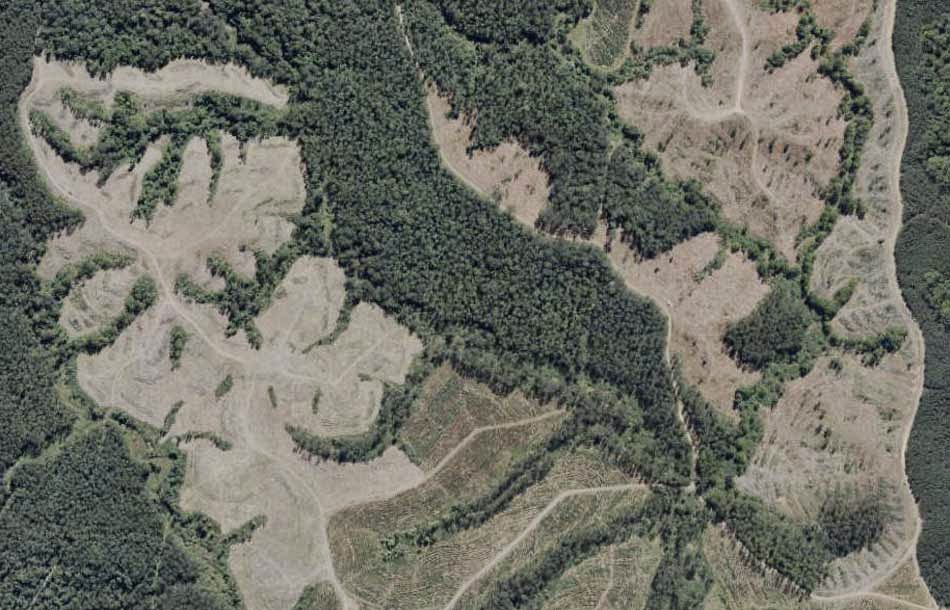
Aerial sightseeing of some of the (random) forests bordering Bellingen town, all Google maps


Update:
Now for the steep slopes west of Urunga and Nambucca Heads. Cable logging... coffs coast advocate 15.03.2015

Stop Cable Logging on Steep Slopes in NSW Public Forests 

Roundup weedkiller 'probably' causes cancer, says WHO study."The weedkiller has been detected in food, water and in the air after it has been sprayed, according to the report from WHO. However, glyphosate use is generally low in and near homes where the general public would face the greatest risk of exposure, the report said." The Guardian 22.03.2015


http://www.iarc.fr/en/media-centre/iarcnews/pdf/MonographVolume112.pdf
WHO, IARC Monographs Volume 112: Evaluation of five organophosphate insecticides and herbicides 20.03.2015

http://www.stoptheaerialspray.org/

Improved protection from pesticides for NSW landowners, with new legislation passing Parliament PDF via @MarkSpeakman 14.05.2015


Culturing Ross River  and Barmah Forest viruses?

31.8.14

Coffs Harbour: A place for whales and birds?


Coffs Harbour has been put on the map for watching whales and birds. Between June and November migrating humpback whales can be watched. The Solitary Islands Marine Park provides a refuge for them and many other marine species.

Also in August thousands of wedge-tailed shearwaters travel thousands of kilometres each year to return to the same burrows on Muttonbird Island Nature Reserve. It is the only easily-accessible place in NSW where the migratory wedge-tailed shearwaters nest.

Just when these migratory species dwell in the region, fossil fuel enthusiasts and the associated industries stage a 1000-horsepower speed boats race in the privatised 'natural amphitheatre' of Coffs Harbour. Rockets 'get airborne' and therefore are not supposed to shred any marine mammals. Sea creatures will simply get replaced by 'high horsepower marine monsters'. Local businesses are waving shopping bags and put up dysfunctional 'fairy lights' in trees to 'draw the crowds' to a run-of-the-mill town.

In a 100 % automobile dependent society with few footpaths and hardly any bike paths petrol runs in the veins of the population. Daily and recreational racing kill the dullness of a marginal existence. 'Boys with toys' are good consumers. They race the atmosphere-polluting machines on the Pacific Ocean and in the scenic hinterland of Coffs Harbour.


Having just thrown billions at the Pacific Highway one could have at least used this purpose-built road which is hacking its way through numerous wildlife habitats as a human-made race course 'amphitheatre'. Just privatise the space and let the benefiting industries pay for the usage. At the moment billboards along the highway appeal to motorists to reduce speed while the next billboards advertise car racing.

Staging such polluting and noisy events discourages visitors to come to the area for its natural aspects. Locals are deprived of a livable place and might move on or avoid shops sponsoring combustion festivals. It is the rapid conversion of a 'special place' to a non-place.

But in the country one just tolerates things ...


See also
Celebrating Fossil Fuel Culture on Forest Roads

Convention on the Conservation of Migratory Species of Wild Animals

15.10.13

Waterfall Way - Lining the Pacific Highway with Crumbled Mountain

Speedy motorist society requires lining the roads with stuff. Mountains disappear and the Pacific Highway gets 'upgraded' with gravel. Bellingen Shire Council has just consented to expand a quarry at Dorrigo. Dorrigo is 731 metres above sea level. All mining trucks will wind their way down steep Waterfall Way. It is also New South Wales' best and Australia's third most beautiful tourist drive. And it is steep and narrow!  "Approval was for 100 trucks and adding an extra 200 trucks each week - many of them with dog trailers... Another concern is any potential instability of the mountain side due to heavy rains that may turn into a landslide under the weight of substantially increased larger truck movements. "

This would mean increased truck movements up and down Waterfall Way and through residential streets. Bellingen is structured like a drive-through town, with logging and smelly cattle trucks already roaring through the village. Car fumes and vehicle noise already prevent one from lingering or shopping.

Traffic is not just noisy and deadly but also has an impact on (residential) property values. "It is estimated that traffic involving trucks can decrease property value 150 times faster than strictly car traffic"

Sources:
Bellingen Council backflips 6-1 on controversial quarry bid

The development application includes increasing truck activity to 400-movements a week, to and from the quarry along Waterfall Way.

EPA stops gravel extraction from Corindi 

Updates:
200 extra laden truck movements through Bellingen. Meeting to discuss heavy traffic impact on Waterfall Way to the Pacific Highway. Bellingen Courier 101113

Waterfall Way Rd. Over the past five years there have been 81 accidents: resulting in one fatality and 133 injuries... It’s believed that approximately 20,000 tonnes per month will be carted down the mountain by 600 loaded trucks...This means that a total of 120 trips per day, or if curtailed to a five day week, 140 truck and dog vehicle movements per day. Bellingen Courier 062014 


400 Bellinger River turtles have been found dead or dying, see especially 2.6.2015 update on petrol contamination from vehicles to build more Roads to Ruin,

15.9.13

Dorrigo

The town of Dorrigo is on the the Dorrigo Plateau , the traditional country of the Gumbaynggirr nation. Today endless paddocks and European flora cover the landscape.

Gondwana rainforests in the form of Dorrigo National Park, World Heritage Area still clings to the edge of this plateau. Sub-tropical rainforest and a large array of animals find refuge there.


In town a collection of black trains, some from 1878, stand out. The private Dorrigo Steam Railway and Museum seems rarely open to the public.

Mining is on the agenda here. The Pacific Highway needs to be lined with stuff from the mountains. Heavy haulage would shoot down Waterfall Way and increase the traffic burden even more. 


A Chinese company also has several exploration licences for minerals including gold and copper northwest of Dorrigo. The Dorrigo Environment Watch Inc. are residents concerned about their local environment, water quality and the effects of antimony mining.