Showing posts with label Gumbaynggirr. Show all posts

15.8.26

Lavenders Bridge - A New Megaproject for Bellingen?

The Lavender bridge is a small wooden bridge over the idyllic Bellinger river connecting the north and south of Bellingen town.

It is the only leisure spot in town for locals and visitors to swim, fish and adore the scenic views of the escarpement, the Ngaali ( Old Man Dreaming or McGraths Hump) as stated in a letter to the editor:
 

"I did not see a long, high-level concrete bridge built for cars and trucks to speed through all this and dominate it. You can see those anywhere, everywhere. But one of those is what the Council’s consultants are recommending, in order to further consolidate the sovereignty of cars and trucks."


Here is the new "Concept Options Appraisal Report for Lavenders Bridge, Bellingen (pdf)

At first glance it does not appear to be a pedestrian and bicycle bridge that seamlessly integrates active and (emergency) transport networks across the river.


In "Urbanisation, megaprojects and dispossession in Asia, Sara Bardhan reviews 'The Political Economy of Megaprojects in Asia: State Power, Land Control, Financial Flows, and Dispossession. Hyun Bang Shin and Dong-Wan Gimm (Editors). Routledge. 2025.' (open edition)

I cite a few deliberations on megaprojects from the LSE Review of Books:
 

"It argues that megaprojects are deeply political formations that reorganise territory, governance, and social life in the service of capital accumulation and state legitimacy."

"...State power is restructured, legitimised, and consolidated to institutionalise megaprojects as “spaces of exception.” "
 

"Megaprojects are not merely infrastructural solutions to urban problems, but powerful political technologies that reshape territory, governance, and citizenship itself." 
 

"Megaprojects reshape urban landscapes while simultaneously reconfiguring relations between the state, private capital, and local communities."

"...Sustainable,” and “world-class” urbanism often conceals speculative urbanisation, dispossession, environmental degradation, and undemocratic governance."
 

"Megaprojects embody a hybrid political-economic formation in which strong states continue to direct urban development while simultaneously facilitating private accumulation, deregulation, and financial speculation."

"Public lands and commons are transformed into commodities to attract private investment and generate speculative value." 
 

"Megaprojects overwhelmingly benefit political elites, developers, financial institutions, and urban middle classes, while vulnerable populations bear the costs of displacement and environmental degradation."


"The social consequences of these processes are severe. The volume identifies three recurring forms of injustice associated with megaprojects: nondemocratic planning processes that exclude civil society, displacement and rising rents that marginalise low-income communities, and emerging forms of resistance against dispossession." 

"Megaprojects overwhelmingly benefit political elites, developers, financial institutions, and urban middle classes, while vulnerable populations bear the costs of displacement and environmental degradation. The language of modernisation and sustainability often masks deeply unequal distributions of risk and reward."

"Megaprojects become symbols of global city ambitions and state legitimacy." 

"Megaprojects restructure the built environment as a “secondary circuit” for capital investment, particularly in contexts where real estate and infrastructure become central sites for profit generation."

Image: Visions of the new Lavenders bridge over the Bellinger river, AI enhanced

9.3.25

At the museum...

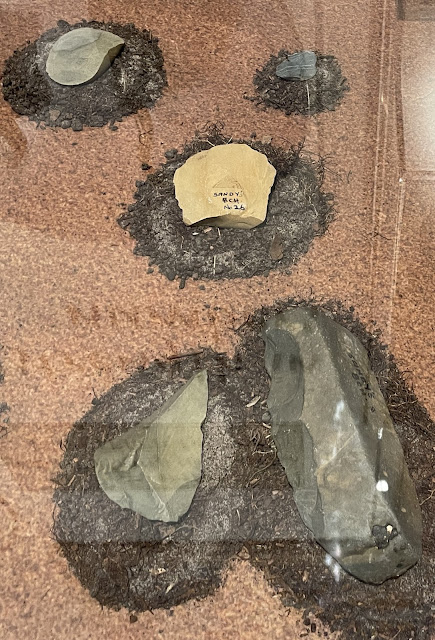
Stone tools,
Bellinger Valley Historical Society Museum

"At the museum, 

this means seeing the objects where they are, and simultaneously seeing them where they no longer are, that is to say, in the regions from which they were taken. It means enjoying the beauty and the knowledge that have been accumulated in our cities over centuries, but enjoying them with full awareness of the conditions in which these objects were collected, in asymmetrical economic, military and epistemological contexts. It means rendering visible, in order to master them better, the internal contradictions and the glaring tensions that have been at work in the very idea of museums since its origin. It means paying close attention, in this context, to the gazes and voices of the dispossessed."   Bénédicte Savoy

Bénédicte Savoy, Objects of Desire, Desire for Objects: Inaugural lecture delivered at the Collège de France on Thursday 30 March 2017

Bénédicte Savoy, Objects of Desire, Desire for Objects, Inaugural lecture, Open Edition

Sandy Beach, NSW artefacts display in the Yarrila Arts and Museum (YAM)

26.2.24

A Master Plan for Bellingen Placemaking and its Surrounding Forests

Bellingen area stripped bare?

Bellingen council is in the process of producing a CBD Master Plan for Bellingen, Dorrigo and Urunga.  “A long-term vision and implementation strategy will be outlined for guiding growth and change in an area." The plan will be used to implement “ land use, building density, public spaces, mobility, sustainability, and heritage.”

These long-term 'visions' and actions will have implications for settlers, Indigenous peoples, visitors and more-than-human lifeforms. Stakeholders were asked to ‘share their ideas’ (consultation) with consultants and council. Biodiversity was rendered voiceless.

A strategy for growth (business as usual) and change (unspecified) ”will influence the future appearance, atmosphere, and functionality of the town centres”

Bellingen is a small town, located on the Mid North Coast of New South Wales. It has a long history of (rainforest) timber extraction. Like most other Australian sprawling towns it is (totally) fossil fuel/ car dependent. Users of the CBD obtain their stuff there and drive to their homes or short term accommodation. All roads are congested and constantly have to be rebuilt to accommodate the increasing traffic.

The idyllic scenery

A drive in the scenic countryside used to be a big drawcard for visitors and boosted the income for the service industry. The cruise past forest canopy from the coast to mountain rivers and waterfalls funneled money into town.

It is these surroundings, the ambient milieu, that gave the small town its charm. Showcasing its physical (rich biodiversity) or social settings (some non mainstream culture) put the place ‘on the map'. It is not a few shops, but the setting, the relational context that gives a 'thing' its value.

Stripped bare - Native forest governance

The NSW state government’s Forestry Corporation has made the decision now to log and clear-fell vast areas of forests surrounding the area before some are declared a Great Koala National Park. Bellingen/ Gleniffer is now surrounded and locked in by industrial forest logging sites for years.

The degradation and destruction of Bellingen’s 'frame' will have impacts on the “the future appearance, atmosphere, and functionality of the town centres.” 


The habitats of plants and animals are being stripped bare while timber is being extracted with the aid of fossil fuel machinery and tax dollars to subsidise these destructive projects. Untold living creatures lose their homes and are being pushed onto the newly updated logging roads to become 'roadkill'. Diverse and endemic remnant flora and fauna are wiped out to make way for a monoculture plantation with the aid of pesticides and lingering fires and smoke pollution.

Residents, visitors and businesses that have chosen this country location find themselves next to industrial sites with mega industrial machine pollution, eroded, dangerous extraction roads and stranded assets. This invasion disrupts and absorbs the lifetime of the residents and carers who are committed to refraining from degrading Australia any further.

The violent destruction of bulldozing ecosystems entails noise, dust clouds, pollution and expulsion. It is the offloading of the externalities, so that the native forests can be sent overseas in the form of wood chips. Voiceless nature undergoes 'dispersal'.

Forest logging robs Australian animals of food, shelter, and breeding areas and threatens their survival. Unique endemic plants and remnant vegetation ‘get under the wheels’ of logging machinery.

Even in 'normal times’ forest-dependent biodiversity is threatened by out of control land clearing, invasive species, cars, pets, pollution, disease and weather extremes due to climate disruption cause by burning fossils.

Native forest logging makes bushfires worse and renders bushfires harder to control. Out of control fires hasten ecosystem collapse.

Wipe out
The industrial extraction of the 'stuff' called timber is torn out of the heart of a complex web of life. The irretrievable evolutionary process of 3.7 billion of years which appears to us as imperceptibly slow motion is just wiped out.

Our present (perception) has an endless past incorporated in it. The bureaucrats/loggers are only able to see the thing called ‘wood' for export income and votes. With this mind frame an open future is foreclosed and the future takes on a necessary trajectory.

Land use vs Country care
Country was managed for 65.000 years (long-termism) with Indigenous knowledge systems of relationality and connectivity. Settler-colonial society encountered a 'pristine' environment. In a very short time of 236 years since European settlement the 'state of the environment' can be summed up as one of degradation and extinction. "More than half of NSW forests were lost since 1750 and logging ‘locking in’ species extinction". (source)

“Our inability to adequately manage pressures will continue to result in species extinctions and deteriorating ecosystem condition, which are reducing the environmental capital on which current and future economies depend. Social, environmental and economic impacts are already apparent.” (source)

The entire Australian environment is deteriorating due to pressures from rapid resource extraction and expansion, climate disruption, habitat destruction, invasive species and pollution.

To squander one’s own environmental capital is maladaptive behaviour, that prevents one from making adjustments that are in one’s own best interest. To destroy the basis of existence is suicidal, unless there is more ‘new found land’ or another planet waiting around the corner.

The speed of exploitation and its associated expansion in spacetime are escalated by the ubiquitous economic dictates. It is an out of control system without functioning guardrails.

“That things are "status quo" is the catastrophe.”
― Walter Benjamin, The Arcades Project


Polycrisis

Ruthless extraction and degradation of one's own existential basis is taking place in the context of an emerging polycrisis, the simultaneous occurrence of several catastrophic events.

Global warming from fossil fuels, putting the chain saw to the tree of life (biodiversity) and pollution of the biosphere are just a few of the intersecting global environmental crises of the collective impacts of one species.

The ongoing ecological depletion on local, regional, and global scales, is seen as normal. The next generations of living entities will just have to deal with this ‘shifting baseline’ of a scorched, barren Earth, devoid of any life as far as the eye can see.

This project is threatening the fabric of complex life on Earth. A 'long-term vision' of a 'master plan', even of a local area, must take the existential risks to humanity and life into account.

It is essential to invoke the precautionary principle to do no social harm and environmental damage in the light of an avalanche of scientific reports and pledges.

Growth, intensification of extraction and expansion of living space constitute the script and the mental landscape of the settler.


The 'superior land use' argument has been used to justify the genocidal violence and ecocide of the colonised diversity of life, replacing it with a monoculture of livestock, plantation crops and pets.

The “logic of elimination”, (Patrick Wolfe, 2006) of the expanding colonial scheme goes hand in hand with the denial of existence (e.g. Indigenous peoples, referendum, forest surveys, data sparsity etc) and imperial governmentality.

The state of the planet demands attention and care. A facing up to the unsettling 'long present' of denial. Ending the undisturbed slumber of collective amnesia.

“Australians haven’t actually started living on this continent like they are from here and they have a responsibility of custodianship.” Richard Swain

As we are sliding into creeping collapse at an accelerated speed the presuppositions of the global governance of the biosphere have to be interrogated to produce strategies of bare survival possible in a post-democratic society where regulatory capture is the norm.

The council, Bellingen Chamber of Commerce, the tourism industry, the short stay lobby and all the other ‘stakeholders’ could position themselves to keep Bellingen’s ecosystems in a healthy state. Eradicating forests around Bellingen/ Gleniffer will not foster place identity.

Bellingen placemaking without the buffer of healthy forests and ecosystems would just be another bare drive-though town ‘in the middle of nowhere'.

"First life, then spaces, then buildings – the other way around never works” Jan Gehl


Links:

M.Ward et al., 2023, The impacts of contemporary logging after 250 years of deforestation and degradation on forest-dependent threatened species
DOI:10.1101/2023.02.22.529603

Patrick Miner et al., 2024, Car harm: A global review of automobility's harm to people and the environment, Journal of Transport Geography, Volume 115, February 2024
 

Patrick Wolfe, 2006, Settler colonialism and the elimination of the native, Journal of Genocide Research Volume 8, 2006 - Issue 4

24.11.23

Toxic Contamination and Dead Mangroves at Boambee Creek

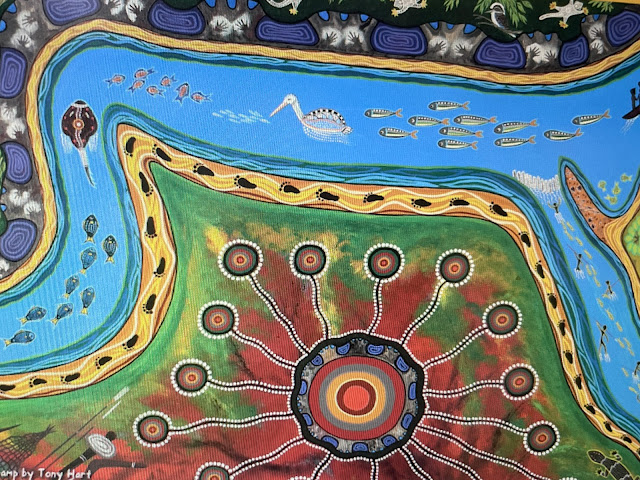
Mural, Solitary Island Coastal Walk, Bonville creek

Recently we observed  'A Cooked Intertidal Ecosystem at Sawtell Beach'. Today's local paper (Coffs Coast News of the Area) reports about 'Dead Mangroves at Boambee Creek'

The Boambee Creek Estuary is just north of Sawtell and south of Coffs Harbour airport. The creek traverses the suburbs of Boambee, Sawtell and Toormina, many roads and highways, industrial estates and resorts till finally it reaches the Pacific ocean.

The shoreline of the Boambee Creek Estuary and Boambee Beach is used as a playground for fishermen, dog owners and SUV owners.

Recently Kirsten Benkendorff (Professor at the National Marine Science Centre, Southern Cross University) and a Gumbaynggirr ranger of the Traditional Owners (Indigenous Protected Area Sea Country program) discovered the dead mangroves and neurotoxic contaminants at Boambee Creek.

"Most of the mangroves were rotting and the mud underneath was black and stinking and no live forms were visible. There was a smell of sulphur and petrol." 

"There was a range of toxic chemicals in the rotting mangrove roots, including carbon disulphide and petrochemicals like naphthalene, furan, xylene and cresol...Many are neurotoxic to the eyes, skin and lung."

"The site is not safe for people or aquatic life." (Coffs Coast News of the Area, 24.11.2023)

Update:

New research led by Southern Cross University has found a cocktail of nasty pesticides in oysters and water from one of the NSW North Coast’s dominant rivers. 12.12.2023
https://www.scimex.org/newsfeed/that-really-shucks-pesticide-pollution-threatens-shellfish-safety 

Pesticide residue from farms and towns is ending up in fresh oysters, 13.12.2023

https://theconversation.com/pesticide-residue-from-farms-and-towns-is-ending-up-in-fresh-oysters-219395

The old camp mural, Coffs Harbour, (no longer exists)dl


8.11.23

A visit to the YAM (Yarrila Arts and Museum)

“Yaamanga Around here is a permanent exhibition exploring the history and identity of the Coffs Coast through themes of place, community and belonging, with Gumbaynggirr culture at its heart." (source)

The gallery, museum and library are housed in a new bright green building that even has bike racks in front. Culture is free there.

At the entry a film is shown: Daalga Nginundi Wajarr (Sing your Country) Gumbaynggirr artist Birrugan Dunn-Velasco uses modern instrumentation and sounds from Country.

The bulk of the museum is devoted to settler culture. Displays of deforestation tools, logging implements, barbed wire and cattle images. Frugal craftiness textiles.

One could say it is an obsession with stuff, with material culture and the hoarding of possessions. Collections of tools, shells, food implements from a nostalgic bygone era.

The only First Nations 'stuff' is showcased in a glass cabinet. Some dusty stone tools are lined up out of context (as seen in most Australian museums). To counter-pose a huge array of settler implements with Aboriginal stone tools could lead one to misleading conclusions.

Missing and therefore invisible in this display of material cultures is the greatest achievement of the Indigenous Peoples, that is having managed Country for 60.000 years without degrading it.

There are some beautiful paintings, glass and textile installations to see..

Suzanna Knight, Shearwater tapestry


12.6.22

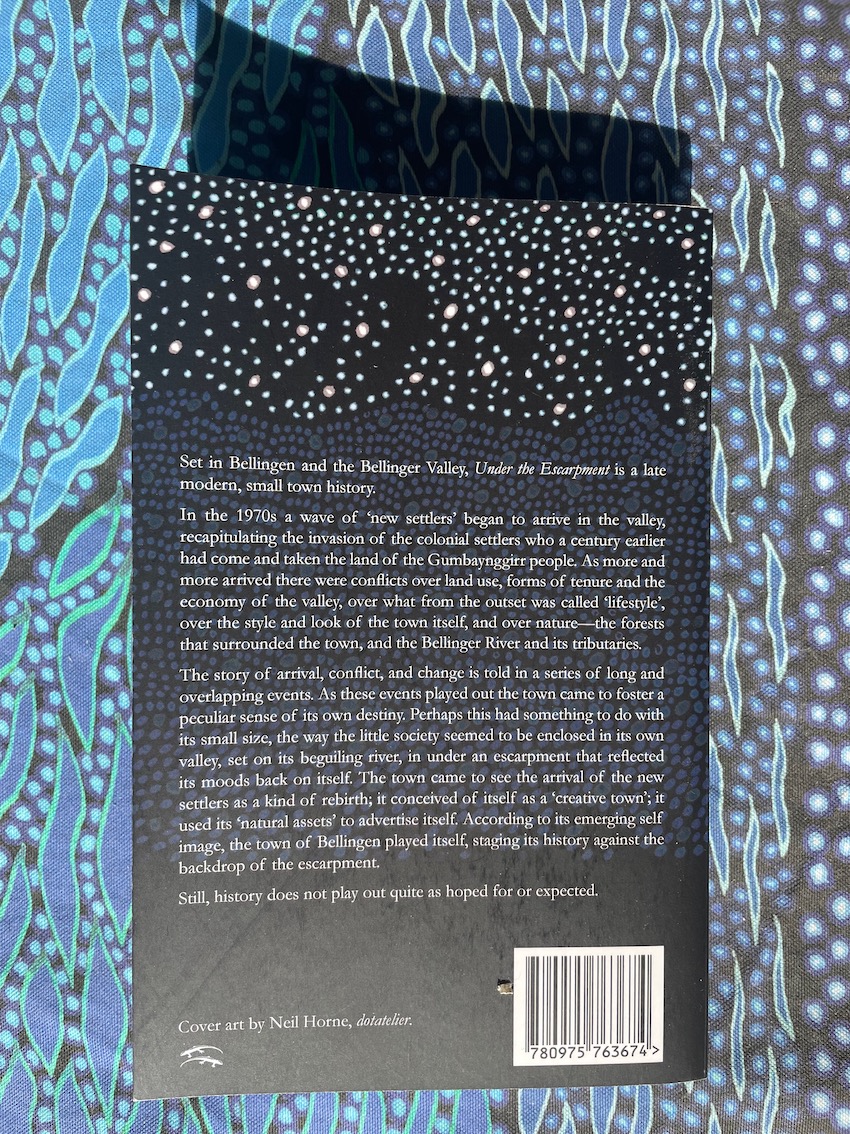
Under the Escarpment - on the late modern history of Bellingen - A Review

A highlight of Bellingen Readers and Writers Festival in June 2022 was the release of Ross Macleay’s latest book, 'Under the Escarpment - on the late modern history of Bellingen' This history of Bellingen is fascinating whether you live here or elsewhere. It conveys the experience of arriving in a new home of one’s choice and confronting an established culture, in this case settler extractivism.

The author has thoroughly researched this detailed book from public archives and oral recounts. In parts the historical events are disputed reflecting the diverse memories of events. The use of words like may have, maybe, and perhaps adds character and uncertainty to this otherwise well-documented history.

When a second invasion of the Bellingen region began in the 1960s and 70s, consisting of mainly educated urban young people with different values to their predecessors, artists, hippies and alternates, the local community put up a strong resistance. The book begins with The Meeting and the events which emerge from this large gathering of both sides are lucidly elaborated.

It covers the banning of the market, the resistance against logging and felling magnificent trees, magic mushrooms, botany, floods, demolition of the community center, and all imaginable topics of modern living.

While reading this book the landscape around becomes mythical. Things become endowed with their  history lending a dimension of time to the surroundings. Reflections about philosophy and the practice of history writing add to this feeling of living in a place which owes its character to the ideas and struggles which created or protected it or failed to do so.

The style is highly readable and entertaining with considerable reflection apparent in every paragraph. People who know Bellingen will be enlightened by this book wherever they go. Like a myth, knowledge makes our experience meaningful. Others will experience it as an entertaining story of universal validity about aesthetics, conflict, love and ecology. And the great drive to make a home somewhere in the world.


16.5.17

East Coast Encounter from Coffs Harbour


A visit to the East Coast Encounter at the Coffs Harbour art gallery. Inspiring artists are depicting the 1770 dialogue from the perspective of the boat or/and the shore. A ‘Visions of Australia program’ that takes Cook's journey through Solitary Island Marine Park as a focal point. His log reads:
“From what I have said of the Natives of New-Holland they may appear to some to be the most wretched people upon Earth, but in reality they are far happier than we Europeans; …. They live in a Tranquillity which is not disturbed by the Inequality of Condition: The Earth and sea of their own accord furnishes them with all things necessary for life; they covet not magnificent houses & Household-stuff they live in a warm and fine climate and enjoy a very wholesome air, so that they have very little need of clothing and this they seem to be fully sensible of, for many to whom we gave cloth, left it carelessly upon the sea beach and in the woods as a thing they had no manner of use for. In short they seemed to set no value upon any thing we gave them, nor would they ever part with any thing of their own for any one article we could offer them; this, in my opinion argues that they think themselves provided with all the necessities of life and that they have no superfluities.”
Extract from Captain Cook’s journal


Stepping outside of the art gallery /library to the great outdoors of the carpark, the contemporary dialogue between indoors and outdoors landscapes continues. The Fitzroy Oval framed by Coffs Creek used to be know as the Old Camp of the Gumbaynggirr Nation. It is now being bricked up. Even the Aboriginal Heritage Signs have disappeared into invisibility....


Images:
Mural, NSW
Old Camp, Fitzroy Oval Aboriginal History Sign 
Fitzroy Oval, Coffs Harbour, Google
Brick by brick The Old Camp ('Yaam Nguura Jalumgal’) and open space disappears

Update:
The Coffs Harbour’s Gumbaynggirr community can call the remains of ‘The Old Camp', also known as  Fitzroy Oval  – 'Yaam Nguura Jalumgal’. The prerogative of interpretation will go to the Geographical Names Board of NSW for approval...  Coffs – Aboriginal Site Recognised with New Name, Bellingen Courier, 26.05.2017

10.1.17

Gurruuja the whale came from the Milky Way...


Gurruuja the whale came from the Milky Way bringing along all living creatures and shaping the land. Humming musical notes on the trail.

So goes the mural in Gumbaynggirr country, Scotts Head Public School.


Many creatures inhabit this school, giving the place a very special ambiance.


Outside, hot suburbia spreads, rejecting the local environment.

Big chunks of coast and gentle green hills populated with bio-diversity are to be flogged off. What would the inveterate composer say?


Update:
Images: A comment from the 23.2.19 gave us a reminder to mention the mural artist Nelli Gallop that did the art works on the Scotts Head primary School (above pictures). The name of the painter was not known to us when we admired the beautiful images on the public building at the time. Apologies.

9.1.17

Valla Nature Reserve and Urbanisation


In coastal Gumbaynggirr country Ngunguru Mirral or 'Picket Hill' can be seen for miles in the area. The ever expanding highway cuts the sacred mountain off from the seaside. The town of Valla divides two coastal nature reserves. Both Valla Nature Reserve and Jagun Nature Reserve to the north contain littoral rainforest and endangered ecological communities. Koalas, powerful owls and glossy black cockatoo among other wildlife find refuge in this habitat.


The Valla Nature reserve and Valla sub-urbia interface
is the usual story of NSW coastal settlements: Habitat fragmentation and habitat grab. Drain pipes spill into the creeks. Horticultural weeds and dogs pour their externalities into nature's refuge. Pets keep wildlife at bay. Endless paths from private properties find the fastest way to the beach and waterways. Private gardens annex the reserve. Fossil fuel and water fuelled lawns expand. Trees blocking 'views' are chopped, poisoned or ripped from the ground.

Dead trees
Each access point to the beach seems to be a hot spot for degradation. Trees all die near housing and human infrastructure. Bitou weeds, the legacy of previous extractive industries are blooming. Today a place for extractive recreational activities.


Frontier lawlessness
An abundance of 'drives' are leading to the ocean. The usual car park 'viewing platforms', timber walkways and forests of signs. Prohibition signs by absentee authorities are always an indication of what behaviour or actions are taking place there. Users seem either illiterate of lawless. At both North and South Valla Beach the beaches and waterways are teaming with dogs 24/7. Pet owners drive their 'best friends' to the beaches to roam and deposit their feces.  Families swim and surf in this beach side atmosphere. SUVs race at high speed through the beach scene. All seem to be in the spirit of indulging in this frontier 'freedom'.


Locals reject the local environment.
Native gardens are rare. Many seem to be hoarding pets that keep the Australian animals at bay. Pet owners are voting with their feet. Dogs are yapping through the night silencing any frog cacophony. The unwillingness to share the space with native flora and fauna makes the town like any other NSW non-place suburbia.


In the Valla Nature Reserve
In coastal Brush Box groves among flowering Christmas Orchids one finds dog dropping wrapped in plastic bags or pure. Cement drain pipes funnel suburban 'run off' into the little dry creeks. A labyrinth of paths leads to backyards.

Valla Nature Reserve shaved for human use
Restoration
The Ngurrala Aboriginal Green Team are attempting to stem the tide by restoring bushland at Valla Beach. As in most North Coast beaches and nature reserves there seems to be zero enforcement by National Parks and Wildlife Service and Nambucca Shire Council to see that the nature reserves continue to be a refuge for biodiversity in a sea of monoculture.


Hungry Head Beach Going to the Dogs

24.6.15

Aboriginal Consumption of Estuarine Food Resources and Potential Implications for Health through Trace Metal Exposure; A Study in Gumbaynggirr Country


Many of the Gumbaynggirr community rely on the Nambucca River estuary and coastal marine environment for fish and seafood. A legacy of the 'extract and dump' culture has polluted the environment with "metal-based sprays of arsenic and lead, organochlorine pesticides including DDT, dieldrin, aldrin and organophosphate pesticides...Derelict mines, agriculture, cattle dips, horticulture and banana growing left behind early generation chemical sprays and fertilizers."

Trace metals concentrations have implications for the health of the people engaging in fishing and seafood consumption. Read the details in the original study:

Shaina Russell, Caroline A. Sullivan, Amanda J. Reichelt-Brushett. Aboriginal Consumption of Estuarine Food Resources and Potential Implications for Health through Trace Metal Exposure; A Study in Gumbaynggirr Country, Australia, PLOS ONE, 2015, DOI: 10.1371/journal.pone.0130689 
Fishing and resource use continues to be an essential aspect of life for many Aboriginal communities throughout Australia. It is important for dietary sustenance, and also retains deep social, cultural and economic significance, playing a fundamental role in maintaining group cohesion, transferring cultural knowledge and affirming Indigenous identities. We surveyed approximately 20% of the Gumbaynggirr Aboriginal community of Nambucca Heads, New South Wales, Australia. This paper explores Gumbaynggirr Connection to Country and engagement in cultural practice. It quantifies fishing efforts and consumption of seafood within the community. We found 95% of the sample group fish, with the highest rate of fishing being 2-3 times a week (27%). Furthermore, 98% of participants eat seafood weekly or more frequently, up to more than once a day (24%). Survey results revealed that Myxus elongatus (Sand mullet) and naturally recruited Saccostrea glomerata (Sydney rock oysters) continue to be important wild resources to the Gumbaynggirr community. Trace metals were measured in M. elongatus and S. glomerata samples collected by community participants in this study. Maximum levels prescribed in the Australia New Zealand Food Standards Code were not exceeded in the edible tissue for either species, however both species exceeded the generally expected levels for zinc and copper and S. glomerata samples exceeded the generally expected level for selenium. Furthermore the average dietary exposure to trace metals from consuming seafood was calculated for the surveyed population. Trace metal intake was then compared to the provisional tolerable weekly intake prescribed by the Joint Expert Committee on Food Additives. This process revealed that copper and selenium intake were both within the provisional tolerable weekly intake, while there is no guideline for zinc. Furthermore, participants relying heavily on wild resources from the Nambucca River estuary may exceed the provisional tolerable weekly intake for cadmium. This suggests the need for further investigation of this issue to minimize any possible health risk.

Images:
From the outside walls of the Yarrawarra Aboriginal Cultural Centre, Corindi Beach


17.11.14

Yarrawarra Corindi Beach - A walk through cultural landscapes

A visit to the Yarrawarra Aboriginal Cultural Centre at Corindi Beach. The Wadjar Regional Indigenous Gallery showcases the works of regional Indigenous artists, artisans and craftspeople.

"The Gumbaynggirr peoples have occupied the Mid North Coast from the Nambucca to the Clarence River since the Yuludarla or the Dreaming."  A persistent caring for country manufactured some stunning culturescapes. A sustainable way of life enables various biological communities to flourish in diverse abundance.

A few walks through some of the habitats in the area:
A pandanus studded coast, rich with estuaries for fishing in canoes. Elaborate stone fish traps and shell middens tell of the abundance of harvesting these waters.


The Wallum (indigenous word for Banksia aemula occuring there) heath (pdf) vegetation on coastal dunefields is stunning and unique. Wallum Heathland is unrivalled for its wealth of biodiversity. Pockets of coastal rainforest.


Plants provide rich food sources:
Yams, Blue Flax Lilies, Pandanus, Banksias and Giant Waterlies to name just a few - provide 'bush tucker'.


Many of the plant fibers are woven into strings and rope for fishing implements, carrying bags and beautiful fiber craft.


Stunning Aboriginal scarred trees remain in the coastal forests despite the deforestation, land clearing and slash and burn culture of the present day 'life style' of settler monoculture.


The Coffs Harbour Local Aboriginal Land Council just successful reclaimed a 3.7 km stretch of beach and fore dune known as Red Rock Beach (located between Red Rock and Corindi.) Hopefully, this unique environment will be safe from 'development'.


'Red Rock' or Blood Rock is a reminder of the 1880s massacres of British colonisation. (pdf)
The Aboriginal Australia Information Deficit Syndrome (AAIDS) suffers from amnesia and denialism.

The point has been reached in the anthropocene where humanity now willfully, with eyes wide open, discontinues the age old existence of humans on the Earth in a habitable and benign climate. The co-existence with other species is also terminated - bio-diversity is kicked off the planet.

With the ship of fools or Shipwreck With Spectator ( H Blumenberg ) we are steering into the end phase of a bare survival mode. So much could have been learned from a sustainable way of interacting with the indigenous Australian people and their land.


Links
Aboriginal history of the Coffs Harbour region pdf

Coastal Walks:
Yuraygir coastal walk, map
Mulloway to Red Rock Walk, pdf


Images:
All images from the outside walls of the Yarrawarra Aboriginal Cultural Centre, @InfoYarrawarra, Corindi Beach