Showing posts with label deforestation. Show all posts

13.3.25

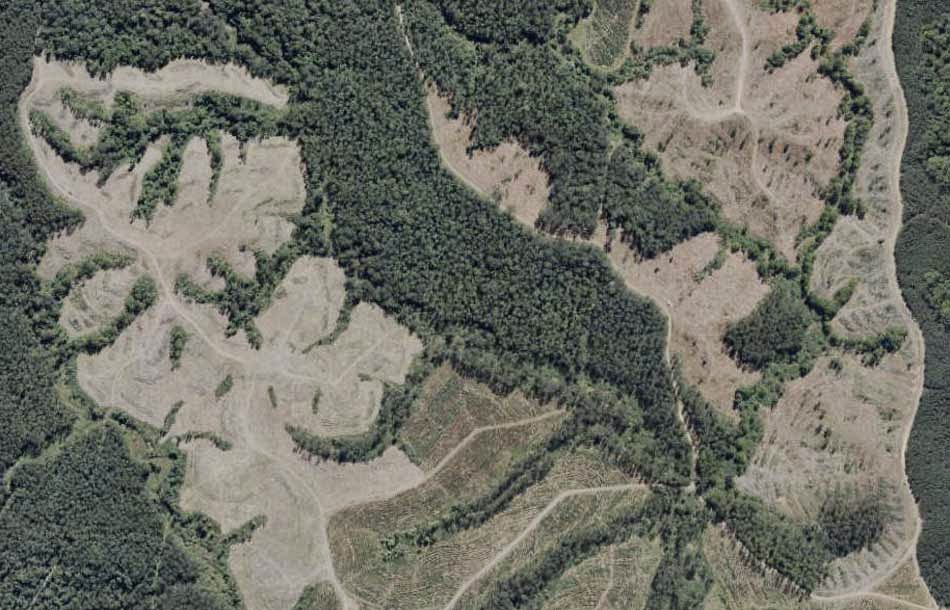
Explosive Growth of Secondary Roads from Industrial Logging

Forest loss - (Secondary) roads from industrial logging fragment ecosystems (ChatGPT)
New roads in forest frontiers enable secondary roads that amplify human impacts. Roads are key proximate drivers of environmental impacts, including forest fragmentation.

"Tropical forests face widespread environmental threats from road expansion. Previous research established that roads enable human incursion, break up ecosystems, and intensify deforestation through land clearing, fires, and illegal resource extraction. The role of secondary roads in amplifying these effects has remained poorly quantified, leading to gaps in environmental impact assessments and conservation strategies.
Environmental impact assessments failed to account for the full scale of road-induced deforestation. " (source)

"In the tropics and beyond, roads are key proximate drivers of environmental impacts, including forest fragmentation. These secondary roads in turn can dramatically elevate forest and biodiversity losses."

Jayden E. Engert et al, Explosive growth of secondary roads is linked to widespread tropical deforestation, Current Biology (2025). DOI: 10.1016/j.cub.2025.02.017

11.7.24

An Environmental History of the Timber Industry: The Social Constructions of Forest and Identity

Some remarks on the Social Constructions of Forest and Identity: An Environmental History of Timber Industry Authorities in the Forests of Southeast Victoria, Australia,  Claire Waddell-Wood, La Trobe University, Victoria, 2024 (source)


One wonders why the degradation of Australia seems unstoppable.
Why are the forests and biodiversity being wiped out, eradicating a future for complex living beings?
What is the nexus between settler society and the extractive relationship to their surrounding country?


Claire Waddell-Wood, is an environmental historian who investigates the Victorian timber industry. Light is thrown on the extractive relationships of settler-colonial interactions with the landscapes they colonise. The conceptual framing foregrounds resource extraction/forestry labour and masculinity constructions against the background of a more-than-human world. 


The metabolism between European modes of production/ consumption took the form of “rape and pillage disasters.”  The resulting ecological crisis does not only take place in the timber industry alone, but is a way of life and work in all the extractive industries.


Victoria officially ceased logging operations recently. But in other states such as NSW (The proposed Great Koala Park) forests and their remaining biodiversity are still being denuded and erased. Elsewhere in the Big Quarry, “dualistic ontologies still guide human behaviour.” 

An acknowledgment and a change of ways of the mainstream structures, institutions and mindsets, as well as in environmental movements could harbour the possibilities for a fundamental transition of socio-ecological relations.


The ‘history of degradation’ traces the (southeast Victorian) forest industry’s  extractive work, masculinities and landscape degradation. p. 202


A “deep time forest culture (which) shaped and was shaped by long histories of interactions” (by Wurundjeri, Boonwurrung, Taungurung, Gunnai Kurnai, Jaitmatang, Bidwell, and Ngarigo people) encountered male dominated European settler culture that conceptualises “those forests through the resource imaginary”.

“The social metabolisms of invasion clashed with deep time forest cultures, and ecosystems became disturbed and damaged. The interactions between settlers and forests led to the escalation of fire frequency in forests.” p. 200


European agricultural ideals of plantation monocultures and short term crop yields constitutes a violent othering of Nature. Ancient Indigenous knowledges about forest ecology and ‘the region’s deep time fire culture’ were ignored. The result were intensified extraction and megafires.


From now on “the only true forest knowledge-holders were those trained in the forestry sciences.”  A move from bare rural masculinity in primary industries with boots on the ground to a ‘technoscience of colonial forestry’ operated at arms length via assemblages of machinery and from a top floor of a distant city.

The administration of the ‘stuff’ becomes ‘spatially alienated from the forests’. Hierarchies of (male) staff control the ‘output’ of the biophysical forest factory. Forestry and science experts with exclusionary language and procedures take control from head office over the landscape. Here “the construction masculinity through work” and the production of “wasted landscape" and “waste peoples” takes place.  p.197 


Waddell-Wood's thesis “can aid in untangling the myths of capitalism and colonialism from our everyday lives and help us to live with the biophysical world rather than against it.” p 203

Yet another stepping stone on the path to truth telling.

7.4.23

Bellingen Deforestation at Gleniffer Road

You might not have noticed it, because of the road diversion (Roadwork resurfacing/ heavy trucks)

You might have noticed numerous logging trucks racing through town. 

Not a good start for the The Great Koala National Park of the Mid North Coast.

Doing our best to eradicate biodiversity habitat, increase fire risks and heat up the climate.


1.9.19

Gleniffer quilts - a cover for the bed and a landscape cover

Sandy Corry quilt
Another Gleniffer Quilt and Craft Fair took place in Gleniffer Hall. A large array of quilts was on display. The star of the show was the 'quilting queen' wearing her diamond tiara and demonstrating her 'doodling' on the sewing machine. Sandy Corry's work has a very haptic quality. Here are some of her pieces:
Click to enlarge pictures

Meat on the BBQ and the car park was full. Years ago the non-quilting crafts had a greater representation. A gang of unregistered trail-bikes demanded attention and disrupted the peace, as it is common in this area.

S.Corry quilt

The landscape cover setting
The Never Never Creek flows behind the Gleniffer Hall and a very small church. The gardens of the buildings 'reject the local environment' like most Australian gardens do. Lichen covered fences frame foreign grasses, known as lawns. A patchwork of Chinese camellia plants were planted in all colours from pink to red. The Japanese azaleas keep to this popular colour scheme too, a comforter landscape. An agave from central Mexico is tended to in a flower pot.


Outside the 'cage', trees drip with epiphytes. Tongue orchids (Dockrillia linguiformis) crawl along branches and pencil orchids (Dendrobium schoeninum) fall like stiff sticks from the tree. Shade!

Nearby stands a very large and lonely red cedar (Toona ciliata). A host for aerophytes and fauna. Did the cedar industry overlook this 'red gold'? Soon after European arrival the cedar forests lining all major rivers were eliminated by an extractive colonial industry. Cedar getter gangs stripped their way from Sydney through all rivers, right up to Queensland.
"An entire species of tree was just about wiped out on the NSW coast during the first 100 years of settlement." (source
The cutters would float the 'filet' pieces down the rivers to go to merchants in Sydney or England. The indiscriminate removal of the timber made way for the settlers/ pastoralists.


Most texts (pdf) of the 'In Search of Red Gold' stress the pioneering spirit of the frontier mentality in a people-free El Dorado. The First Nation Peoples, in this case the Gumbaynggirr of the Billengen River are invisible in the narratives.

25.1.17

Cacti and Succulents of the Bellingen Area


On a walk through Bellingen one can encounter cacti and succulents in cafes, shops, markets and community gardens. The spiny exotic plants are everywhere. They seem to be an expression of the fashionable Bellingen lifestyle. They are trendy and convenient as they require no care.

Residents and businesses rejecting their local environment make a clear statement with their decor: Wish I was somewhere else - far away from here.

The must-have plants are easy to name as 'cactus' or 'spiky plant', even for the botanically naive person.


The pots grace the outdoor lounges of hipsters. For years now ‘spiky plants’ have showcased Sydney’s real estate. That Mediterranean-style feeling seems to sell. Interior gardens, green walls, rooftop/balconies and outdoor living rooms sprout a mono-culture of spiky things in planter rows. It is the botanic message of the ‘for sale sign’ or 'money dwells here'.


Dispersal by plant segment makes it a dream for the horticultural industry and customers. Once the thing has outgrown its pot it is time to 'set it free.' In the garden they become a serial drain blocker. On larger blocks the fossil fuel maintenance team tends to throw the cut offs into the edge of the bush.

Forgotten are the Prickly Pear Cacti hedges from South America that quickly overran many thousand acres of farmland. Today still mother of millions are poisoning cattle and succulents are poisoning children.

While some attempt to control weeds, others are disseminating invasive plants throughout the Valley. Limiting the trade in potentially invasive species is outright unthinkable.


Despite of being set in a rich Gumbaynggirr landscape of biodiversity both businesses and residents choose to populated the landscape with introduced and invasive cacti, succulents, agaves, bromeliads and bamboo, among other weeds.

While deforestation, rapid land clearing, shave the land of native vegetation and biodiversity, the Big Quarry exports more coal then ever before.


It almost seems that people have resigned themselves to climate inaction and are preparing their air conditioned dwellings for Death Valley like (56.7 °C) temperatures extremes. Ornamental flora from the desert of central Mexico or Arizona seems to be the appropriate setting for anticipating the climate catastrophe on the most arid continent.


Update:
"Bellingen registers its hottest day on record. Temperatures soared into the 40s as Bellingen went past its previous best to a top of 48.9 degrees just after 5pm according to Bellingen Weather’s station... in 60 years it has never been that hot." Bellingen Courier. 13.02.2017
NSW smashes February statewide heat records two days in a row SMH, 13.02.2017

23.2.16

The hills around Bellingen could burn for a year...


NSW Forestry Corporation will log, bulldoze and burn Tarkeeth State Forest. “Residents have been told by Forestry Corporation that waste vegetation would be bulldozed into windrows and burnt over a period of a year or more...Imagine the smoke pollution right across the Valley." (source)

Study indicates 'biomass burning' may play larger role in climate change than previously realized. "Based on aircraft observations, satellite data and models, the findings indicate 'biomass burning' may need to be addressed with future regulations. Following closely after COP21, the results could suggest a need to look at other sources of greenhouse gas emissions, in addition to industrial activities and fossil fuel combustion in industrialized nations." (source)

Smoke - "Globally around 340,000 deaths per year are thought to be attributable to the additional pollution from landscape fires. Ending deforestation by burning would have many benefits, not only for global climate and biodiversity but for human health too." (source)

Measuring air quality/ NSW clean air legislation EPA NSW

Smoke and dust sensors. Open source technology for citizens:
Low-cost sensors to measure air quality. Monitor the air you breathe. Nature 09.01.2015


Links:
The hills around Bellingen could 'burn for a year', Bellingen Courier, 22.02.2016

University of Maryland. "Fires burning in Africa, Asia cause high ozone in tropical Pacific: Study indicates 'biomass burning' may play larger role in climate change than previously realized." ScienceDaily, 13.01.2016. 

World Pollutionwatch: Wildfires can kill – far from the flames, Guardian, 31.08.2015

 Hazard reduction burning kills 

Updates:
Tracking forest degradation regarding carbon emissions. Amazon Satellite alerts track deforestation in real time, nature 23.02.2016 

How Forest Loss Is Leading To a Rise in Human Disease, Yale Environment 360, 23.02.2016

Land-clearing surge in Queensland set to wipe out Direct Action gains – report Guardian 29.02.2016

'Like a scene from a doomsday sci-fi movie': Flames burn through Tarkeeth Forest, Bellingen Courier, 24.04.2017

Image:
Eugene von Guérard, Bush fire between Mount Elephant and Timboon, 1857

11.9.15

Car Racing in the Home of the Koala

The koala calls the North Coast forests of NSW its home. Coastal sprawl and deforestation fragment and thin their habitat. The path to the next yummy canopy becomes ever longer and more dangerous. Settlers and their industry demand roads that bulldoze their way through forests 'dripping with koalas'. Many animals are injured and killed by motorists in this process. Their packs of roaming dogs hunt and maul the threatened species. Record-breaking temperatures, "extreme weather events, such as killer heat waves, devastating droughts and intense, flooding rains" unleashed by us will not enhance the life of the koala or any other being.

This weekend it is time again to roar racing cars through Coffs Coast subtropical hinterland. The wonder of 'sustainable' motor racing will take place on forest roads between the Nambucca and the Orara river valleys. Motor 'sport' "is a glorious, lovely thing, all noise and violence and sliding sideways between trees at 100 mph." (source) Dust and noise pollution is generated in abundance.

1400 people donate their free labour to showcase this motor spectacle over four days. Wardens "will use airhorns to scare" the marsupials up the trees. "The numbers of animals that get run over are very low" we are told. (source)


"Population numbers on the East Coast fell by 40% between 1990 and 2010, and in other areas like the Pilliga Forest, the population has crashed by 70% in 10 years." (source)

According to the criteria of the Office of Environment and Heritage, NSW this event does not seem to constitute an 'activity to assist a threatened species'.


Koala, threatened species profile 

Car ploughs into spectators at Rally Championship
 
Staging Car Races in Nine State Forests of NSW 2014

Celebrating Fossil Fuel Culture on Forest Roads  2013 

Update:
Racing drivers generated a lot of dust in a landscape cracked by drought. They complained that Valla was too hard “to navigate due to excessive dust and inadequate lighting.” Maybe they will refrain from driving with ‘impaired vision’. 16.09.2015

WRC on collision course in forest habitat : Norwegian rally driver, Mads Østberg was admitted to hospital after a collision with a logging truck. FOUR crashes during September's World Rally Championships have sparked calls for a re-think of next year's event. 17.10.2015 coffs coast advocate

Image:
Koala, Brehm's Life of Animals

24.7.15

The acoustic ecology of native bird extinction and the sound of “cock-a-doodle-doo”

For eons the Laughing Kookaburra has been announcing the break of dawn for eastern Australia. The loud 'koo-koo-koo-koo-koo-kaa-kaa-kaa' is often heard in a chorus. The bird is one of the larger members of the kingfisher family and lives in one place for most of its life. It also mates for life.

The more settlers convert bio-diverse landscapes into mono-culture and populate it with alien species, the ecology changes into an artifact. The soundscape too takes on the characteristic of a noise composition.

Now the highest-ranking rooster has priority to announce the break of dawn. The (overseas) circadian clock of the domesticated fowl often is set off long before dawn. They do not sing in a chorus but in a strict hierarchical pattern. The sound of “cock-a-doodle-doo” echos over the dark valleys. Barking dogs and cars complete the early morning cacophony.

Non-native species and fossil fuel combustion machines constitute the ambient soundscape that announces the break of dawn of more industrial activity. The bird chorus of kookaburras and other common native birds fades as the environmental noise increases.

Deforestation and land clearing robs Kookaburras (and other Australian wildlife) of their homes which they need for nesting, roosting and perching to catch snakes and mice. The generously splashed pesticides poison the insects that the birds eat.


Kookaburra and magpie among Australian birds in decline, says report , Guardian 15.07.2015

Magpies, kookaburras and willie wagtails among common Australian birds 'starting to disappear', report suggests, abc, 15.07.2015

The highest-ranking rooster has priority to announce the break of dawn, Tsuyoshi Shimmura, Shosei Ohashi, and Takashi Yoshimura, July 23, 2015 in Scientific Reports, 5, Article number: 11683. DOI: 10.1038/srep11683

http://birdlife.org.au/state-of-birds/

Wedge-tailed Eagle vs rooster

Wedge-tailed eagle rescued from a chicken coop. WIRES
 

Images
Graffiti EU

9.3.15

Bellingen - No Spray, No Way or Land Use Conflict


Bellingen is a small logging town in Gumbaynggirr Country. In the 1840s the Bellinger Valley was so "rich in cedar that it was estimated that over 2 million feet of cedar were being extracted each year." (source) By the early 1900s, the red cedars were depleted and cattle hit the cleared areas. By 1975, there were only sclerophylls left to log. After the degradation of frontier colonisation, other extractive industries besides logging such as mining came on the scene. Pebbles from the Bellinger river and gold further 'opened' up the land. The ethos of 'dig it up, cut it down' permeates into the 21st Century where the whole country is truly 'open for business'.


Today Bellingen is surrounded by an array of state forests and national parks. The state forests are intensively worked with heavy machinery, agri-chemicals and fire. They are industrial forests. Clear felling is widely practised. The national parks are seen as a storehouse for the remaining biodiversity and a cash cow for 4W Drive Tours for tourists. Even car races are staged through some of the state forests. Unregistered, uninsured and unlicensed dirt bike riders harass bushwalkers and wildlife. Horse enthusiasts feel free to go anywhere. Other 'recreational activities' consist of shooting and fishing.


Chasing the fairy-tale dream
Amongst the remaining forest mosaic, more and more settlers try to live the 'Aussie dream' or are 'getting away from it all'. Retirees want a tree change with a lot of lawn. City dwellers are fatigued from house flipping and a cut-throat work culture and seek the stay-at-home lifestyle of the sleepy town.  Old hippies, retired surfers, hipsters without contraceptives, underachievers, young heirs, drop outs and oddballs all seek some acres where the packs of kids, dogs, horses or livestock can roam. 5 to 100 acre kingdoms promise a rootedness in land ownership for fringe dwellers.
Peri-urbanisation or the quest for a cheap dwelling might also be a driving force for the ever-growing community. Degraded land is converted into a real estate Eldorado.


The conquered bush: fossil fuels, pesticides and fire
Many bring their sub-urban mental landscape with them. Everything is done in the same way but only on a bigger scale. Sprawl and automotive dependency require active denial about climate disruption. 'Land management', private or by authorities or corporations, consists of two 'magic wands': fossil fuels and pesticide. If it can't be done with heavy machinery, 2-stroke 'gardening' equipment (pdf), slashers, mowers, blowers and chainsaws and 'spray' - it won't be done. Beside petrol, herbicide and 1080, fire is another tool to 'clean up the land' to make it fit for human habitation. Private piles burn regularly and smouldering forest fires burn over months, they are part of 'normal' culture. Seasonal incineration of Australian flora and fauna, known as 'backburning' turns the air into a deadly smog.


Out here in 'the middle of nowhere' one can 'break free', free themselves from all restraint. Monster houses, monster SUVs, why have one dog, when one can have 3 and a few cats. The dogs gang up and go for the remaining wildlife. Bored fun-seeking teens organise 'out-of-control' parties in the forests. 'Freedom' to be the one exempt form the law - to be wild. Yes, there is no police station within an hour's drive.


The scenic 'little town' with an 'old world ambiance' has endless long quarry and logging trucks with multiple trailers shooting through the 'sleepy little town', down the Dorrigo mountains, along Waterfall Way to 'upgrade' an XXL Pacific Highway which pushes all endemic bio-diversity out of the way. Tabula rasa  for more of the same. Even when these 'trains' don't push through the village road the daily vehicle exhaust is breath-taking. So much for fresh country air.


The modern fairy tale is of endless growth on a finite planet. Fossil-fuel reliance puts the world on track for 4-degree rise in temperature. Most dwellings in the area have coal-powered air-conditioning but not solar. The refrigerated humans are OK so far, but the cattle in the 'great outdoors' are semi cooked, goats are hammered by hail and even roos and the eucalyptus suffer. Bats drop out of the trees stone dead. Turtles go blind and are starving. The disappearing endemic biodiversity is invisible. This is a pet-loving country. But Australia appears free of climate angst and goes: Great day for the beach! and drives the meat gobbling dogs to the beach to chase a few little terns or oyster catchers.


Back to the bush settlements - The land-use conflict
Various rural residential acres or hobby farms are scattered through the area. Many borders are in proximity to a patchwork of industrial forests. The presence of intense agro-chemical forestry, large scale fires and residential areas can only generate conflict due to their potential incompatibility. Both parties seek expansion, forestry and roads and increasing subdivisions of unplanned developments and residential agglomerations. The conflict laden interface erupts when for example State Forests wants to do aerial spraying via helicopters of a cocktail of pesticides near dwellings. The majority of residents are already affected by the air and noise pollution of clear felling that lasts for months. Giant machinery is ploughing up the ground from the early mornings. The subsequent spraying of toxins and fires, as well as increased traffic take the charm out of 'country living'. The heavy logging machinery leaves behind puddles of stagnant water that become mosquito-infested (pdf).  Living in a spray and logging zone with hovering helicopters and braking trucks is more reminiscent of the much publicised Amazon basin, rather than a developed country.


Most people seem to be teflon-coated and tolerate it all, many sell up and some protest about the doings in their backyard.


Like the original owners, residents feel disenfranchised about the invasion of their properties. Koalas and the rest of biodiversity do not get a 3 day notice about the toxic shower and the elimination of their habitat. They are chased by packs of dogs and cars in a tree-less and fragmented environment.


But a booming population is hungry for building materials and infrastructure. The State Forest is already eyeing the steep slopes of the native forests for cable logging. Private loggers might get the idea too. But a few more landslides, erosion or flooding - who cares.


The dispersal of bio-cides on the land, water and from the air is ubiquitous in Australia (map). National parks, councils, private individuals and agri-forestry almost all do it. The 'precautionary principle' is foreign lingo for humans or wildlife.


The latest case of land-use conflict came to a head between residents near the Gladstone State Forest between Bowraville and Bellingen. Forests NSW was going to aerial sprays herbicide over 175ha of logged eucalyptus plantation. They argued that

"There is nothing unusual about what we are proposing – farmers all over Australia control weeds using helicopters" (source)

The spray would be a "combination of glyphosphate (RoundUp), Metsulfuron Methyl, Fluoroxypr Methy lheptyl, Simazine and other chemicals from a helicopter" (source)

The Bellingen Green Action Group is concerned about the pesticide drift and the impact on the many waterways. Although aerial spray is so 'cost effective' SF will do ground spraying now.

The land use conflict between human demands will continue. The interests and culture of big quarry Australia will follow its logic till all is sold, unless the paradigm is changed.


Images:
Bellingen mural of settlers with axe
Bellingen downtown with logging truck
Bellingen logging images
Aerial sightseeing of some of the (random) forests bordering Bellingen town, all Google maps


Update:
Now for the steep slopes west of Urunga and Nambucca Heads. Cable logging... coffs coast advocate 15.03.2015

Stop Cable Logging on Steep Slopes in NSW Public Forests 

Roundup weedkiller 'probably' causes cancer, says WHO study."The weedkiller has been detected in food, water and in the air after it has been sprayed, according to the report from WHO. However, glyphosate use is generally low in and near homes where the general public would face the greatest risk of exposure, the report said." The Guardian 22.03.2015


http://www.iarc.fr/en/media-centre/iarcnews/pdf/MonographVolume112.pdf
WHO, IARC Monographs Volume 112: Evaluation of five organophosphate insecticides and herbicides 20.03.2015

http://www.stoptheaerialspray.org/

Improved protection from pesticides for NSW landowners, with new legislation passing Parliament PDF via @MarkSpeakman 14.05.2015


Culturing Ross River  and Barmah Forest viruses?

10.9.14

Staging Car Races in Nine State Forests of NSW


200 kilometres of NSW forest roads will be used for a three-day car race on 11-14 September. The public is being denied access to various state owned forests.

Nine State Forests are effectively privatised:
Bagawa,
Lower Bucca,
Nana Creek,
Newry,
Orara East,
Pine Creek,
Tarkeeth,
Tuckers Nob and
Wedding Bells State Forests.

The racing cars will shoot at high speed through 'dirt roadways'. The "roads are lined by trees close to the edge in many places... they will travel through dense rainforest." These forests are the habitat for a rich biodiversity. Flora, fauna and fungi mingle in this refuge. To stage a high speed fossil fuel orgy amongst this diverse habitat and 'boost' greenhouse gases will leave all living beings with an inhospitable home. Australia is well known for working hard on making its unique species rapidly extinct.
The roaring noise pollution can be heard over kilometres, the dust generation is a hazard. Housing adjoining the State Forest are already challenged by ongoing logging pollution and breaking mining trucks. As well as the acoustic pollution on the land, the air space is filled with hovering air craft noise. The house-shaking sounds of the helicopter/s ( in the age of uavs ) over 'lifestyle' properties make any creature want to flee the area. To add such a combustion event probably will flood the market with 4sale signs and dissuade visitors that might 'boost the local economy' in the long run in a sustainable way.

Youth on (unregistered) trailbikes and bombs already doing wheelies in forests and residential areas take it as a go ahead. Such mass spectacles demonstrates to them, that it is ok to speed.

The price is too high to be 'put on the map' in such a way.


See also
Celebrating Fossil Fuel Culture on Forest Roads, 2013
Noise Pollution and Vibration in the Bellingen Shire, 2015


Images
Australian fauna, Brockhaus encyclopedia
Large frogmouth, (Batrachostomus auritus), Brehm's Life of Animals

22.8.14

Dr Hewitt's Bellingen Hospital Arboretum

Once upon a time settlers set to work in Billingen (Gumbaynggir name for river) to denude the Bellingen Valley. They logged the rainforest, grazed and razed the waterways with their introduced ungulates. The primary sector, especially livestock production, holds a deep fear of a 'woody plant invasion'. Graziers suffer deeply from dendrophobia. The established extraction industries of intense logging, mining and cattle finally reached a point of depletion.

The 1920s brought a new wave of settlers. One notably one was Dr. George Hewitt, who worked in the Bellingen Hospital. This young doctor set out to plant as many ' woody plants' as he could all over Bellingen. His arboretum hugging the hospital consisted mainly of Australian native plants. A place for the recuperating and visitors to enjoy a beautiful garden walk. He was also planting a sign for the 70's wave of settlers that deforestation does not lead to a more habitable planet.

Today the garden is in unloved decay. Some giant trees still stand in the weed infested place. Social eutrophication dumps excess into the 'backyard' green space. An ambiance of loud humming air conditioners in winter fill the air space. The surrounding area is incessantly scratched 'clean' for yet more parking. Lack of tree cover lays bare the impervious hot asphalt and rubble.

At the dawn of the 21st century yet a new demographic mindset is populating the valley rapidly. Logging and mining trucks shoot through the small 'turn-of-the-century' main street of Bellingen. The few remaining trees look paltry or are dead. They would make wonderful parking. Car exhaust fills the country air. Addicted to automobile dependency all have to top up in the 'scenic town'. Retail reflects the changed demographics: Copious amounts of sugar and plastic for toddlers, pets for all the family and the staple of petrol, meat and beer.
 
The howls of private and state forest chainsaws are all-pervading. The time is ripe (again) to go for the steep slopes. The new suburbia does not yearn for tree shaded walkability.

Update: 0914
Australia's failure to act on climate pollution gives rise to angst about the hell-fires to come. Two reactions are being offered: Combusting all that is not human settlement and a 'godsend' 10/50 tree felling law that allows for the elimination of all (native) flora and fauna around human settlements and happens to increase the 'value' of the real estate simultaneously. Bingo!