Showing posts with label violence. Show all posts

16.2.25

Social Acceleration in Bellingen/ Gleniffer Suburbia

After logging machinery has denuded the forest and ploughed up Gleniffer Rd. more fossil fuel monstrosities are widening the road again. This degraded landscape of Bellingen/ Geniffer now attracts high-speed burnouts with boomboxes.

This 'production of space' opened up the space for burning some tyres throughout the night. Far away from civilisation and enforcement the drivers are racing though the denuded koala habitat and residential areas.

It is futile to deliberate whether the suicides of young men are unintentional or intentional. The mobility infrastructure design demands automobility and speed. The active transport desert repels pedestrians and slow (e)mobility. The traffic jam spurs rage and violence.

Society demands the acceleration of the pace of life. Commercial combustion racing events encourage all petrolheads in petrotopia.

Driving always entails a latent ‘suicide risk' in this given system. The ‘integral accident’ is inherently woven into this mode of transport and technological acceleration. It is the 'collateral damage’ tolerated by all.

Mainstream media bombards us with ‘news’ of ‘accidents’. The overexposure to the daily slaughter on the roads leads to its normalisation. Only spectacles and superlatives can demand any attention now.

Daily reporting of a house that has 'collided' with a speeding car. A group of people without armouring that 'collided' with a flying car. Just another hit-and-run. Just another normal hit-and-run. A few walking school kids ploughed off the footpath while mounting the kerb. No road is ever wide enough or has enough bollards to protect living beings from these machine operators on autopilot mode.

The concepts of the all-terrain vehicle (ATV) and the 'Sports Utility Vehicle’ (SUV) destroyed all mental guardrails for the motorist. Roads became 'so yesterday'. The 4x4 combustion machine was liberated to conquer the rugged terrain (car ads) of all non road spaces. A mindscape of ‘without any limits’ was born.

This allocation of space/time means that humans and other animals now have to dodge these ubiquitous flying bullets. Living beings are literally out of a habitat, considering how many cars end up on top of their homes.

Cars doing burnouts at night are just a matter of degree to the ‘normal’ daytime traffic of a commercialised and heavily industrialised sub-urban Bellingen/Gleniffer area now.

Links:

Suicide or accident? The hidden complexities of intentional road crashes in Australia
https://theconversation.com/suicide-or-accident-the-hidden-complexities-of-intentional-road-crashes-in-australia-248673

The Original Accident, Paul Virilio, 2007
https://www.wiley.com/en-us/The+Original+Accident-p-9780745636146

12.1.25

"The Vermin of the Street: The Politics of Violence and the Nomos of Automobility"

 
"The authors of "The Vermin of the Street: The Politics of Violence and the Nomos of Automobility" analyze how the dominance of automobiles has transformed the world into a space of exception. They argue that, since the rise of the automobile, road violence has become normalized, reducing humans to "bare life" who can be killed without consequence. Drawing on Carl Schmitt's concept of the "nomos," they argue that the road functions as a "bracketed space" where laws and ethics are suspended, similar to the "state of exception" found in concentration camps. The authors ultimately conclude that the automobile has not simply changed the landscape, but our very way of being-in-the-world, transforming the entire globe into a "global nomos" governed by the constant threat of automobility violence."
(NotebookLM summary)

Robert Braun & Richard Randell (2022) The vermin of the street: the politics of violence and the nomos of automobility, Mobilities, 17:1, 53-68

https://www.sciencedirect.com/org/science/article/pii/S1745010122007299#ks0010

28.4.24

Visions of Nature - How Landscape Photography Shaped Settler Colonialism by Jarrod Hore - A commentary

Jarrod Hore is an environmental historian of settler colonial landscapes, nature writing, and geology. ’Visions of Nature How Landscape Photography Shaped Settler Colonialism' elucidates cultural techniques used in the Anglo-American settler empire over various centuries. The Pacific Rim Nations (North America, Aotearoa/NZ and Australia) command the most attention of the critical historical image research. It is a historical elaboration of pictorial imagery (iconography), mainly photography, paintings, but also texts.

At the time of steam trains, photos were a novelty with which to view exotic locations. Photography and paintings informed worldviews and worldmaking practices. Visual cultural analysis can reveal the power relations that are embedded in the narrative knowledge that these images and publications entail.

Hore’s text emphasises the underlying scaffolding of presence and absence in the visual realm, textual narrations and the world. The unseen is rendered visible through an apparatus of in- and exclusion. The dominant motif is the binary opposition of existence and non-existence, life and erasure, being and necropolitics.

In 500 years of European expansion, the legal myth of ‘terra nullius’  (‘nobody's land' or ’uninhabited land’) was a foundational imperative. Settlers transferred the ‘empty land’ or ‘natural environment’ into their possession. The human absence of a ‘disembodied land’ was not a given but was achieved by on-going violence and exploitation by the global settler community.

The ‘wide-open spaces’ depicted in images of the time lacked any human trace. They were selling tales of empty land to satisfy settlers/farmers driven by an expanding ‘land hunger’. The ‘empty spaces’ were ‘yearning’ to be filled with plant and animal mono-cultures from the mother country.

Images of this environmental transformation had to depict the taming of a ‘wilderness’ not as the degradation that it was by then, but as a J Locke-style “clothed in the language of improvement” and thereby value creating.

Spatial politics was composed of cultural practices, monotheistic belief systems and iconoclastic enactments. The dominant culture usurps interpretive sovereignty over all cultural artefacts.

Later, new customers were assured of an empty and available commodity to project their imagination upon. “Rampant land speculation” chopped up the land into square rectilinear bits and put it on the market.

Upper Orara 1912

After this period of utility came the romantic idyllic scenery with nationalism to foster belonging. Pictures drove the real estate industry and satisfied “European expectations of the scenic” for leisure. The spatial production of ‘wilderness’ opened up new possibilities for recreation.

National Parks were declared in Australia as primarily for settlers to access recreational spaces, whereas in the US they were set aside for the conservation of biodiversity primarily. “Wilderness was violently, legislatively and spatially produced before it could be preserved.” (Hore, 2022, p.106)

To the same degree as Indigenous mobility was restricted and confined, settlers' mobility was increased. It was time for explorative drives into the countryside. “Pioneering settlers constructed new environmental regimes that improved the prospects for settler mobility and constrained Indigenous movement.” (Hore, 2022, p. 211)  First Nations peoples and Australian flora and fauna were by now “outside the frame” of the settler society's gaze.

When nationalism severed ties from the mother country, some floral and faunal emblems were allowed to impregnate the hearts and minds and stand for the new nation.

While this new national identity was manufactured, a new wave of exclusion and denial was pursued for people not of the Anglo-Saxon ‘race’ - a ‘neo-European nationalist destiny’ was to be established.

A hierarchisation of ‘races’ discouraged settlers from non-European origins, as well as ranking European ‘ethnics’. Newcomers should have been preferably "white/British" or Anglo-Celtic peoples to make up a monocultural ‘white ethnostate'. 

Coffs Harbour, 1924

The entanglement of nationalism and colonialism continued for the ‘chosen people of the promised land’. An expansionist Manifest Destiny excluded non-white settlers from entry and/or citizenship. The White Australia policy was ended in 1973. In 1967 they finally acknowledged the existence of First Nations people of Australia and started to count the survivors.

The presence of First Nation peoples is a “logical anomaly in settler polities - an embarrassment to the sovereign settler state.” (Hore, 2022, p.109) The outstanding business lingers and is unsettling and traumatic. The dispossession and exclusion of Indigenous peoples in this country is like a festering wound rocking the unstable foundation. 

On the biodiversity front it appears that settler society has not stopped rolling up the unique rich ‘carpet’ of Australian animals and plants, and turning them into a fast buck. ‘Superior land use’ consists of having the worst animal extinction rate in the world. Most ecosystems are degraded and collapsing.

“Australia has the worst record of mammal extinctions globally. (It) is regarded as one of the world's 11 deforestation fronts (WWF, 2015) and is likely to suffer widespread biodiversity loss from climate change and habitat loss over coming decades.” (source)


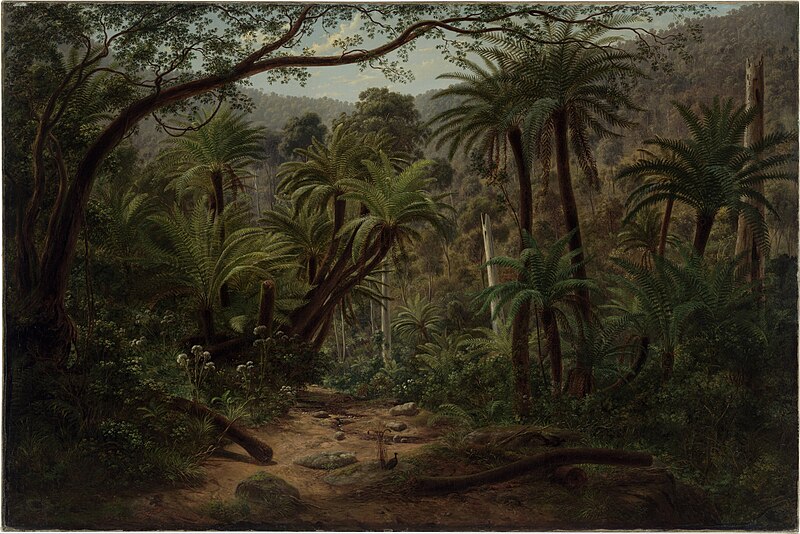
File:Eugene VON GUÉRard - Ferntree Gully in the Dandenong Ranges - Google Art Project.jpg
Ferntree Gully in the Dandenong Ranges
Eugene von Guerard, 1857


The modus operandi of settler society has not changed. Genocide and ecocide practices are still the dominant structure. The social and natural metabolism is intensifying. The gear is changing from business as usual to fast-tracking everything. The distribution of gain and harm of this extractive and exploitative process is made to appear as natural. 

An expansionist political agenda increasingly excludes uncomfortable positions by scientists, ecologists, conservation experts and Indigenous peoples with hushing-up tactics. People speaking up about threatened species, mining, logging, carbon credits and other harm to the environment are in danger of becoming a persona non grata. Their voices or studies might just cease to exist, data might just vanish. Many whistleblowers and demonstrators are gagged and are existentially threatened. Resonance spaces for counter narratives shrink in civil society.

An inadequate public discourse and science suppression do not make for a literate citizenry. The absence of the acknowledgment of the truth of the violent legacies cannot break the prevailing ‘code of silence’.

The past still echoes in the collective psyche as unfinished business. There is an unwillingness to properly confront the uncomfortable truths about genocidal colonialism and the extractive relationship towards nature. It takes reparative justice and mindful symmetrical relations to heal the poly-traumas.

Settlers on this Earth need a fundamental reorganisation, a paradigm shift (a Copernican like revolution) to demonstrate that they are not the navel of the universe.

The Eurocentric baggage brings with it epistemic violence, exploitative relationships towards others and the ecosphere. The Western world view and practices curate our habitus and seem to be set on autopilot. Extraction, pollution and exploitation without limits has to end.

It is time to re-imagine the contemporary landscape and reconfigure the connectivity to the natural and social world.

Hore’s Visions of Nature provides another stepping stone on the path of truth telling.

22.11.23

The Western Genre and The Settler Society Narrative


Some readings about the latest Western the entertainment industry has to offer: Killers of The Flower Moon, Martin Scorsese.

The western genre convention usually depicts the 'unbounded freedom' of the individual, the 'Lone Cow-boy' trope on horseback set in a 'wide and open spaces' narrative. The 'hero' operates outside the law on Indigenous landscapes and in frontier towns.

"Unlike the visions of unbounded freedom found in traditional westerns, Martin Scorsese’s new film is a study of a West bounded by the vertical geometry of oil rigs and the violent conspiracies of powerful men.” (source)

It is an “epic about the bloody birth of modern America... An epic of creeping, existential horror about the birth of the American century, a macabre tale of quasi-genocidal serial killings" (source)

The film is “an epic story of greed and betrayal in its examination of Osage life in Oklahoma circa 1920, and the mass murders of the Indigenous community at the hands of their white neighbors.” (source)

Leonardo DiCaprio: “It's still happening...The more work that I've done, certainly in the environmental space, you realise the systematic persecution of Indigenous cultures all throughout the world...It's happening all over the world, in Australia. It's happening in Africa, it's happening in South America...And I keep saying this quote over and over again, those places that are most rich in resources are those that are often most drenched in blood." (source)

The BBC mentions that the zeitgeist how Indigenous peoples are treated might be changing in the 21st Century: "The film is making a strong statement that it's no longer acceptable to extract valuable assets from Indigenous communities without our consent and input.” (source)

Interesting times when Hollywood actors and their products problematise past massacres of settler colonialism and present day injustices against Indigenous peoples.

As Patrick Wolfe said: Settler colonialism is a “structure not an event” (source)

Update:

Revealing reading regarding mineral and petroleum royalties: For the Osage Nation, the betrayal of the murders depicted in ‘Killers of the Flower Moon’ still lingers, Conservation

20.9.15

Hate Crimes Against Wombats


Ten wombats, including four feeding mothers were deliberately run over and killed by a SUV driver at Bendeela camping ground, Kangaroo Valley, abc 20.09.2015


On the Making of Biodiversity Guardians 

Updates:
Footage emerged of a driver appearing to deliberately swerve at a dingo on Fraser Island, World Heritage 02102015

Image:
John Gould, Vombatus ursinus,"Mammals of Australia", Vol. I Plate 55, 1863, via Wikimedia Commons

16.9.15

The Eels of Bellingen and the Making of Biodiversity Guardians


The scene
The Bellingen River community has just recently allowed the totem of their river, the Bellinger River Snapping Turtle, (Myuchelys georges) to go the way of the dodo. After a mass mortality event it is now listed as a critically endangered species. (PDF)

The event
Soon the 'Bellingen Eel Fishing Championship' will take place. The maltreatment of the endemic Longfin Eels (Anguilla reinhardtii) is 'terrific family fun' promising that 'the kids (will be) amused during the holidays.' (source)

The options
One could instead educate young Australians about the unique fauna and its environment, but the usual 'take, chuck and run' culture is perpetuated.

The eels
Since ancient times, the living fossil has fascinated humans as it has a very mysterious life-cycle. Till today knowledge of freshwater eels and their oceanic migrations and spawning in the tropical Pacific is very limited. Once in their life they travel some 850 km away from their home using smell and magnetism to spawn in unknown locations. During their 6 - 12 month journey they do not feed.


In the EU the Anguilla anguilla is now critically endangered (PDF). After numbers dropped by 99% in 20 years, they have proposed a fishing ban. (source) In NZ the species is overexploited. The Japanese eels are at risk of extinction. The American eel is also in danger of extinction (source). The Taiwanese eel is now perilously close to extinction. (source) It is now uncool to kill and eat the species in many countries.
 
The young guardians
The media abounds with (young) Australians torturing, maiming and killing Australian wildlife and pets. Drive-by shooting of livestock occurs or the latest fashion is killing by bow and arrow. Hate crimes against wildlife are common. Here, here, here, here, here, here, here etc
 
It is possible that individual animal cruelty is just an expression of a national mindset of excelling at the extinction of Australian biodiversity. "Australia is recorded as one of the countries with worst extinction records in the world." (source) Unique animals and plants are allowed to slip into extinction.

On the making of empathy
It has been found that preschool children in NSW "showed callous and unemotional traits such as lacking remorse or empathy for the feelings of other people." The psychopathic traits found could lead to anti social behaviour against their own species (bullying, family violence) or cruelty against any creature.

The undeveloped emotional skills can be acquired by interacting with offspring and teaching "the parents how to be very warm, involved and loving with them to see if that reduces those callous traits over time." (source)


"Respecting other forms of life is not an intrinsic value – it has to be taught, and it has to be learned. While there are certainly exceptions, I am of the opinion that unless you discourage children from that sort of behaviour, it will proliferate into adulthood...Unless we can convince children to respect other species, we can expect to continue failing to elicit much sympathy for the plight of global biodiversity." (source)

Sources:
The Mysterious Incredible Life-cycle of Short-finned Eels PDF
Oceanic migration behaviour of tropical Pacific eels from Vanuatu, Marine Ecology Progress Series

Psychopathic traits found in preschool children by University of NSW researchers, SMH 10.09.2015
Innate cruelty and exploitation: does biodiversity stand a chance, Conservation bytes

Updates:
Eight wombats deliberately run over and killed at Kangaroo Valley camping ground: police, abc 
Hate Crimes Against Wombats
Two teenagers refused bail over torturing farm animals to death in Dural, abc 23.09.2015

The Family Fishing Festival now changed its sustainability ethos from measure and brag to measure then put the fish straight back into the water. "From Friday to Sunday, there were hundreds of adults and children dipping a line in the water from the Nambucca River up to south of Muttonbird Island, including on the banks of Deep Creek, Kalang River, Bellinger River, Bonville Creek and Boambee Creek." The Bellingen Shire Courier-Sun,  13.01.2020

Images:
Tiles northern NSW
Moray eel graffiti
Young human, deficient in empathy, graffiti
Young human, graffiti

20.6.15

Vandalising Home


Somewhere in the oeuvre of Hans Blumenberg's Metaphorology he stated that humans are vandalising God's creation having usurped the power of sole owners of the world and the rest of the universe.

In more popular circles the same has finally been mentioned by a Pope: "If we destroy Creation, Creation will destroy us."

"We are sawing off the limb that we are sitting on." BBC

The lust to eradicate life from our only common home is a self destructive suicidal mental condition.

 
For some time we have been working hard at making the sixth mass extinction possible at ever greater speed:

Accelerated modern human–induced species losses: Entering the sixth mass extinction
"The oft-repeated claim that Earth’s biota is entering a sixth “mass extinction” depends on clearly demonstrating that current extinction rates are far above the “background” rates prevailing in the five previous mass extinctions. Earlier estimates of extinction rates have been criticized for using assumptions that might overestimate the severity of the extinction crisis. We assess, using extremely conservative assumptions, whether human activities are causing a mass extinction. First, we use a recent estimate of a background rate of 2 mammal extinctions per 10,000 species per 100 years (that is, 2 E/MSY), which is twice as high as widely used previous estimates. We then compare this rate with the current rate of mammal and vertebrate extinctions. The latter is conservatively low because listing a species as extinct requires meeting stringent criteria. Even under our assumptions, which would tend to minimize evidence of an incipient mass extinction, the average rate of vertebrate species loss over the last century is up to 114 times higher than the background rate. Under the 2 E/MSY background rate, the number of species that have gone extinct in the last century would have taken, depending on the vertebrate taxon, between 800 and 10,000 years to disappear. These estimates reveal an exceptionally rapid loss of biodiversity over the last few centuries, indicating that a sixth mass extinction is already under way. Averting a dramatic decay of biodiversity and the subsequent loss of ecosystem services is still possible through intensified conservation efforts, but that window of opportunity is rapidly closing."

Gerardo Ceballos, Paul R. Ehrlich, Anthony D. Barnosky, AndrĂ©s GarcĂ­a, Robert M. Pringle and Todd M. Palmer. Accelerated modern human–induced species losses: Entering the sixth mass extinction. Science Advances, 2015 DOI: 10.1126/sciadv.1400253


Stanford researcher declares that the sixth mass extinction is here, Stanford Report, June 19, 2015

Pope Francis’ encyclical: On care for our common homeGuardian excerpt, (for the impatient) 18.06.2015

Karl Heinrich Leopold Deschner, A Criminal History of Christianity.

Aristotle, Nicomachean Ethics

Videos:
Paul Ehrlich, Stanford researcher warns sixth mass extinction is here, video

Prof. Hans Joachim Schellnhuber, Climate change: state of play, Director of Potsdam Institute for Climate Impact Research (PIK). video

Update:
Extinction of more threatened Australian species is not inevitable, 08.07.2015
James Trezise is a policy coordinator for the Australian Conservation Foundation

We need to tighten the law to protect wildlife homes, 13.07.2015 Don Anton , The Conversation


IMAGES:
Adel Abdessemed, Habibi Sculpture, Berlin

21.10.13

The Armed Man - Thoughts on War

The Concert:
Karl Jenkins: The Armed Man (‘Mass for Peace’) The anti-war piece was performed by the North Coast Performing Arts Orchestra and Choir for the UN International Day of Peace. The event took place in the Bellingen Soldiers' Memorial hall.


Thoughts on War:
Intense warfare is the evolutionary driver of large complex populations. Primate and ant societies pursue war to defend their turf or invade others for resources. Settler culture and rapid reproduction leads to an overflow of the 'petri dish'. The early enthusiasm for endless growth and expansion brought about a way of life of  'Go forth, multiply, fill the Earth, subdue and vandalise the Garden'. The logic of expansionism led man to the "The brutal destruction of 'creation'." H. Blumenberg

The uncanny hubris
of 'creation's crowning glory' promising to achieve paradise on Earth now might have as an outcome the creation of hell on a once habitable planet. (Anthropocene, CO2)

'The pride of creation' usurped the place of the many Earth gods, which they later rationalised into monotheism before upstaging 'the only one'. Heads of hierarchical societies grounded their existence with recourse to God - the sovereign's ownership of the land.

Techné
Controlled fire use by early humans and tool manufacturing enabled a civilisation of ever-refined means of destruction. Warfare conducted throughout human history has refined the means of killing and formed society.
The perpetual peace of “citizens of the Earth” (ErdbĂĽrger) had no chance against the perpetual war of defending the home soil from the other, or the land grab 'over there'. The state of war of all against all' in a 'free market' and the invisible fist of the market place became the new state of nature.


Sovereignty declares a 'state of exception' (G.Agamben) with a tendency to generalize of the exceptional state. This is a powerful strategy for legalised lawlessness,  suspension of the juridical order. Undeclared wars rage and no one can any longer say "we didn't know".

Framing of War
War is "framed" in the media so as to prevent us from recognising the people who are to be killed as living fully "grievable" lives, like ours. "Collateral damage" is not part of the war game.

Spectacles of Blood
"Roman gladiatorial shows were not put on for the purposes of indulging violence, bloodlust and cruelty, even if they may seem that way today. Instead, they were put on for several important purposes including social control and education". Today's media frames the robot wars 'over there'. Decisions are outsourced to machines. The masses consume the spectacle at a safe distance on screens. The spectacle, a social relation between people that is mediated by images is a self-fulfilling control mechanism for society.
 
A society modelled on war.
The 'war model' of the modern city and of human catastrophic society is elaborated in Virilio's  'dromology'.  "The expansive project of modernity has reached its limit in the light speed colonization of terrestrial time and space by technology and media"


A permanent war economy merged with Disaster Capitalism (Naomi Klein) further accelerates and exacerbates the catastrophic nature of modernity. Disasters (economic, political, military or natural) are good for profits - they reboot the system.  "Creative destruction, interventions and economic reconstruction mobilise resources for some. Margins are the largest outside the system of civil society. All is frontier with the loot going to the 'highest bidder'. There is no longer a safe place - anywhere!


Discipline techniques
Disciplinary or managerial techniques are initiated and developed into a technology for the control of individuals. (Michel Foucault) "'Discipline' may be identified neither with an institution nor with an apparatus; it is a type of power, a modality for its exercise, comprising a whole set of instruments, techniques, procedures, levels of application, targets; it is a 'physics' or an 'anatomy' of power, a technology." Psycho-orthopedics and pharmaceuticals also aid in the pathology of normality.

Ordinary people engage in "the banality of evil." (Hannah Arendt). Genocides continue and we are running amok causing "the earth’s sixth mass extinction event, through such anthropogenic impacts as habitat loss and modification, the spread of invasive species and climate change" Is omnicide the goal? Modernity as a system of efficiency, beyond ethics, mobilises all in the war against nature.

The driverless and shipwrecked ship of fools cruises (kyvernĂł̱:  steers, navigates) into the anthropocene, with no goal other than cruising the ocean of 'business as usual': more growth on an infinite planet, holding tight to the rudder of pathological denial. 

Armed man is a tautology inhabiting the machinery of war.


Texts:
Agamben, GiorgioState of Exception. Translated by Kevin Attell. Chicago: University of Chicago Press, 2005, excerpt, Video, European Graduate School. 2003, starts at 2.29 min.
Gilles Deleuze and Félix Guattari, A Thousand Plateaus:, 1980/ Nomadology: The War Machine (New York: Semiotext(e), 19
Subtopia, A field guide to military urbanism
Aeschylus, The Persians 

Images:
1.  Blake, William Blake, The Ghost of a Flea, 1819–1820  
2.  Arcimboldo, Giuseppe, Fire 1566
3.  Goya, Francisco, The Disasters of War  (DĂ©sastres de la Guerra), 1815–1820
4.  Bosch, Hieronymus, detail of Haywain Triptych, 1516

1.10.13

A Society Tolerating Dog Attacks

And again a small child was mauled by a pet. A five-year-old girl was badly injured in a dog attack on the NSW mid north coast. The dog bit her face taking off part of her nose. The little girl is in a stable condition but traumatised for life. abc 1.10.13

A strange society privileging meat-eating carnivores over their own offspring... 

Declaring the dog "Man's best friend" and rejecting Australian fauna.

Update:
Wild dog pack ‘hunted’ down grandmother at Casuarina beach, NSW 24.03.2015


Related
Dangerous Animals of Australia
Australia has one of the highest rates of pet ownership in the world
Repurposed Zebras, Ostriches and Australian fauna into Dog Poo
Pet owners go barking mad over controls push
Rejecting the local environment: Australian fauna. Biodiversity decline in Australia.

Image
Graffito artist unknown,  On CO2 concrete jungle