Showing posts with label toxins. Show all posts

24.11.23

Toxic Contamination and Dead Mangroves at Boambee Creek

Mural, Solitary Island Coastal Walk, Bonville creek

Recently we observed  'A Cooked Intertidal Ecosystem at Sawtell Beach'. Today's local paper (Coffs Coast News of the Area) reports about 'Dead Mangroves at Boambee Creek'

The Boambee Creek Estuary is just north of Sawtell and south of Coffs Harbour airport. The creek traverses the suburbs of Boambee, Sawtell and Toormina, many roads and highways, industrial estates and resorts till finally it reaches the Pacific ocean.

The shoreline of the Boambee Creek Estuary and Boambee Beach is used as a playground for fishermen, dog owners and SUV owners.

Recently Kirsten Benkendorff (Professor at the National Marine Science Centre, Southern Cross University) and a Gumbaynggirr ranger of the Traditional Owners (Indigenous Protected Area Sea Country program) discovered the dead mangroves and neurotoxic contaminants at Boambee Creek.

"Most of the mangroves were rotting and the mud underneath was black and stinking and no live forms were visible. There was a smell of sulphur and petrol." 

"There was a range of toxic chemicals in the rotting mangrove roots, including carbon disulphide and petrochemicals like naphthalene, furan, xylene and cresol...Many are neurotoxic to the eyes, skin and lung."

"The site is not safe for people or aquatic life." (Coffs Coast News of the Area, 24.11.2023)

Update:

New research led by Southern Cross University has found a cocktail of nasty pesticides in oysters and water from one of the NSW North Coast’s dominant rivers. 12.12.2023
https://www.scimex.org/newsfeed/that-really-shucks-pesticide-pollution-threatens-shellfish-safety 

Pesticide residue from farms and towns is ending up in fresh oysters, 13.12.2023

https://theconversation.com/pesticide-residue-from-farms-and-towns-is-ending-up-in-fresh-oysters-219395
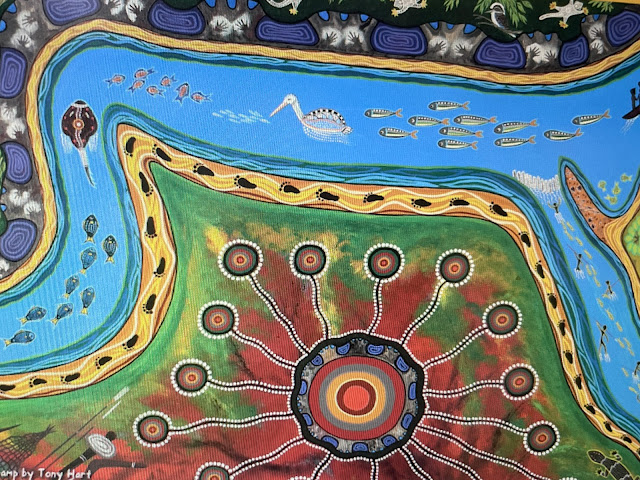
The old camp mural, Coffs Harbour, (no longer exists)dl


27.8.15

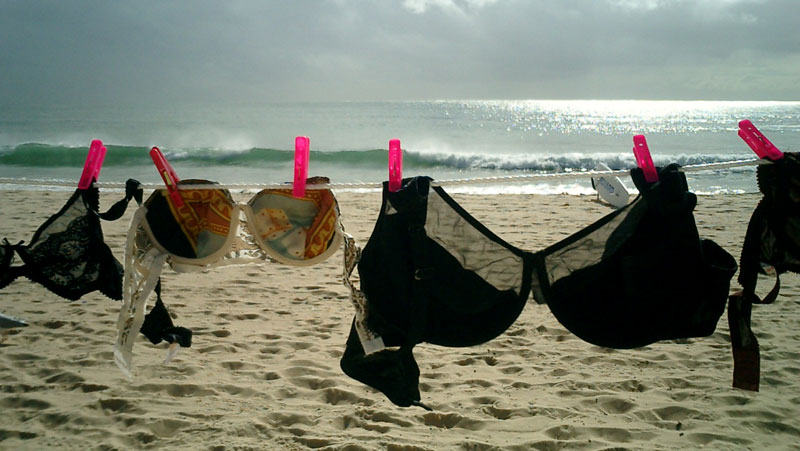
Microplastic from Clothing is Accumulating on Shorelines Woldwide


60-85 percent of human-made material found on shorelines consists of micro fibers from clothing. (source)

Plastic clothing has become the norm. From lingerie to outdoor gear, synthetic garments fill shops and wardrobes, cling to bodies and households. Synthetic fabrics (polyester, acrylic, nylon, rayon, acetate, spandex, latex, etc) are convenient and just require a quick spin.

The bright, fashionable colours of the season make the textiles obsolete by the time they leave the shop. Mending is out in a throw-away society. Mountains of old rags go into 'landfill' or end up in smelly second hand shops.

Synthetic and some natural fibers are often pickled in chemicals: toxic dyes, flame retardants, nano -silver and other chemicals in stain-proof textiles and waterproof clothing.


Garments that are washed by hand or machine shed fibers and chemicals/detergents into the water. As there is a paucity of sewerage systems in rural areas like Bellingen and the mid north coast, the effluent drains into the catchment. "Wastewater from domestic washing machines demonstrated that a single garment can produce 1900 fibers per wash." (source)

The shed micro fibers reach the shorelines. They are "micron-scale synthetic fibers, mostly polyester and acrylic, in sediments along beaches the world over." (source)

The invisible contamination of soil, water catchment and marine habitat with microplastic enters the food chain of all living creatures.


Natural fibers, untreated and of organic origin produced and tailored under ethical conditions (no land grab or exploitation) is the right choice to make...


Sources:
Accumulation of Microplastic on Shorelines Woldwide: Sources and Sinks
The Damage I Cause When I Wash My Clothes
Chemicals in clothing, Choice
Two-thirds of new clothing is plastic


Updates:

What does micro plastic less than 1mm do to animals?
Linking effects of anthropogenic debris to ecological impacts
Mark Anthony Browne, A. J. Underwood, M. G. Chapman, Rob Williams, Richard C. Thompson, Jan A. van Franeker, Published 22 April 2015.DOI: 10.1098/rspb.2014.2929

Chris Wilcox, Erik Van Sebille, and Britta Denise Hardesty. Threat of plastic pollution to seabirds is global, pervasive, and increasing. PNAS, August 31, 2015 DOI: 10.1073/pnas.1502108112
( 99 per cent of the world's seabirds species will be ingesting plastic by 2050 if current marine pollution trends continue. They starve to death from plastic fibres from synthetic clothes an other 'junk food'.)
or
Almost all seabirds to have plastic in gut by 2050, CSIRO


24.6.15

Aboriginal Consumption of Estuarine Food Resources and Potential Implications for Health through Trace Metal Exposure; A Study in Gumbaynggirr Country


Many of the Gumbaynggirr community rely on the Nambucca River estuary and coastal marine environment for fish and seafood. A legacy of the 'extract and dump' culture has polluted the environment with "metal-based sprays of arsenic and lead, organochlorine pesticides including DDT, dieldrin, aldrin and organophosphate pesticides...Derelict mines, agriculture, cattle dips, horticulture and banana growing left behind early generation chemical sprays and fertilizers."

Trace metals concentrations have implications for the health of the people engaging in fishing and seafood consumption. Read the details in the original study:

Shaina Russell, Caroline A. Sullivan, Amanda J. Reichelt-Brushett. Aboriginal Consumption of Estuarine Food Resources and Potential Implications for Health through Trace Metal Exposure; A Study in Gumbaynggirr Country, Australia, PLOS ONE, 2015, DOI: 10.1371/journal.pone.0130689 
Fishing and resource use continues to be an essential aspect of life for many Aboriginal communities throughout Australia. It is important for dietary sustenance, and also retains deep social, cultural and economic significance, playing a fundamental role in maintaining group cohesion, transferring cultural knowledge and affirming Indigenous identities. We surveyed approximately 20% of the Gumbaynggirr Aboriginal community of Nambucca Heads, New South Wales, Australia. This paper explores Gumbaynggirr Connection to Country and engagement in cultural practice. It quantifies fishing efforts and consumption of seafood within the community. We found 95% of the sample group fish, with the highest rate of fishing being 2-3 times a week (27%). Furthermore, 98% of participants eat seafood weekly or more frequently, up to more than once a day (24%). Survey results revealed that Myxus elongatus (Sand mullet) and naturally recruited Saccostrea glomerata (Sydney rock oysters) continue to be important wild resources to the Gumbaynggirr community. Trace metals were measured in M. elongatus and S. glomerata samples collected by community participants in this study. Maximum levels prescribed in the Australia New Zealand Food Standards Code were not exceeded in the edible tissue for either species, however both species exceeded the generally expected levels for zinc and copper and S. glomerata samples exceeded the generally expected level for selenium. Furthermore the average dietary exposure to trace metals from consuming seafood was calculated for the surveyed population. Trace metal intake was then compared to the provisional tolerable weekly intake prescribed by the Joint Expert Committee on Food Additives. This process revealed that copper and selenium intake were both within the provisional tolerable weekly intake, while there is no guideline for zinc. Furthermore, participants relying heavily on wild resources from the Nambucca River estuary may exceed the provisional tolerable weekly intake for cadmium. This suggests the need for further investigation of this issue to minimize any possible health risk.

Images:
From the outside walls of the Yarrawarra Aboriginal Cultural Centre, Corindi Beach


8.10.13

Retreat

A long weekend in a retreat (60-something kms from Bellingen). Multiple huts in a rural landscape.

On arrival multiple fossil fuel powered machinery made the landscape 'tidy'. The disturbing and excessive noise and dust pollution hogged the attention.

On opening the door to the premises, one was hit by an intense cloud of synthetic fragrances that was cooking on a power point. All textiles were drenched in these potentially hazardous synthetic chemicals. Curtains and furniture seemed to be dipped in fire foam and flame retardants. The bedsheets smelled perfumed. The kitchen cupboard had, as in most Aussie kitchens, the well-used spray can of pesticide handy. The water, without a filter, tasted foul and metallic.

The closeness of the  neighbouring huts tried to emulate a feeling of a tight-knit sub-urbia back home. Families wanting a "getting away from it all" feeling ended up in the confinement of 'family cabins'. "Loudness-as-an-inalienable-right “(Wallace, David Foster) of families one might add. Large unplanned families with the full package of pets and all the baggage. Parents intensely interacting with their wearables. Many mouths scream. The child that cannot use language cries and screams.

The dads of instant culture pour petrol, meths or other accelerants on the meat altar. The incinerated meat stands in the form of cows not far off. They are usually pre-cooked in the shelter-less Australian sun.

The toy pets bark and squeal from the abuse of being mistaken for a horse. Agitated the free range dog chases the only Australian native fauna in sight, a brush turkey. For short minutes distraction culture goes sensation seeking and then they sprawl and sprawl.

The use of the veranda is impossible and the hut smells toxic. The entire night the resident rooster claims his territory over the visiting Koel and the array of family dogs bark and yap and yap and yap.

Next idyllic morning the neighbouring fence is being drenched with toxins trailing in a large dust drift. The posts are meters away from the line of huts. Copious amounts of herbicide/pesticide is being doused, the diesel of the tractor fills the 'shelter' up with thick clouds of diesel fumes.

We retreat to a coastal eatery.  A deafening aural ambiance from families being fed. In the food preparation area a white, plastic auto mist box disperses pesticides totally unmanned round-the-clock! At short intervals poison is being released on to 'bugs', staff and customers. Enthusiasts of old car wrecks generously share the fumes of their old timers which fill the entire cafe.

People just seem to tolerate the ubiquity of pesticides and noise pollution

We disappeared through the sanitised, chemicalised agricultural acres which stretch for mile upon mile. Australian flora and fauna has been eradicated or only fragments are left as retreats.

Images: 
Cicada, domesticated silkmoth, Bombyx mori and a diversity of flies, Alfred BrehmBrehm's Life of Animals

Even ‘environmentally protective’ levels of pesticide devastate insect biodiversity. 
 Common insecticide used in homes associated with delayed mental development of young children

Update
Pyrethroid insecticides exposure increasing in homes and people,
07022014