Showing posts with label forests. Show all posts

13.3.25

Explosive Growth of Secondary Roads from Industrial Logging

Forest loss - (Secondary) roads from industrial logging fragment ecosystems (ChatGPT)
New roads in forest frontiers enable secondary roads that amplify human impacts. Roads are key proximate drivers of environmental impacts, including forest fragmentation.

"Tropical forests face widespread environmental threats from road expansion. Previous research established that roads enable human incursion, break up ecosystems, and intensify deforestation through land clearing, fires, and illegal resource extraction. The role of secondary roads in amplifying these effects has remained poorly quantified, leading to gaps in environmental impact assessments and conservation strategies.
Environmental impact assessments failed to account for the full scale of road-induced deforestation. " (source)

"In the tropics and beyond, roads are key proximate drivers of environmental impacts, including forest fragmentation. These secondary roads in turn can dramatically elevate forest and biodiversity losses."

Jayden E. Engert et al, Explosive growth of secondary roads is linked to widespread tropical deforestation, Current Biology (2025). DOI: 10.1016/j.cub.2025.02.017

26.2.24

A Master Plan for Bellingen Placemaking and its Surrounding Forests

Bellingen area stripped bare?

Bellingen council is in the process of producing a CBD Master Plan for Bellingen, Dorrigo and Urunga.  “A long-term vision and implementation strategy will be outlined for guiding growth and change in an area." The plan will be used to implement “ land use, building density, public spaces, mobility, sustainability, and heritage.”

These long-term 'visions' and actions will have implications for settlers, Indigenous peoples, visitors and more-than-human lifeforms. Stakeholders were asked to ‘share their ideas’ (consultation) with consultants and council. Biodiversity was rendered voiceless.

A strategy for growth (business as usual) and change (unspecified) ”will influence the future appearance, atmosphere, and functionality of the town centres”

Bellingen is a small town, located on the Mid North Coast of New South Wales. It has a long history of (rainforest) timber extraction. Like most other Australian sprawling towns it is (totally) fossil fuel/ car dependent. Users of the CBD obtain their stuff there and drive to their homes or short term accommodation. All roads are congested and constantly have to be rebuilt to accommodate the increasing traffic.

The idyllic scenery

A drive in the scenic countryside used to be a big drawcard for visitors and boosted the income for the service industry. The cruise past forest canopy from the coast to mountain rivers and waterfalls funneled money into town.

It is these surroundings, the ambient milieu, that gave the small town its charm. Showcasing its physical (rich biodiversity) or social settings (some non mainstream culture) put the place ‘on the map'. It is not a few shops, but the setting, the relational context that gives a 'thing' its value.

Stripped bare - Native forest governance

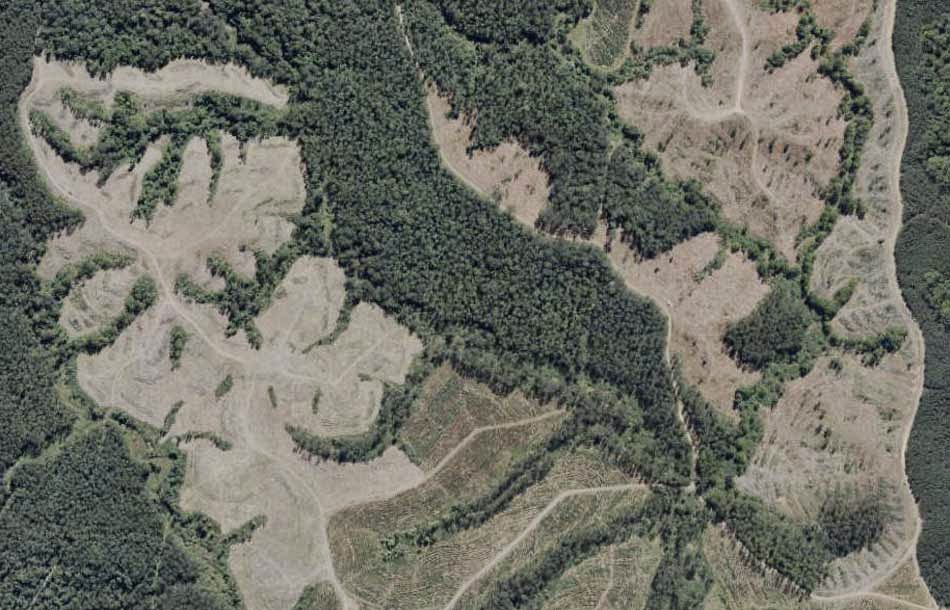
The NSW state government’s Forestry Corporation has made the decision now to log and clear-fell vast areas of forests surrounding the area before some are declared a Great Koala National Park. Bellingen/ Gleniffer is now surrounded and locked in by industrial forest logging sites for years.

The degradation and destruction of Bellingen’s 'frame' will have impacts on the “the future appearance, atmosphere, and functionality of the town centres.” 


The habitats of plants and animals are being stripped bare while timber is being extracted with the aid of fossil fuel machinery and tax dollars to subsidise these destructive projects. Untold living creatures lose their homes and are being pushed onto the newly updated logging roads to become 'roadkill'. Diverse and endemic remnant flora and fauna are wiped out to make way for a monoculture plantation with the aid of pesticides and lingering fires and smoke pollution.

Residents, visitors and businesses that have chosen this country location find themselves next to industrial sites with mega industrial machine pollution, eroded, dangerous extraction roads and stranded assets. This invasion disrupts and absorbs the lifetime of the residents and carers who are committed to refraining from degrading Australia any further.

The violent destruction of bulldozing ecosystems entails noise, dust clouds, pollution and expulsion. It is the offloading of the externalities, so that the native forests can be sent overseas in the form of wood chips. Voiceless nature undergoes 'dispersal'.

Forest logging robs Australian animals of food, shelter, and breeding areas and threatens their survival. Unique endemic plants and remnant vegetation ‘get under the wheels’ of logging machinery.

Even in 'normal times’ forest-dependent biodiversity is threatened by out of control land clearing, invasive species, cars, pets, pollution, disease and weather extremes due to climate disruption cause by burning fossils.

Native forest logging makes bushfires worse and renders bushfires harder to control. Out of control fires hasten ecosystem collapse.

Wipe out
The industrial extraction of the 'stuff' called timber is torn out of the heart of a complex web of life. The irretrievable evolutionary process of 3.7 billion of years which appears to us as imperceptibly slow motion is just wiped out.

Our present (perception) has an endless past incorporated in it. The bureaucrats/loggers are only able to see the thing called ‘wood' for export income and votes. With this mind frame an open future is foreclosed and the future takes on a necessary trajectory.

Land use vs Country care
Country was managed for 65.000 years (long-termism) with Indigenous knowledge systems of relationality and connectivity. Settler-colonial society encountered a 'pristine' environment. In a very short time of 236 years since European settlement the 'state of the environment' can be summed up as one of degradation and extinction. "More than half of NSW forests were lost since 1750 and logging ‘locking in’ species extinction". (source)

“Our inability to adequately manage pressures will continue to result in species extinctions and deteriorating ecosystem condition, which are reducing the environmental capital on which current and future economies depend. Social, environmental and economic impacts are already apparent.” (source)

The entire Australian environment is deteriorating due to pressures from rapid resource extraction and expansion, climate disruption, habitat destruction, invasive species and pollution.

To squander one’s own environmental capital is maladaptive behaviour, that prevents one from making adjustments that are in one’s own best interest. To destroy the basis of existence is suicidal, unless there is more ‘new found land’ or another planet waiting around the corner.

The speed of exploitation and its associated expansion in spacetime are escalated by the ubiquitous economic dictates. It is an out of control system without functioning guardrails.

“That things are "status quo" is the catastrophe.”
― Walter Benjamin, The Arcades Project


Polycrisis

Ruthless extraction and degradation of one's own existential basis is taking place in the context of an emerging polycrisis, the simultaneous occurrence of several catastrophic events.

Global warming from fossil fuels, putting the chain saw to the tree of life (biodiversity) and pollution of the biosphere are just a few of the intersecting global environmental crises of the collective impacts of one species.

The ongoing ecological depletion on local, regional, and global scales, is seen as normal. The next generations of living entities will just have to deal with this ‘shifting baseline’ of a scorched, barren Earth, devoid of any life as far as the eye can see.

This project is threatening the fabric of complex life on Earth. A 'long-term vision' of a 'master plan', even of a local area, must take the existential risks to humanity and life into account.

It is essential to invoke the precautionary principle to do no social harm and environmental damage in the light of an avalanche of scientific reports and pledges.

Growth, intensification of extraction and expansion of living space constitute the script and the mental landscape of the settler.


The 'superior land use' argument has been used to justify the genocidal violence and ecocide of the colonised diversity of life, replacing it with a monoculture of livestock, plantation crops and pets.

The “logic of elimination”, (Patrick Wolfe, 2006) of the expanding colonial scheme goes hand in hand with the denial of existence (e.g. Indigenous peoples, referendum, forest surveys, data sparsity etc) and imperial governmentality.

The state of the planet demands attention and care. A facing up to the unsettling 'long present' of denial. Ending the undisturbed slumber of collective amnesia.

“Australians haven’t actually started living on this continent like they are from here and they have a responsibility of custodianship.” Richard Swain

As we are sliding into creeping collapse at an accelerated speed the presuppositions of the global governance of the biosphere have to be interrogated to produce strategies of bare survival possible in a post-democratic society where regulatory capture is the norm.

The council, Bellingen Chamber of Commerce, the tourism industry, the short stay lobby and all the other ‘stakeholders’ could position themselves to keep Bellingen’s ecosystems in a healthy state. Eradicating forests around Bellingen/ Gleniffer will not foster place identity.

Bellingen placemaking without the buffer of healthy forests and ecosystems would just be another bare drive-though town ‘in the middle of nowhere'.

"First life, then spaces, then buildings – the other way around never works” Jan Gehl


Links:

M.Ward et al., 2023, The impacts of contemporary logging after 250 years of deforestation and degradation on forest-dependent threatened species
DOI:10.1101/2023.02.22.529603

Patrick Miner et al., 2024, Car harm: A global review of automobility's harm to people and the environment, Journal of Transport Geography, Volume 115, February 2024
 

Patrick Wolfe, 2006, Settler colonialism and the elimination of the native, Journal of Genocide Research Volume 8, 2006 - Issue 4

11.9.15

Car Racing in the Home of the Koala

The koala calls the North Coast forests of NSW its home. Coastal sprawl and deforestation fragment and thin their habitat. The path to the next yummy canopy becomes ever longer and more dangerous. Settlers and their industry demand roads that bulldoze their way through forests 'dripping with koalas'. Many animals are injured and killed by motorists in this process. Their packs of roaming dogs hunt and maul the threatened species. Record-breaking temperatures, "extreme weather events, such as killer heat waves, devastating droughts and intense, flooding rains" unleashed by us will not enhance the life of the koala or any other being.

This weekend it is time again to roar racing cars through Coffs Coast subtropical hinterland. The wonder of 'sustainable' motor racing will take place on forest roads between the Nambucca and the Orara river valleys. Motor 'sport' "is a glorious, lovely thing, all noise and violence and sliding sideways between trees at 100 mph." (source) Dust and noise pollution is generated in abundance.

1400 people donate their free labour to showcase this motor spectacle over four days. Wardens "will use airhorns to scare" the marsupials up the trees. "The numbers of animals that get run over are very low" we are told. (source)


"Population numbers on the East Coast fell by 40% between 1990 and 2010, and in other areas like the Pilliga Forest, the population has crashed by 70% in 10 years." (source)

According to the criteria of the Office of Environment and Heritage, NSW this event does not seem to constitute an 'activity to assist a threatened species'.


Koala, threatened species profile 

Car ploughs into spectators at Rally Championship
 
Staging Car Races in Nine State Forests of NSW 2014

Celebrating Fossil Fuel Culture on Forest Roads  2013 

Update:
Racing drivers generated a lot of dust in a landscape cracked by drought. They complained that Valla was too hard “to navigate due to excessive dust and inadequate lighting.” Maybe they will refrain from driving with ‘impaired vision’. 16.09.2015

WRC on collision course in forest habitat : Norwegian rally driver, Mads Østberg was admitted to hospital after a collision with a logging truck. FOUR crashes during September's World Rally Championships have sparked calls for a re-think of next year's event. 17.10.2015 coffs coast advocate

Image:
Koala, Brehm's Life of Animals

9.3.15

Bellingen - No Spray, No Way or Land Use Conflict


Bellingen is a small logging town in Gumbaynggirr Country. In the 1840s the Bellinger Valley was so "rich in cedar that it was estimated that over 2 million feet of cedar were being extracted each year." (source) By the early 1900s, the red cedars were depleted and cattle hit the cleared areas. By 1975, there were only sclerophylls left to log. After the degradation of frontier colonisation, other extractive industries besides logging such as mining came on the scene. Pebbles from the Bellinger river and gold further 'opened' up the land. The ethos of 'dig it up, cut it down' permeates into the 21st Century where the whole country is truly 'open for business'.


Today Bellingen is surrounded by an array of state forests and national parks. The state forests are intensively worked with heavy machinery, agri-chemicals and fire. They are industrial forests. Clear felling is widely practised. The national parks are seen as a storehouse for the remaining biodiversity and a cash cow for 4W Drive Tours for tourists. Even car races are staged through some of the state forests. Unregistered, uninsured and unlicensed dirt bike riders harass bushwalkers and wildlife. Horse enthusiasts feel free to go anywhere. Other 'recreational activities' consist of shooting and fishing.


Chasing the fairy-tale dream
Amongst the remaining forest mosaic, more and more settlers try to live the 'Aussie dream' or are 'getting away from it all'. Retirees want a tree change with a lot of lawn. City dwellers are fatigued from house flipping and a cut-throat work culture and seek the stay-at-home lifestyle of the sleepy town.  Old hippies, retired surfers, hipsters without contraceptives, underachievers, young heirs, drop outs and oddballs all seek some acres where the packs of kids, dogs, horses or livestock can roam. 5 to 100 acre kingdoms promise a rootedness in land ownership for fringe dwellers.
Peri-urbanisation or the quest for a cheap dwelling might also be a driving force for the ever-growing community. Degraded land is converted into a real estate Eldorado.


The conquered bush: fossil fuels, pesticides and fire
Many bring their sub-urban mental landscape with them. Everything is done in the same way but only on a bigger scale. Sprawl and automotive dependency require active denial about climate disruption. 'Land management', private or by authorities or corporations, consists of two 'magic wands': fossil fuels and pesticide. If it can't be done with heavy machinery, 2-stroke 'gardening' equipment (pdf), slashers, mowers, blowers and chainsaws and 'spray' - it won't be done. Beside petrol, herbicide and 1080, fire is another tool to 'clean up the land' to make it fit for human habitation. Private piles burn regularly and smouldering forest fires burn over months, they are part of 'normal' culture. Seasonal incineration of Australian flora and fauna, known as 'backburning' turns the air into a deadly smog.


Out here in 'the middle of nowhere' one can 'break free', free themselves from all restraint. Monster houses, monster SUVs, why have one dog, when one can have 3 and a few cats. The dogs gang up and go for the remaining wildlife. Bored fun-seeking teens organise 'out-of-control' parties in the forests. 'Freedom' to be the one exempt form the law - to be wild. Yes, there is no police station within an hour's drive.


The scenic 'little town' with an 'old world ambiance' has endless long quarry and logging trucks with multiple trailers shooting through the 'sleepy little town', down the Dorrigo mountains, along Waterfall Way to 'upgrade' an XXL Pacific Highway which pushes all endemic bio-diversity out of the way. Tabula rasa  for more of the same. Even when these 'trains' don't push through the village road the daily vehicle exhaust is breath-taking. So much for fresh country air.


The modern fairy tale is of endless growth on a finite planet. Fossil-fuel reliance puts the world on track for 4-degree rise in temperature. Most dwellings in the area have coal-powered air-conditioning but not solar. The refrigerated humans are OK so far, but the cattle in the 'great outdoors' are semi cooked, goats are hammered by hail and even roos and the eucalyptus suffer. Bats drop out of the trees stone dead. Turtles go blind and are starving. The disappearing endemic biodiversity is invisible. This is a pet-loving country. But Australia appears free of climate angst and goes: Great day for the beach! and drives the meat gobbling dogs to the beach to chase a few little terns or oyster catchers.


Back to the bush settlements - The land-use conflict
Various rural residential acres or hobby farms are scattered through the area. Many borders are in proximity to a patchwork of industrial forests. The presence of intense agro-chemical forestry, large scale fires and residential areas can only generate conflict due to their potential incompatibility. Both parties seek expansion, forestry and roads and increasing subdivisions of unplanned developments and residential agglomerations. The conflict laden interface erupts when for example State Forests wants to do aerial spraying via helicopters of a cocktail of pesticides near dwellings. The majority of residents are already affected by the air and noise pollution of clear felling that lasts for months. Giant machinery is ploughing up the ground from the early mornings. The subsequent spraying of toxins and fires, as well as increased traffic take the charm out of 'country living'. The heavy logging machinery leaves behind puddles of stagnant water that become mosquito-infested (pdf).  Living in a spray and logging zone with hovering helicopters and braking trucks is more reminiscent of the much publicised Amazon basin, rather than a developed country.


Most people seem to be teflon-coated and tolerate it all, many sell up and some protest about the doings in their backyard.


Like the original owners, residents feel disenfranchised about the invasion of their properties. Koalas and the rest of biodiversity do not get a 3 day notice about the toxic shower and the elimination of their habitat. They are chased by packs of dogs and cars in a tree-less and fragmented environment.


But a booming population is hungry for building materials and infrastructure. The State Forest is already eyeing the steep slopes of the native forests for cable logging. Private loggers might get the idea too. But a few more landslides, erosion or flooding - who cares.


The dispersal of bio-cides on the land, water and from the air is ubiquitous in Australia (map). National parks, councils, private individuals and agri-forestry almost all do it. The 'precautionary principle' is foreign lingo for humans or wildlife.


The latest case of land-use conflict came to a head between residents near the Gladstone State Forest between Bowraville and Bellingen. Forests NSW was going to aerial sprays herbicide over 175ha of logged eucalyptus plantation. They argued that

"There is nothing unusual about what we are proposing – farmers all over Australia control weeds using helicopters" (source)

The spray would be a "combination of glyphosphate (RoundUp), Metsulfuron Methyl, Fluoroxypr Methy lheptyl, Simazine and other chemicals from a helicopter" (source)

The Bellingen Green Action Group is concerned about the pesticide drift and the impact on the many waterways. Although aerial spray is so 'cost effective' SF will do ground spraying now.

The land use conflict between human demands will continue. The interests and culture of big quarry Australia will follow its logic till all is sold, unless the paradigm is changed.


Images:
Bellingen mural of settlers with axe
Bellingen downtown with logging truck
Bellingen logging images
Aerial sightseeing of some of the (random) forests bordering Bellingen town, all Google maps


Update:
Now for the steep slopes west of Urunga and Nambucca Heads. Cable logging... coffs coast advocate 15.03.2015

Stop Cable Logging on Steep Slopes in NSW Public Forests 

Roundup weedkiller 'probably' causes cancer, says WHO study."The weedkiller has been detected in food, water and in the air after it has been sprayed, according to the report from WHO. However, glyphosate use is generally low in and near homes where the general public would face the greatest risk of exposure, the report said." The Guardian 22.03.2015


http://www.iarc.fr/en/media-centre/iarcnews/pdf/MonographVolume112.pdf
WHO, IARC Monographs Volume 112: Evaluation of five organophosphate insecticides and herbicides 20.03.2015

http://www.stoptheaerialspray.org/

Improved protection from pesticides for NSW landowners, with new legislation passing Parliament PDF via @MarkSpeakman 14.05.2015


Culturing Ross River  and Barmah Forest viruses?

10.9.14

Staging Car Races in Nine State Forests of NSW


200 kilometres of NSW forest roads will be used for a three-day car race on 11-14 September. The public is being denied access to various state owned forests.

Nine State Forests are effectively privatised:
Bagawa,
Lower Bucca,
Nana Creek,
Newry,
Orara East,
Pine Creek,
Tarkeeth,
Tuckers Nob and
Wedding Bells State Forests.

The racing cars will shoot at high speed through 'dirt roadways'. The "roads are lined by trees close to the edge in many places... they will travel through dense rainforest." These forests are the habitat for a rich biodiversity. Flora, fauna and fungi mingle in this refuge. To stage a high speed fossil fuel orgy amongst this diverse habitat and 'boost' greenhouse gases will leave all living beings with an inhospitable home. Australia is well known for working hard on making its unique species rapidly extinct.
The roaring noise pollution can be heard over kilometres, the dust generation is a hazard. Housing adjoining the State Forest are already challenged by ongoing logging pollution and breaking mining trucks. As well as the acoustic pollution on the land, the air space is filled with hovering air craft noise. The house-shaking sounds of the helicopter/s ( in the age of uavs ) over 'lifestyle' properties make any creature want to flee the area. To add such a combustion event probably will flood the market with 4sale signs and dissuade visitors that might 'boost the local economy' in the long run in a sustainable way.

Youth on (unregistered) trailbikes and bombs already doing wheelies in forests and residential areas take it as a go ahead. Such mass spectacles demonstrates to them, that it is ok to speed.

The price is too high to be 'put on the map' in such a way.


See also
Celebrating Fossil Fuel Culture on Forest Roads, 2013
Noise Pollution and Vibration in the Bellingen Shire, 2015


Images
Australian fauna, Brockhaus encyclopedia
Large frogmouth, (Batrachostomus auritus), Brehm's Life of Animals

12.9.13

Celebrating Fossil Fuel Culture on Forest Roads

The International Automobile Federation is showcasing car culture on forest roads in the Coffs Coast region. The spectacle of conspicuous consumption of fossil fuel will attract 10,000 motor enthusiasts arriving with their vehicles to enjoy the "quiet country roads and an endless network of forest trails, lush green hinterland roads, creeks and rainforest drives." They will encounter "a variety of beautiful bush settings and will find tranquil spots in the towns of Nana Glen, Glenreagh, Lowanna, Bellingen, Valla, Raleigh and Bowraville and Argents Hill." There will be the breath-taking landscapes of the Newry State Forest, Tuckers Nob State Forest and the Wedding Bells State Forest


The Mid North Coast of NSW, still has various protected refuges for Australian fauna and flora. The rich biodiversity of life is able to coexist in more or less fragmented habitats. Sprawl and the arteries of automobile dependency etch their way through 'the bush'". Logging, mining and speeding cars already encroach on the environment.

Residents living in little towns, rural dwellings or bush blocks seem to be used to the roar and dust of speeding vehicles and the local wildlife smeared across the roads. The noise pollution generated by racing cars might hardly outdo the daily chainsaws/slashers/mowers/whippersnippers/trail bikes etc.

One just tolerates things in the country...

Once the bushfire smoke from three hundred and fifty escaped hazard reductions has dissipated motorised business as usual can continue.


Traffic-Related Air Pollution, Particulate Matter, and Autism
Exposure to traffic-related air pollution, nitrogen dioxide, PM2.5, and PM10 during pregnancy and during the first year of life was associated with autism. Further epidemiological and toxicological examinations of likely biological pathways will help determine whether these associations are causal.

See also
Staging Car Races in Nine State Forests of NSW, 2014 

Noise Pollution and Vibration in the Bellingen Shire, 2015 

Update
One child dies and two other children injured in Rally Championship spectacle, the guardian 10.05.2015