Showing posts with label Solitary_Islands_coastal_walk. Show all posts

16.5.17

East Coast Encounter from Coffs Harbour


A visit to the East Coast Encounter at the Coffs Harbour art gallery. Inspiring artists are depicting the 1770 dialogue from the perspective of the boat or/and the shore. A ‘Visions of Australia program’ that takes Cook's journey through Solitary Island Marine Park as a focal point. His log reads:
“From what I have said of the Natives of New-Holland they may appear to some to be the most wretched people upon Earth, but in reality they are far happier than we Europeans; …. They live in a Tranquillity which is not disturbed by the Inequality of Condition: The Earth and sea of their own accord furnishes them with all things necessary for life; they covet not magnificent houses & Household-stuff they live in a warm and fine climate and enjoy a very wholesome air, so that they have very little need of clothing and this they seem to be fully sensible of, for many to whom we gave cloth, left it carelessly upon the sea beach and in the woods as a thing they had no manner of use for. In short they seemed to set no value upon any thing we gave them, nor would they ever part with any thing of their own for any one article we could offer them; this, in my opinion argues that they think themselves provided with all the necessities of life and that they have no superfluities.”
Extract from Captain Cook’s journal


Stepping outside of the art gallery /library to the great outdoors of the carpark, the contemporary dialogue between indoors and outdoors landscapes continues. The Fitzroy Oval framed by Coffs Creek used to be know as the Old Camp of the Gumbaynggirr Nation. It is now being bricked up. Even the Aboriginal Heritage Signs have disappeared into invisibility....


Images:
Mural, NSW
Old Camp, Fitzroy Oval Aboriginal History Sign 
Fitzroy Oval, Coffs Harbour, Google
Brick by brick The Old Camp ('Yaam Nguura Jalumgal’) and open space disappears

Update:
The Coffs Harbour’s Gumbaynggirr community can call the remains of ‘The Old Camp', also known as  Fitzroy Oval  – 'Yaam Nguura Jalumgal’. The prerogative of interpretation will go to the Geographical Names Board of NSW for approval...  Coffs – Aboriginal Site Recognised with New Name, Bellingen Courier, 26.05.2017

12.7.15

The Park Beach Reserve, Coffs Harbour and Land Care

Click to enlarge
The Park Beach Reserve is unusual for NSW because it has a remaining strip of coastal bush separating it from the 'wanna be a Gold Coast'  high rises on Ocean Parade.  In the age of rising sea levels the Australian habit of building ON the beach and erasing protective vegetation barriers should be a thing of the old days.

The mushrooming tall buildings of Ocean Parade have a slim buffer at the front and back separating them from the road (Hogbin Drive) and the glaring light pollution from a bare sport field framed by large weeds (pines). The busy road and the speeding cars gobble up the green margins. Burnout wrecks set the bush alight and garbage is generously dumped by motorists.

A wide strip of vegetation bordering the road is regularly doused with herbicide, giving the edge of the little forest a brown and dead appearance. In the latest addition to 'land care', it seems that the endemic littoral rainforest species were just hacked to the ground with no apparent reason.

Maybe flat dwellers requested a better view of the noisy road and access to the light glare opposite? All weeds have been left standing. They are working hard on making Coffs Harbour even more ugly.

29.3.15

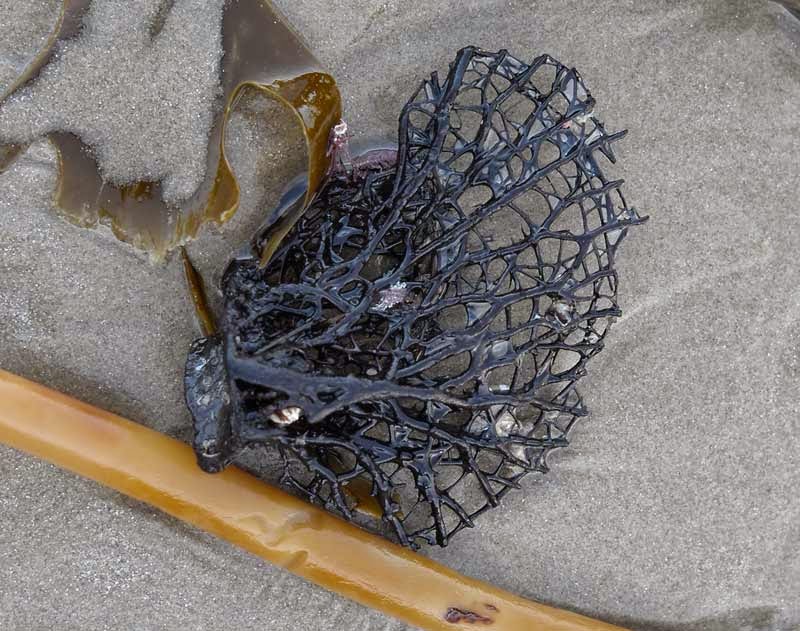
Sponges at Diggers Beach


Coral
Diggers Beach is part of the The Solitary Islands Marine Park Coastal Walk (pdf). A suburban beach where people come to surf, swim, jog, sun-bake and empty their dogs (illegally). Rarely does anyone look at the flora and fauna at the beach. The beach serves as a backdrop for their activities.

At high tide and during storms sponges are dislodged from their garden communities and end up amongst rocks, seaweed and shells at the beach. If one is observant, these ancient multi cellular organisms (Porifera) can be found in a multitude of colours and structures. They cling to the floor of the ocean and allow nutrient-containing water to circulate through their pores and channels. 

"Like all temperate life forms in the waters of southern Australia the habitat forming invertebrates in sponge gardens rely on clean water and sufficient nutrients and food particles to survive. Because many of the animals are permanently attached to the rock and unable to move around, they cannot go in search of food or flee from harm." (source)

They emerged 700 million years ago, when the oceans contained little oxygen. “The effects we predict suggest that the first animals, far from being a passive response to rising atmospheric oxygen, were the active agents that oxygenated the ocean around 600 million years ago....They created a world in which more complex animals could evolve, including our very distant ancestors.” (source)


http://www.marinespecies.org/porifera/
The WPD, the World Database of all Recent sponges ever described, is part of the World Register of Marine Species (WoRMS), a global initiative to arrive at a register of all marine organisms

http://www.nerpmarine.edu.au/
NERP Marine Biodiversity Hub

https://peerj.com/articles/901/
PeerJ: "Indirect effects of overfishing on Caribbean reefs: sponges overgrow reef-building corals"

18.3.15

Korora - The Solitary Islands Marine Park Coastal Walk


One stop along the Solitary Islands Marine Park coastal walk (map) is Korora. It is a small ocean-side suburb to the north of Coffs Harbour. Approaching from Charlesworth Bay the walk follows a steep littoral rainforest track. One knows when one is near dwellings as the weeds multiply and the sound of yapping dogs can be heard. All over NSW it seems a tradition to chuck the 'garden clippings' over the fence, into the 'bush'. They strain to distinguish themselves from this amorphous  'bush' of bio-diversity to grow a mono-culture of lawn and pretty weeds. The only welcomed animals are dogs, stuffed with native marsupial meat. The barking cacophony is not the only extension beyond their fence posts, but the diverse bush is also simply annexed as a tip. The chuck and grab formula applies all over coastal Australia - it is a frame of mind.


When the McMansions are 'just in your face' on the cliff top, there are only dead trees and stumps providing ocean 'views'. The bush reserve is simply disposed over by private interests. Coal- powered air conditioners hum along to the barking audio pollution. No solar ever in sight. The thick line of weeds emanating from these non-places get a regular dousing of pesticide. A sign reads 'These trees have been poisoned'.  Juvenile brush boxes hug the edge of the cliff site,  retaining the soil close to the walk way. This endemic coastal rain forest tree has a colourful bark and white flowers.

Leading down steep stairs to the lagoon more tree stumps grace the walk and indicate that it is a culture scape. Till in the 70s this water body has been described as 'a pristine water hole'. Now it stinks and appears to be a health hazard. "A decade on and the lagoon is choked with silt, weeds, pollution and rubbish." It is still fringed by a bit of native vegetation, if not annexed by the properties hugging the stream. A shy yellow-billed spoonbill (Platalea flavipes) is wading in the foul slime-covered waters searching for food. What option has it got but this human sewer?


More houses are directly ON the beach sprouting stumps and green lawn. Unusual white quartz, pumice accumulates here on the sand. Native Pandanus and Crinum pedunculatum scent the air in a positive way - but the stench wins.


At the beach packs of dogs are let loose. Wildlife like plovers and goannas flee to make way for these feces and urine depositing machines. Most of the poo remains. Even as a human being one does not feel that one's safety is guaranteed. The hyper abundance of canines without effective enforcement makes this a 'backgarden of pet enthusiasts' only. Australian wildlife and walkers/ visitors find themselves in a stinking, noisy and threatening place.


The ocean/surf also smells off-putting which makes one wonder about the sewage arrangements of concrete coastal sprawl. Looking back to the cliff one has spectacular views of the human-made erosion from eradicating the cliff vegetation. Landslides are just there where trees have been poisoned and killed. The beach also seems to erode rapidly in this coal-fuelled climate.