Showing posts with label food. Show all posts

7.6.25

Do we want to live under a cloud of drones?

Drone can now deliver hot coffee and fast food from shopping centres to the suburbs. An ‘instant now culture’ makes it possible that the highly processed soggy food is directly delivered to your couch. Immediate access to everything, every commodity on-demand can be gratified by drone delivery. Soon tens of thousands of unmanned aerial vehicles will fill the sky over Australia.

The humming noise of the flying machines will hardy be noticed among the cacophony of noise and vibrations from vehicles, mowers, slashers and chainsaws. One is already well accustomed to ubiquitous fossil fuel generated noise pollution.


New information and communication technologies are not perceived as spying machines posing a significant privacy issue.

Should a neighbour object to the disruptive and irritating noise, security risks and privacy invasion then the first line of defence is always the Australian mantra:

“No-one has ever complained about it” and

“Have you spoken to your council?” 

Thereafter one encounters an array of Kafkaesque institutional labyrinths where no instance/ agency is responsible for anything. For complainants it is “a morass of laws and buck-passing.” (source)

The decisions to populate the sky with more machines have already been made. The precautionary principle is foreign lingo while the airspace over cities and suburbia is already humming with drones. The slow creep of the ‘outdoor lab’ is gradually and almost imperceptibly becoming a monster interchange in the sky with all the associated impacts.

”The Department of Infrastructure, which has taken control of drone regulation, wants to see expansion in the sector. A political discussion about the desirability of drone delivery services has yet to take place.” (source)

95% of Earth's land surface displays some form of human impact, much of it is human infrastructure. The ocean habitats and many rivers have been turned into shipping and boating highways. Now it is time for the 'highway in the skies’. A full-service logistics will fill the blue sky with heavy aerial traffic.

“The companies involved in drone delivery pilots want the sky for themselves.." The vision is to architect highway infrastructure across our skyscape.” (source)
 

Time to fast track a sky-highway for business. There is no time to waste for the assessment of emerging technologies.

 A disenfranchised public can only look up to the congested, automated and privatised sky highway. "The regulation is moving in a way that effectively gets rid of opportunities for people to have a political say.” (source)

Defaunation of terrestrial and aquatic ecosystems seems of no concern to humanity. Wildlife that call the sky and the atmosphere their home are classified as ‘obstacles’ to human progress.

Drones are seen as a panacea for data collection on wildlife such as koalas. They can buzz through their canopy 24/7. Human crowds can also be controlled in real-time. (source) Ultra-high-resolution overhead surveillance of citizens is already in operation. (source)

As a means of destruction unmanned aerial vehicles are widely used for asymmetric warfare in hit-and-run ambushes in the battlefield of the numerous war zones. In the Ukraine combat zones birds now incorporate nests from fiber optic cable from FPV kamikaze drones.

The sky's the limit.


Image: Curated by Bellingen Area Blog, J. M. W. Turner and ChatGPT

Drone deliveries aren't attracting many complaints but experts say that's not a sign of public endorsement. ABC

Do we want to live under a cloud of drones? The Conversation

2.3.17

The Big Blueberry on the North Coast of NSW

The coastline of Spain is known as the ‘Sea of Plastic’ ("Mar de Plástico”) (film)  It is the world’s largest plastic greenhouse complex with 350 square km of fruit and vegetables grown by immigrant  labour for the horticultural industry.

Will the North Coast of NSW become such an industrial plastic wrapped landscape?

This ‘country’ has had 229 years of extractive industries. The extraction and export of natural resources in colonial times and now leads to conflicts with residential areas.

Small scale rural landholdings populate the coast and the hinterland. The commons protects National Parks and reserves to afford biodiversity a home. The interface of nature reserves, human settlement and industrial production is that of conflict. “Residents and council do not know about a blueberry farm development until they are there”. (source)

The high rainfall area has been also ‘discovered’ by multinational agribusiness. Once, some of the Coffs Harbour area was know as the ‘Big Banana’, it seems now the North Coast is being developed into the BIG BLUEBERRY.


The cash crop is grown for export. After the land is cleared (image) and all Australian flora and fauna have been made homeless, the crops are grown with agri-chemicals (pesticide, fungicide etc). Runoff impacts the surrounding areas. The berries and the incorporated water and soil are sent overseas. The legacy remains.

Increased machine noise and traffic impact on residents and remaining wildlife.

The promise of ‘jobs’ reads more like ’The Grapes of Wrath’. It has been found that backpackers and non-English speaking background workers from o.s. are underpaid and exploited. (here, here, here)

The farm workers go, but residents are stuck in a neighbourhood that is becoming an industrial site. The conflict between locals and large corporate agribusiness interests needs attention by the regulatory bodies.

As coastal urbanisation increases, the space and resources shrink. The horticultural industry expands in Bellingen, Boambee Valley, Coffs Coast, Corindi, Crossmaglen, Woolgoolga, Repton, Valla, Valery and Nambucca. At Bruxner Park the views towards Coffs Harbour and the ocean are starting to look like the above plastic netting landscape, white plastic nets are gobbling up the green coastal landscape.

The 21st century could offer a chance to refrain from treating ‘country’ as a BIG QUARRY. A future beyond extraction and exploitation. Care for the commons, the water bodies, soil and biodiversity.

Authorities can regulate and monitor ‘land use’ and prevent abuse in the interest of all.

 
Quotes:
- A meeting at the CWA on Monday, March 13 at 7pm
“Intensive Horticulture is creeping into the Bellinger Valley by stealth and residents across the Shire will gather to discuss largely unmonitored and unregulated development of intensive horticulture as a new plantation has now become evident to worried neighbours from Valery,” Bellingen Environment Centre spokesperson Caroline Joseph said. (source)

- Valla: “There is no visual flow in Deep Creek and still pumping continues" (source)

- Repton: “A key feature of the village is the natural setting, surrounded by the Bongil Bongil National Park and Pine Creek State Forest. The conversion of land zoned R5 to provide for an agricultural development is wholly at odds with the primary objective of the zone.”
Thirty-Two separate chemicals are listed in the NSW Department of Primary Industry’s Blueberry Plant protection Guide 2015-2016 for use on blueberries in NSW to control disease and pests...Of the 32 chemicals approved one third of the chemicals are identified as likely to have a long-lasting, negative off-target impact … most disturbing is that pesticides can have both immediate (acute) effects and long term (chronic) effects on the health of people who are exposed to them. ... (The) main concern is spray drift over to nearby houses whose only water is collected in tanks and consequently we will drink.” (source)

- Woolgoolga: “The development of a blueberry farm near his property further west on Newmans Rd resulted in a reduction of kangaroos in that area.” (source)

Links:
Blueberry farm in the Shire reignites the debate, Bellingen Courier, 28.02.2017
Repton resistance  Bellingen Courier, 29.11.2015 
Like living in a war zone, abc 01.03.2017 
Australian agriculture safeguarding against climate change. Structures for larger-scale growers to cover whole paddocks or orchards. abc 04.03.2017
Warning against the deliberate exploitation of young people and visa holders, Bellingen Courier, 06.03.2017

Updates:
 
Blueberry blues: how the cash crop is causing a contamination crisis in Coffs Harbour, 29.09.2022 The Guardian  
 
Calls for royal commission as report details allegations blueberry farmers pay workers $3 an hour 3.12.2020

 Concerned residents want blueberry farms to need a DA 
“We were shocked to learn that there is no monitoring or compliance required at a local (council) level to clear privately owned,forested land or to establish intensive horticulture plantations and that this concern about unregulated development is being shared across the region,” Bellingen Environment Centre’s Caroline Joseph said... Pine Creek is dying ..." Bellingen Courier, 14.03.2017

Deregulate, deregulate - "Productivity Commission recommends a wide slash of farm red tape, except biosecurity and food safety. It also recommends agricultural land should be used for its highest value, even if that means resource development." abc rural 29.03.2017

"Europe's Dirty Little Secret: Moroccan Slaves and a 'Sea of Plastic' " or landscapes a perennial plastic greenhouses, Ecowatch 2015
 
Marine scientists fingerprint sources of nitrogen on the Coffs coast. Nearly all creeks with agriculture (blueberry, macadamia) and urban land use have (sewage) water quality issues. Bellingen Courier, 16.09.2020


Images:
Greenhouses of the Campo de Dalías, Almería Province, Spain , NASA’s Earth Observatory
Organic blueberries
The March of Business, Bellingen graffiti 
 
More images:

Mar del Plastico, Bernhard Lang

27.8.15

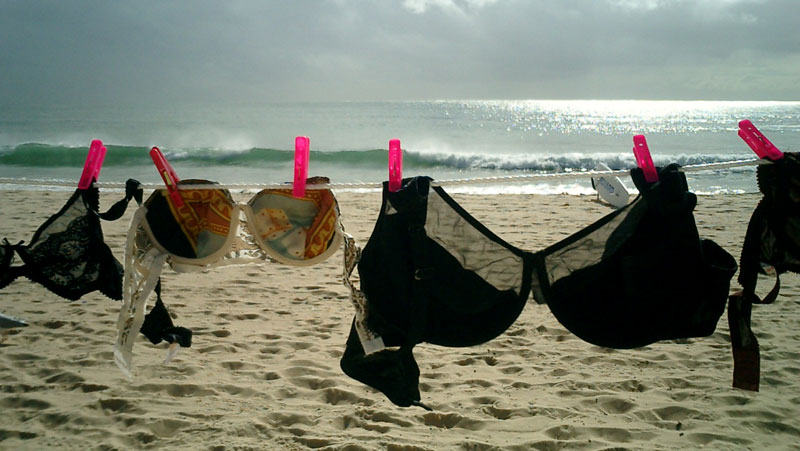
Microplastic from Clothing is Accumulating on Shorelines Woldwide


60-85 percent of human-made material found on shorelines consists of micro fibers from clothing. (source)

Plastic clothing has become the norm. From lingerie to outdoor gear, synthetic garments fill shops and wardrobes, cling to bodies and households. Synthetic fabrics (polyester, acrylic, nylon, rayon, acetate, spandex, latex, etc) are convenient and just require a quick spin.

The bright, fashionable colours of the season make the textiles obsolete by the time they leave the shop. Mending is out in a throw-away society. Mountains of old rags go into 'landfill' or end up in smelly second hand shops.

Synthetic and some natural fibers are often pickled in chemicals: toxic dyes, flame retardants, nano -silver and other chemicals in stain-proof textiles and waterproof clothing.


Garments that are washed by hand or machine shed fibers and chemicals/detergents into the water. As there is a paucity of sewerage systems in rural areas like Bellingen and the mid north coast, the effluent drains into the catchment. "Wastewater from domestic washing machines demonstrated that a single garment can produce 1900 fibers per wash." (source)

The shed micro fibers reach the shorelines. They are "micron-scale synthetic fibers, mostly polyester and acrylic, in sediments along beaches the world over." (source)

The invisible contamination of soil, water catchment and marine habitat with microplastic enters the food chain of all living creatures.


Natural fibers, untreated and of organic origin produced and tailored under ethical conditions (no land grab or exploitation) is the right choice to make...


Sources:
Accumulation of Microplastic on Shorelines Woldwide: Sources and Sinks
The Damage I Cause When I Wash My Clothes
Chemicals in clothing, Choice
Two-thirds of new clothing is plastic


Updates:

What does micro plastic less than 1mm do to animals?
Linking effects of anthropogenic debris to ecological impacts
Mark Anthony Browne, A. J. Underwood, M. G. Chapman, Rob Williams, Richard C. Thompson, Jan A. van Franeker, Published 22 April 2015.DOI: 10.1098/rspb.2014.2929

Chris Wilcox, Erik Van Sebille, and Britta Denise Hardesty. Threat of plastic pollution to seabirds is global, pervasive, and increasing. PNAS, August 31, 2015 DOI: 10.1073/pnas.1502108112
( 99 per cent of the world's seabirds species will be ingesting plastic by 2050 if current marine pollution trends continue. They starve to death from plastic fibres from synthetic clothes an other 'junk food'.)
or
Almost all seabirds to have plastic in gut by 2050, CSIRO


27.7.15

Sewage discharge and shellfish don't mix. The Bellinger-Kalang rivers.

"One of the more pervasive aspects of European settlement was the pollution of the air and water." (source)
"The indications are that we will not have, inside the Bellinger-Kalang, an oyster industry within the next two years...” (source)

"The Aborigines on the coastal regions feasted on oysters and shell beds can be found in the many kitchen middens along the coast. Some of these middens have been carbon-dated to ten thousand years." (source)

Oyster growers on the NSW Mid North Coast are going to grow Sydney Rock Oysters in land-based tanks now to control water quality. "The Bellinger River was closed for 270 days last year due to heavy rainfall." (source)

Along the Bellinger River catchment and the Kalang River dense settlements sprawl along that are not on any sewer system. The majority of the rural blocks are on an on-site sewage management system (OSMS).

In 2008 sewage bacteria really hit the filter feeding oyster beds. "The NSW Food Authority closed the Kalang River at Urunga in August while a search was made for norovirus, which causes gastroenteritis in humans." (source)

Sewage discharge and shellfish don't mix
"The Bellingen Shire Council says septic systems in the river catchment have been identified as a possible source of the pollution...One of the potential contamination sources are privately operated onsite sewage management systems." (source)


Aquaculture farmers have been waiting for seven years for the Kalang River to reopen to oyster harvesting. "Protracted river testing, analysis and meetings began with riverside septics found to be high on the list of culprits, especially on Newry Island and along Urunga’s Atherton Dr." (source). Additionally the "Urunga sewage treatment plant, holiday cabins, two caravan parks adjacent to the river." were also mentioned as sources of contamination. (source)

After the endemic totem of the river, the Bellinger River turtle has been pushed into extinction, the question of water quality and river health is an acute one for the entire catchment.

Updates:
Dairy growth in north-west Tasmania causing concern for oyster farmers: effluent run-off from farms. abc 13.08.2015


Images:
Beert, Osias, Still life with oysters, c. 1610
Bellingen tiles

24.6.15

Aboriginal Consumption of Estuarine Food Resources and Potential Implications for Health through Trace Metal Exposure; A Study in Gumbaynggirr Country


Many of the Gumbaynggirr community rely on the Nambucca River estuary and coastal marine environment for fish and seafood. A legacy of the 'extract and dump' culture has polluted the environment with "metal-based sprays of arsenic and lead, organochlorine pesticides including DDT, dieldrin, aldrin and organophosphate pesticides...Derelict mines, agriculture, cattle dips, horticulture and banana growing left behind early generation chemical sprays and fertilizers."

Trace metals concentrations have implications for the health of the people engaging in fishing and seafood consumption. Read the details in the original study:

Shaina Russell, Caroline A. Sullivan, Amanda J. Reichelt-Brushett. Aboriginal Consumption of Estuarine Food Resources and Potential Implications for Health through Trace Metal Exposure; A Study in Gumbaynggirr Country, Australia, PLOS ONE, 2015, DOI: 10.1371/journal.pone.0130689 
Fishing and resource use continues to be an essential aspect of life for many Aboriginal communities throughout Australia. It is important for dietary sustenance, and also retains deep social, cultural and economic significance, playing a fundamental role in maintaining group cohesion, transferring cultural knowledge and affirming Indigenous identities. We surveyed approximately 20% of the Gumbaynggirr Aboriginal community of Nambucca Heads, New South Wales, Australia. This paper explores Gumbaynggirr Connection to Country and engagement in cultural practice. It quantifies fishing efforts and consumption of seafood within the community. We found 95% of the sample group fish, with the highest rate of fishing being 2-3 times a week (27%). Furthermore, 98% of participants eat seafood weekly or more frequently, up to more than once a day (24%). Survey results revealed that Myxus elongatus (Sand mullet) and naturally recruited Saccostrea glomerata (Sydney rock oysters) continue to be important wild resources to the Gumbaynggirr community. Trace metals were measured in M. elongatus and S. glomerata samples collected by community participants in this study. Maximum levels prescribed in the Australia New Zealand Food Standards Code were not exceeded in the edible tissue for either species, however both species exceeded the generally expected levels for zinc and copper and S. glomerata samples exceeded the generally expected level for selenium. Furthermore the average dietary exposure to trace metals from consuming seafood was calculated for the surveyed population. Trace metal intake was then compared to the provisional tolerable weekly intake prescribed by the Joint Expert Committee on Food Additives. This process revealed that copper and selenium intake were both within the provisional tolerable weekly intake, while there is no guideline for zinc. Furthermore, participants relying heavily on wild resources from the Nambucca River estuary may exceed the provisional tolerable weekly intake for cadmium. This suggests the need for further investigation of this issue to minimize any possible health risk.

Images:
From the outside walls of the Yarrawarra Aboriginal Cultural Centre, Corindi Beach


26.1.14

Climate wars


As an update on climate reading, here is some very informative climate listening.

The book:
Climate Wars, by Gwynne Dyer reads:

"From one of the world’s great geopolitical analysts, a terrifying glimpse of the none-too-distant future, when climate change will force the world’s powers into a desperate struggle for advantage and even survival.

Dwindling resources. Massive population shifts. Natural disasters. Spreading epidemics. Drought. Rising sea levels. Plummeting agricultural yields. Crashing economies. Political extremism. These are some of the expected consequences of runaway climate change in the decades ahead, and any of them could tip the world towards conflict. Prescient, unflinching, and based on exhaustive research and interviews, Climate Wars promises to be one of the most important books of the coming years."

Listen to part 1 (2, 3) by Gwynne Dyer

Image:
Boat of Environmental migrants/ climate refugees fleeing the effects of catastrophic climate change and environmental degradation.

Update:
Failure to address global warming could lead to war, F. Hollande at G20, reuters 161114

8.10.13

Retreat

A long weekend in a retreat (60-something kms from Bellingen). Multiple huts in a rural landscape.

On arrival multiple fossil fuel powered machinery made the landscape 'tidy'. The disturbing and excessive noise and dust pollution hogged the attention.

On opening the door to the premises, one was hit by an intense cloud of synthetic fragrances that was cooking on a power point. All textiles were drenched in these potentially hazardous synthetic chemicals. Curtains and furniture seemed to be dipped in fire foam and flame retardants. The bedsheets smelled perfumed. The kitchen cupboard had, as in most Aussie kitchens, the well-used spray can of pesticide handy. The water, without a filter, tasted foul and metallic.

The closeness of the  neighbouring huts tried to emulate a feeling of a tight-knit sub-urbia back home. Families wanting a "getting away from it all" feeling ended up in the confinement of 'family cabins'. "Loudness-as-an-inalienable-right “(Wallace, David Foster) of families one might add. Large unplanned families with the full package of pets and all the baggage. Parents intensely interacting with their wearables. Many mouths scream. The child that cannot use language cries and screams.

The dads of instant culture pour petrol, meths or other accelerants on the meat altar. The incinerated meat stands in the form of cows not far off. They are usually pre-cooked in the shelter-less Australian sun.

The toy pets bark and squeal from the abuse of being mistaken for a horse. Agitated the free range dog chases the only Australian native fauna in sight, a brush turkey. For short minutes distraction culture goes sensation seeking and then they sprawl and sprawl.

The use of the veranda is impossible and the hut smells toxic. The entire night the resident rooster claims his territory over the visiting Koel and the array of family dogs bark and yap and yap and yap.

Next idyllic morning the neighbouring fence is being drenched with toxins trailing in a large dust drift. The posts are meters away from the line of huts. Copious amounts of herbicide/pesticide is being doused, the diesel of the tractor fills the 'shelter' up with thick clouds of diesel fumes.

We retreat to a coastal eatery.  A deafening aural ambiance from families being fed. In the food preparation area a white, plastic auto mist box disperses pesticides totally unmanned round-the-clock! At short intervals poison is being released on to 'bugs', staff and customers. Enthusiasts of old car wrecks generously share the fumes of their old timers which fill the entire cafe.

People just seem to tolerate the ubiquity of pesticides and noise pollution

We disappeared through the sanitised, chemicalised agricultural acres which stretch for mile upon mile. Australian flora and fauna has been eradicated or only fragments are left as retreats.

Images: 
Cicada, domesticated silkmoth, Bombyx mori and a diversity of flies, Alfred BrehmBrehm's Life of Animals

Even ‘environmentally protective’ levels of pesticide devastate insect biodiversity. 
 Common insecticide used in homes associated with delayed mental development of young children

Update
Pyrethroid insecticides exposure increasing in homes and people,
07022014