Showing posts with label plastic. Show all posts

10.3.17

Cover In-Pram Children from Car Exhaust Emissions


Children are particularly vulnerable to even low levels of pollution. Psychiatric disorders in children and adolescents are linked to traffic pollution. (source) Air pollution generally demands sacrifices in lives and economic costs. (source) Pollution from combustion (diesel) vehicles/ motors, fires (back-burning) and wood heaters are just a few that shorten lives prematurely.

Now parents are advised to use covers on their prams during toxic school runs to protect their infants from air pollution:
 “Fine particles show larger health impacts compared to their larger counterparts and at the young age children are more susceptible to particulate pollution, suggesting a clear need for precautionary measures to limit their exposure during their transport along the busy roadsides…Children could be at risk of breathing in some nasty and harmful chemical species…One of the simplest ways to combat this is to use a barrier between the in-pram children and the exhaust emissions, especially at pollution hotspots such as traffic intersections, so parents should use pram covers if at all possible.” (Source)


Links:
Use buggy covers to combat air pollution danger, parents warned, The Guardian, 10.03.2017
Exposure of in-pram babies to airborne particles during morning drop-in and afternoon pick-up of school children, Environmental Pollution 06.03.2017

Top tips to avoid getting metal pollution in your brain, New Scientist, 5 September 2016

NICU treatments for improving neurodevelopmental outcomes rely heavily on touch. On the somatosensory scaffolding of later perceptual, cognitive, and social development. Touch is a cornerstone of interpersonal interactions and sensory-cognitive development. Current Biology, DOI: http://dx.doi.org/10.1016/j.cub.2017.02.036

Update:
Air quality concerns spur anti-idling push at schools. Parents who leave their cars idling in school pick-up zones urged to switch off.  abc 12.04.2017


Images:
Mother and child getting poisoned by cars, Street art EU
Plastic covered prams of North Shore jogging mums, Sydney
Tyre Adventure Playground, Bellingen

2.3.17

The Big Blueberry on the North Coast of NSW

The coastline of Spain is known as the ‘Sea of Plastic’ ("Mar de Plástico”) (film)  It is the world’s largest plastic greenhouse complex with 350 square km of fruit and vegetables grown by immigrant  labour for the horticultural industry.

Will the North Coast of NSW become such an industrial plastic wrapped landscape?

This ‘country’ has had 229 years of extractive industries. The extraction and export of natural resources in colonial times and now leads to conflicts with residential areas.

Small scale rural landholdings populate the coast and the hinterland. The commons protects National Parks and reserves to afford biodiversity a home. The interface of nature reserves, human settlement and industrial production is that of conflict. “Residents and council do not know about a blueberry farm development until they are there”. (source)

The high rainfall area has been also ‘discovered’ by multinational agribusiness. Once, some of the Coffs Harbour area was know as the ‘Big Banana’, it seems now the North Coast is being developed into the BIG BLUEBERRY.


The cash crop is grown for export. After the land is cleared (image) and all Australian flora and fauna have been made homeless, the crops are grown with agri-chemicals (pesticide, fungicide etc). Runoff impacts the surrounding areas. The berries and the incorporated water and soil are sent overseas. The legacy remains.

Increased machine noise and traffic impact on residents and remaining wildlife.

The promise of ‘jobs’ reads more like ’The Grapes of Wrath’. It has been found that backpackers and non-English speaking background workers from o.s. are underpaid and exploited. (here, here, here)

The farm workers go, but residents are stuck in a neighbourhood that is becoming an industrial site. The conflict between locals and large corporate agribusiness interests needs attention by the regulatory bodies.

As coastal urbanisation increases, the space and resources shrink. The horticultural industry expands in Bellingen, Boambee Valley, Coffs Coast, Corindi, Crossmaglen, Woolgoolga, Repton, Valla, Valery and Nambucca. At Bruxner Park the views towards Coffs Harbour and the ocean are starting to look like the above plastic netting landscape, white plastic nets are gobbling up the green coastal landscape.

The 21st century could offer a chance to refrain from treating ‘country’ as a BIG QUARRY. A future beyond extraction and exploitation. Care for the commons, the water bodies, soil and biodiversity.

Authorities can regulate and monitor ‘land use’ and prevent abuse in the interest of all.

 
Quotes:
- A meeting at the CWA on Monday, March 13 at 7pm
“Intensive Horticulture is creeping into the Bellinger Valley by stealth and residents across the Shire will gather to discuss largely unmonitored and unregulated development of intensive horticulture as a new plantation has now become evident to worried neighbours from Valery,” Bellingen Environment Centre spokesperson Caroline Joseph said. (source)

- Valla: “There is no visual flow in Deep Creek and still pumping continues" (source)

- Repton: “A key feature of the village is the natural setting, surrounded by the Bongil Bongil National Park and Pine Creek State Forest. The conversion of land zoned R5 to provide for an agricultural development is wholly at odds with the primary objective of the zone.”
Thirty-Two separate chemicals are listed in the NSW Department of Primary Industry’s Blueberry Plant protection Guide 2015-2016 for use on blueberries in NSW to control disease and pests...Of the 32 chemicals approved one third of the chemicals are identified as likely to have a long-lasting, negative off-target impact … most disturbing is that pesticides can have both immediate (acute) effects and long term (chronic) effects on the health of people who are exposed to them. ... (The) main concern is spray drift over to nearby houses whose only water is collected in tanks and consequently we will drink.” (source)

- Woolgoolga: “The development of a blueberry farm near his property further west on Newmans Rd resulted in a reduction of kangaroos in that area.” (source)

Links:
Blueberry farm in the Shire reignites the debate, Bellingen Courier, 28.02.2017
Repton resistance  Bellingen Courier, 29.11.2015 
Like living in a war zone, abc 01.03.2017 
Australian agriculture safeguarding against climate change. Structures for larger-scale growers to cover whole paddocks or orchards. abc 04.03.2017
Warning against the deliberate exploitation of young people and visa holders, Bellingen Courier, 06.03.2017

Updates:
 
Blueberry blues: how the cash crop is causing a contamination crisis in Coffs Harbour, 29.09.2022 The Guardian  
 
Calls for royal commission as report details allegations blueberry farmers pay workers $3 an hour 3.12.2020

 Concerned residents want blueberry farms to need a DA 
“We were shocked to learn that there is no monitoring or compliance required at a local (council) level to clear privately owned,forested land or to establish intensive horticulture plantations and that this concern about unregulated development is being shared across the region,” Bellingen Environment Centre’s Caroline Joseph said... Pine Creek is dying ..." Bellingen Courier, 14.03.2017

Deregulate, deregulate - "Productivity Commission recommends a wide slash of farm red tape, except biosecurity and food safety. It also recommends agricultural land should be used for its highest value, even if that means resource development." abc rural 29.03.2017

"Europe's Dirty Little Secret: Moroccan Slaves and a 'Sea of Plastic' " or landscapes a perennial plastic greenhouses, Ecowatch 2015
 
Marine scientists fingerprint sources of nitrogen on the Coffs coast. Nearly all creeks with agriculture (blueberry, macadamia) and urban land use have (sewage) water quality issues. Bellingen Courier, 16.09.2020


Images:
Greenhouses of the Campo de Dalías, Almería Province, Spain , NASA’s Earth Observatory
Organic blueberries
The March of Business, Bellingen graffiti 
 
More images:

Mar del Plastico, Bernhard Lang

27.8.15

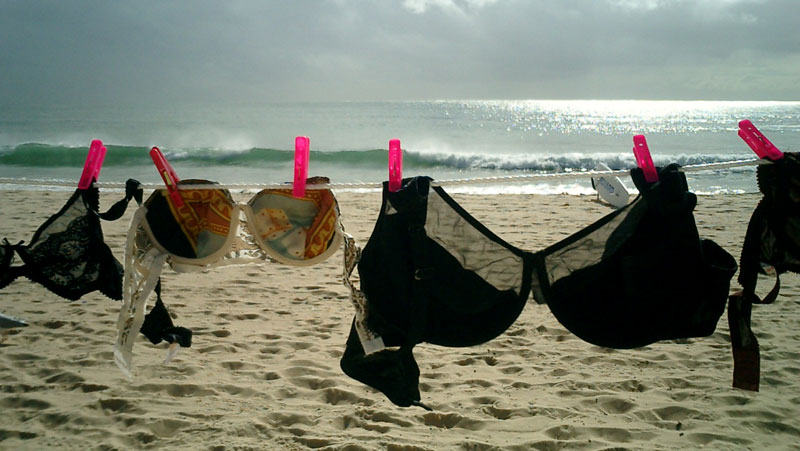
Microplastic from Clothing is Accumulating on Shorelines Woldwide


60-85 percent of human-made material found on shorelines consists of micro fibers from clothing. (source)

Plastic clothing has become the norm. From lingerie to outdoor gear, synthetic garments fill shops and wardrobes, cling to bodies and households. Synthetic fabrics (polyester, acrylic, nylon, rayon, acetate, spandex, latex, etc) are convenient and just require a quick spin.

The bright, fashionable colours of the season make the textiles obsolete by the time they leave the shop. Mending is out in a throw-away society. Mountains of old rags go into 'landfill' or end up in smelly second hand shops.

Synthetic and some natural fibers are often pickled in chemicals: toxic dyes, flame retardants, nano -silver and other chemicals in stain-proof textiles and waterproof clothing.


Garments that are washed by hand or machine shed fibers and chemicals/detergents into the water. As there is a paucity of sewerage systems in rural areas like Bellingen and the mid north coast, the effluent drains into the catchment. "Wastewater from domestic washing machines demonstrated that a single garment can produce 1900 fibers per wash." (source)

The shed micro fibers reach the shorelines. They are "micron-scale synthetic fibers, mostly polyester and acrylic, in sediments along beaches the world over." (source)

The invisible contamination of soil, water catchment and marine habitat with microplastic enters the food chain of all living creatures.


Natural fibers, untreated and of organic origin produced and tailored under ethical conditions (no land grab or exploitation) is the right choice to make...


Sources:
Accumulation of Microplastic on Shorelines Woldwide: Sources and Sinks
The Damage I Cause When I Wash My Clothes
Chemicals in clothing, Choice
Two-thirds of new clothing is plastic


Updates:

What does micro plastic less than 1mm do to animals?
Linking effects of anthropogenic debris to ecological impacts
Mark Anthony Browne, A. J. Underwood, M. G. Chapman, Rob Williams, Richard C. Thompson, Jan A. van Franeker, Published 22 April 2015.DOI: 10.1098/rspb.2014.2929

Chris Wilcox, Erik Van Sebille, and Britta Denise Hardesty. Threat of plastic pollution to seabirds is global, pervasive, and increasing. PNAS, August 31, 2015 DOI: 10.1073/pnas.1502108112
( 99 per cent of the world's seabirds species will be ingesting plastic by 2050 if current marine pollution trends continue. They starve to death from plastic fibres from synthetic clothes an other 'junk food'.)
or
Almost all seabirds to have plastic in gut by 2050, CSIRO