Showing posts with label history. Show all posts

11.7.24

An Environmental History of the Timber Industry: The Social Constructions of Forest and Identity

Some remarks on the Social Constructions of Forest and Identity: An Environmental History of Timber Industry Authorities in the Forests of Southeast Victoria, Australia,  Claire Waddell-Wood, La Trobe University, Victoria, 2024 (source)


One wonders why the degradation of Australia seems unstoppable.
Why are the forests and biodiversity being wiped out, eradicating a future for complex living beings?
What is the nexus between settler society and the extractive relationship to their surrounding country?


Claire Waddell-Wood, is an environmental historian who investigates the Victorian timber industry. Light is thrown on the extractive relationships of settler-colonial interactions with the landscapes they colonise. The conceptual framing foregrounds resource extraction/forestry labour and masculinity constructions against the background of a more-than-human world. 


The metabolism between European modes of production/ consumption took the form of “rape and pillage disasters.”  The resulting ecological crisis does not only take place in the timber industry alone, but is a way of life and work in all the extractive industries.


Victoria officially ceased logging operations recently. But in other states such as NSW (The proposed Great Koala Park) forests and their remaining biodiversity are still being denuded and erased. Elsewhere in the Big Quarry, “dualistic ontologies still guide human behaviour.” 

An acknowledgment and a change of ways of the mainstream structures, institutions and mindsets, as well as in environmental movements could harbour the possibilities for a fundamental transition of socio-ecological relations.


The ‘history of degradation’ traces the (southeast Victorian) forest industry’s  extractive work, masculinities and landscape degradation. p. 202


A “deep time forest culture (which) shaped and was shaped by long histories of interactions” (by Wurundjeri, Boonwurrung, Taungurung, Gunnai Kurnai, Jaitmatang, Bidwell, and Ngarigo people) encountered male dominated European settler culture that conceptualises “those forests through the resource imaginary”.

“The social metabolisms of invasion clashed with deep time forest cultures, and ecosystems became disturbed and damaged. The interactions between settlers and forests led to the escalation of fire frequency in forests.” p. 200


European agricultural ideals of plantation monocultures and short term crop yields constitutes a violent othering of Nature. Ancient Indigenous knowledges about forest ecology and ‘the region’s deep time fire culture’ were ignored. The result were intensified extraction and megafires.


From now on “the only true forest knowledge-holders were those trained in the forestry sciences.”  A move from bare rural masculinity in primary industries with boots on the ground to a ‘technoscience of colonial forestry’ operated at arms length via assemblages of machinery and from a top floor of a distant city.

The administration of the ‘stuff’ becomes ‘spatially alienated from the forests’. Hierarchies of (male) staff control the ‘output’ of the biophysical forest factory. Forestry and science experts with exclusionary language and procedures take control from head office over the landscape. Here “the construction masculinity through work” and the production of “wasted landscape" and “waste peoples” takes place.  p.197 


Waddell-Wood's thesis “can aid in untangling the myths of capitalism and colonialism from our everyday lives and help us to live with the biophysical world rather than against it.” p 203

Yet another stepping stone on the path to truth telling.

4.7.23

Historical truth-telling after the ‘great Australian silence’

"Historical truth-telling is increasingly seen as an important part of restorative justice in settler-colonial contexts." 

After 50 years of the ‘great Australian silence’ don't ask why didn’t I know? But how can I find out? 

‘Why didn’t we know?’ is no excuse. Non-Indigenous Australians must listen to the difficult historical truths told by First Nations people, The Conversation

12.6.22

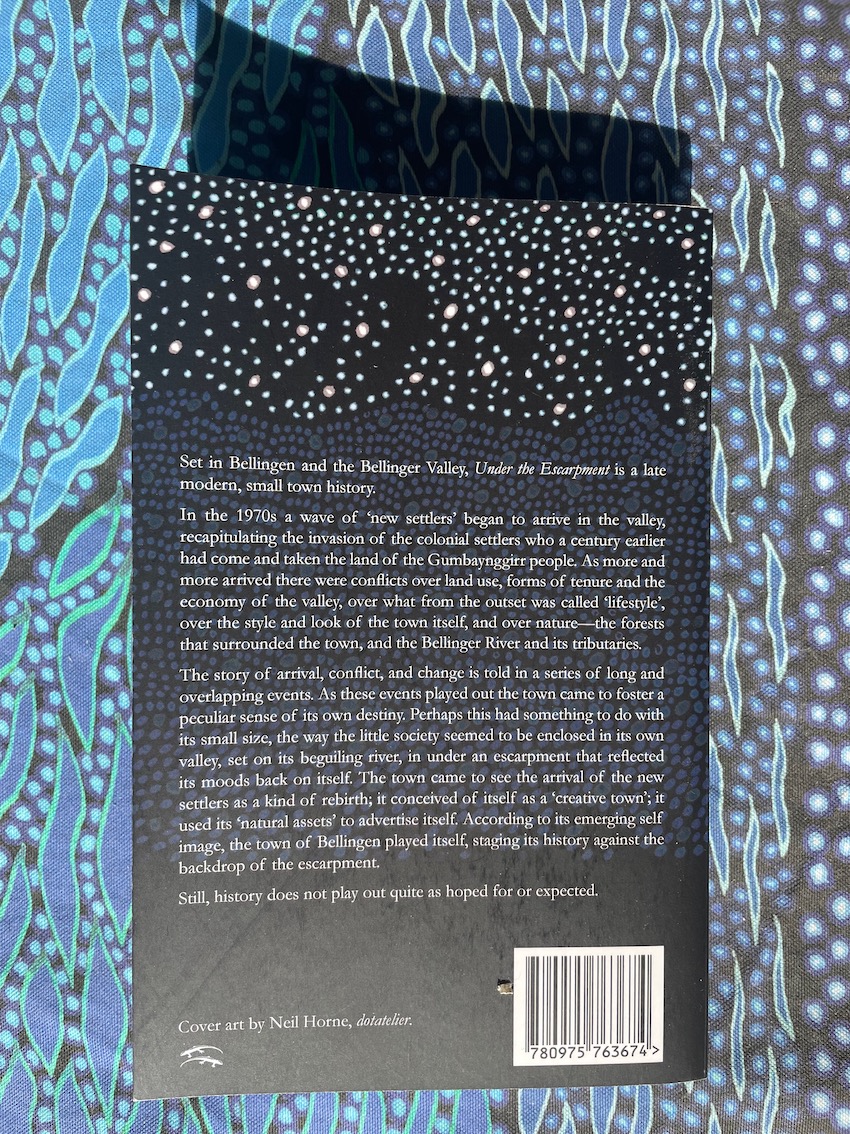
Under the Escarpment - on the late modern history of Bellingen - A Review

A highlight of Bellingen Readers and Writers Festival in June 2022 was the release of Ross Macleay’s latest book, 'Under the Escarpment - on the late modern history of Bellingen' This history of Bellingen is fascinating whether you live here or elsewhere. It conveys the experience of arriving in a new home of one’s choice and confronting an established culture, in this case settler extractivism.

The author has thoroughly researched this detailed book from public archives and oral recounts. In parts the historical events are disputed reflecting the diverse memories of events. The use of words like may have, maybe, and perhaps adds character and uncertainty to this otherwise well-documented history.

When a second invasion of the Bellingen region began in the 1960s and 70s, consisting of mainly educated urban young people with different values to their predecessors, artists, hippies and alternates, the local community put up a strong resistance. The book begins with The Meeting and the events which emerge from this large gathering of both sides are lucidly elaborated.

It covers the banning of the market, the resistance against logging and felling magnificent trees, magic mushrooms, botany, floods, demolition of the community center, and all imaginable topics of modern living.

While reading this book the landscape around becomes mythical. Things become endowed with their  history lending a dimension of time to the surroundings. Reflections about philosophy and the practice of history writing add to this feeling of living in a place which owes its character to the ideas and struggles which created or protected it or failed to do so.

The style is highly readable and entertaining with considerable reflection apparent in every paragraph. People who know Bellingen will be enlightened by this book wherever they go. Like a myth, knowledge makes our experience meaningful. Others will experience it as an entertaining story of universal validity about aesthetics, conflict, love and ecology. And the great drive to make a home somewhere in the world.


1.9.19

Gleniffer quilts - a cover for the bed and a landscape cover

Sandy Corry quilt
Another Gleniffer Quilt and Craft Fair took place in Gleniffer Hall. A large array of quilts was on display. The star of the show was the 'quilting queen' wearing her diamond tiara and demonstrating her 'doodling' on the sewing machine. Sandy Corry's work has a very haptic quality. Here are some of her pieces:
Click to enlarge pictures

Meat on the BBQ and the car park was full. Years ago the non-quilting crafts had a greater representation. A gang of unregistered trail-bikes demanded attention and disrupted the peace, as it is common in this area.

S.Corry quilt

The landscape cover setting
The Never Never Creek flows behind the Gleniffer Hall and a very small church. The gardens of the buildings 'reject the local environment' like most Australian gardens do. Lichen covered fences frame foreign grasses, known as lawns. A patchwork of Chinese camellia plants were planted in all colours from pink to red. The Japanese azaleas keep to this popular colour scheme too, a comforter landscape. An agave from central Mexico is tended to in a flower pot.


Outside the 'cage', trees drip with epiphytes. Tongue orchids (Dockrillia linguiformis) crawl along branches and pencil orchids (Dendrobium schoeninum) fall like stiff sticks from the tree. Shade!

Nearby stands a very large and lonely red cedar (Toona ciliata). A host for aerophytes and fauna. Did the cedar industry overlook this 'red gold'? Soon after European arrival the cedar forests lining all major rivers were eliminated by an extractive colonial industry. Cedar getter gangs stripped their way from Sydney through all rivers, right up to Queensland.
"An entire species of tree was just about wiped out on the NSW coast during the first 100 years of settlement." (source
The cutters would float the 'filet' pieces down the rivers to go to merchants in Sydney or England. The indiscriminate removal of the timber made way for the settlers/ pastoralists.


Most texts (pdf) of the 'In Search of Red Gold' stress the pioneering spirit of the frontier mentality in a people-free El Dorado. The First Nation Peoples, in this case the Gumbaynggirr of the Billengen River are invisible in the narratives.

13.9.15

The Cerura Moth, The Scott Sisters and Nature Depictions

This hairy moth was hanging out where coastal rainforest trees are allowed to be. Cerura australis (Lepidoptera) is attracted by the perfume of the Flintwood tree (Scolopia braunii). It is the favourite food plant of its larva.

Both moth and tree were depicted by the scientific illustrators and naturalists the Scott sisters, Harriet (1830–1907) and Helena (1832–1910). Their book 'Australian Lepidoptera and their transformations' was published in 1864.

The father and co-author took possession of 2560 acres of prime land on the Hunter River estuary in 1827. Ash Island was seen as a 'paradise for naturalist'. For thousands of years the Worimi and Awabakal people had cultured this tidal wetland into a biodiversity hub. Alexander Walker Scott, an entomologist of the day invited other explorers, like Ludwig Leichhardt to his tropical place and even "offered to clear 10 acres in the district, construct a cottage and establish a vineyard for Leichhardt."(source). With time the usual degradation took place at the hands of settlers: subdividing, clearing, draining, agribusiness and finally industrial use of the landscape. In 1866, AW Scott went bankrupt and sold the Ash Island property. (source)

The young women had many years to depict 'paradise' and functioned as 'lady’ plant collectors to 'male experts' as was common in colonial days. "Their father’s bankruptcy forced the sisters to seek payment for their art and endure the perceived social shame for doing so." (source) Excluded from careers, universities and learned societies they continued to draw and paint Australian animals and wildflowers commercially till the end of their life. The artists were largely forgotten (in the land of pesticides) until there was an exhibition in 2011. (source)

 
One outstanding aspect of these 'amateur' naturalists was, that Harriet and Helena were drawing from live animals. "Most natural history illustrators of the time worked with long-dead, pinned specimens that were faded and lacked colour."(source) They refused the 'pinned' appearance of butterfly and moth cadavers and let them live. They also refused to depict 'the thing' in its decontextualised form. Like Maria Sibylla Merian before them they displayed the mutualistic symbiotic relationships between flora and fauna. The plants and the animals are shown at various stages of their cycles as an educational understanding of living creatures.

The scientific minds and the market demand an encyclopedic knowledge and repository for present and future disposability. Till today 'nature' is classified for the logistics warehouse of man. The 'thing' is still pinned, cut, tagged, frozen in vaults yearning for the self-made catastrophe. The bio-diversity of the ecosystem is reduced to a free service to humanity.

Removing a living organism from its larger environmental context in mind and practice allows for the reduction of life into mere stuff, living beings become mere material for one species' industriousness or the collector's wunderkammer.

The 'thing', once removed from its habitat/ biome can be utilised or exterminated by us and we can remain in proud denial about the basis of our life being pulled from under our (and others) feet.
 
It is also popular to have individual bird sound repositories for example. The 'thing' is without it's home habitat. The soundscape ecologist Bernie Krause: " is interested in a given habitat’s entire soundscape—its “biophony”—(he) finds the single-species paradigm absurd...each living organism in a biome evolves in situ to find its own acoustic niche, based either on frequency or time, so that “their utterances are not buried by other signals.” Thus, each animal sound, plus the sounds of the wind in the trees, or waves on a beach, fit together like pieces of a puzzle to create the kaleidoscopic composition we hear. According to this theory, animals change their sounds when their habitat changes." (source)

A perception and depiction of the whole in situ could contribute to the continuing existence of the web of life.

Today Ash Island is part of Hunter Wetlands National Park.


Images:
Cerura australis
Detail of hand coloured lithograph by Harriet Scott from A.W. Scott, “Australian Lepidoptera and their transformations drawn from the life”, London, 1864

31.5.15

The Bush: Travels in the Mind of Australia, inspired by Don Watson

Some thoughts inspired by Don Watson, interviewed by The World Today at @SydWriters'Fest on soundcloud. His latest book: The Bush: Travels in the Heart of Australia, Penguin Australia. (2014)

First there is the outstanding and unbelievable voracious appetite for destruction of all things Australian by European colonialisation. To 'wipe it all away' in this newly established British colony, also known as the 'blank slate' of Terra nullius. Proceeding with the 'business as usual' expansionist progress paradigm, all endemic flora and fauna had to disappear. The indigenous owners of the land "felt the full force of Australian colonial brutality" (source). The inflexible aliens found themselves in an alien land and strained to recreate their place of origin that they were habituated to.

The amazing point is not only 'the scale of destruction', but its perpetual continuation right into 21st century contemporary society and landscape. 'The Great Australian Silence' permeates and it is coupled with an inability to confront reality. The mental state is one of oscillating between learning disability and ‘intentional ignorance’, commonly known as denial.

The long list of inconvenient truths about climate disruption, massacres of indigenous people, land degradation and biodiversity impoverishment are overwhelming.

The mind manufactures defense mechanisms for a required state of permanent 'feel good' existence. A delusional unwillingness to face reality is coupled with a melancholy across generations. Like a social transgenerational epigenentics the uncleared deeds of the past linger in the minds of the present. Existence in rural and sub-urban isolation, bereft of meaning, populates the minds with roaming packs of 'black dogs': mental illness, depression and suicide. The others busy themselves with Anglo pragmatism to get things done by recreating the status quo.

A bit of bush lore, Aussie 'nature' (45,000 years of Aboriginal land stewardship) or #wildoz add to the pride and puffs up the chest. Most of the time one is propelled by fossil fuel machines, racing through the paved bush at 100 km/h.

Isolation also molded the psyche of national insecurity, stuck on an island in the Asian Pacific region. Sliding from a democracy without a bill of rights into an oligopoly of vested interests. A withering sovereign state replaced by (semi-) private instrumentalities.


'The bush' is still clear felled in the country, native vegetation is bulldozed and residents of the major cities seem to hunger for tree free cities (10/50) to go with the diy heatwaves. The majority of Australians huddle in cities, mostly along the coast. The bush is still unknown to most. It is a place to dump the weedy garden clippings, fly-tipping or empty the dogs.

The mind is caged by fence posts.


Images:
Henri Rousseau,  La Femme en rouge dans le forêt, (detail),1886
Caspar David Friedrich, The Monk by the Sea, 1808


Listen:
After a lot of laughter and giggling, the audience demands 'something positive'! at the end of the interview...


22.8.14

Dr Hewitt's Bellingen Hospital Arboretum

Once upon a time settlers set to work in Billingen (Gumbaynggir name for river) to denude the Bellingen Valley. They logged the rainforest, grazed and razed the waterways with their introduced ungulates. The primary sector, especially livestock production, holds a deep fear of a 'woody plant invasion'. Graziers suffer deeply from dendrophobia. The established extraction industries of intense logging, mining and cattle finally reached a point of depletion.

The 1920s brought a new wave of settlers. One notably one was Dr. George Hewitt, who worked in the Bellingen Hospital. This young doctor set out to plant as many ' woody plants' as he could all over Bellingen. His arboretum hugging the hospital consisted mainly of Australian native plants. A place for the recuperating and visitors to enjoy a beautiful garden walk. He was also planting a sign for the 70's wave of settlers that deforestation does not lead to a more habitable planet.

Today the garden is in unloved decay. Some giant trees still stand in the weed infested place. Social eutrophication dumps excess into the 'backyard' green space. An ambiance of loud humming air conditioners in winter fill the air space. The surrounding area is incessantly scratched 'clean' for yet more parking. Lack of tree cover lays bare the impervious hot asphalt and rubble.

At the dawn of the 21st century yet a new demographic mindset is populating the valley rapidly. Logging and mining trucks shoot through the small 'turn-of-the-century' main street of Bellingen. The few remaining trees look paltry or are dead. They would make wonderful parking. Car exhaust fills the country air. Addicted to automobile dependency all have to top up in the 'scenic town'. Retail reflects the changed demographics: Copious amounts of sugar and plastic for toddlers, pets for all the family and the staple of petrol, meat and beer.
 
The howls of private and state forest chainsaws are all-pervading. The time is ripe (again) to go for the steep slopes. The new suburbia does not yearn for tree shaded walkability.

Update: 0914
Australia's failure to act on climate pollution gives rise to angst about the hell-fires to come. Two reactions are being offered: Combusting all that is not human settlement and a 'godsend' 10/50 tree felling law that allows for the elimination of all (native) flora and fauna around human settlements and happens to increase the 'value' of the real estate simultaneously. Bingo!

22.11.13

Australia a free republic ?

Governor-General Quentin Bryce, the Queen's representative, says she would like Australia to become a republic one day.

Ms Bryce, delivering the final Boyer Lecture of the year, said she hoped Australia might become a nation where "people are free to love and marry whom they choose" abc 221113

Image:
Graffiti on urban walls of a representative democratic republic

Update:
Prime Minister Tony Abbott has brought back the titles of knights and dames for "pre-eminent" Australians abc 250314, Guardian

In the 1999 republic referendum, 55 per cent of Australians voted that Australia should remain a monarchy. SMH 2013

Campaign to end celebrity royal worship in Australia  0614 Courier Sun

Scottish referendum: Yes vote to independence could leave Australia without head of state, expert says abc 26082014 

It's unbelievable that we are going back to property based voting! So 18th century @Wendy_Bacon 

Australia is one of the few remaining western democracies whose citizens and residents lack any significant, constitutionally declared rights. Bill of Rights 

Aust Republican Movement says awarding Prince Philip Knight of the Order of Australia is a sign of cultural cringe abc 012015

Don't forget, it's Tony Abbott who approves Australian Knighthoods.... Twitter 012015

14.9.13

The Gleniffer Quilt and Craft Fair

Quilting, beading, fabric dying and rug making in the Gleniffer Hall
For 2015 see here