Jarrod Hore is an environmental historian of settler colonial landscapes, nature writing, and geology. ’Visions of Nature How Landscape Photography Shaped Settler Colonialism' elucidates cultural techniques used in the Anglo-American settler empire over various centuries. The Pacific Rim Nations (North America, Aotearoa/NZ and Australia) command the most attention of the critical historical image research. It is a historical elaboration of pictorial imagery (iconography), mainly photography, paintings, but also texts.
At the time of steam trains, photos were a novelty with which to view exotic locations. Photography and paintings informed worldviews and worldmaking practices. Visual cultural analysis can reveal the power relations that are embedded in the narrative knowledge that these images and publications entail.
Hore’s text emphasises the underlying scaffolding of presence and absence in the visual realm, textual narrations and the world. The unseen is rendered visible through an apparatus of in- and exclusion. The dominant motif is the binary opposition of existence and non-existence, life and erasure, being and necropolitics.
In 500 years of European expansion, the legal myth of ‘terra nullius’ (‘nobody's land' or ’uninhabited land’) was a foundational imperative. Settlers transferred the ‘empty land’ or ‘natural environment’ into their possession. The human absence of a ‘disembodied land’ was not a given but was achieved by on-going violence and exploitation by the global settler community.
The ‘wide-open spaces’ depicted in images of the time lacked any human trace. They were selling tales of empty land to satisfy settlers/farmers driven by an expanding ‘land hunger’. The ‘empty spaces’ were ‘yearning’ to be filled with plant and animal mono-cultures from the mother country.
Images of this environmental transformation had to depict the taming of a ‘wilderness’ not as the degradation that it was by then, but as a J Locke-style “clothed in the language of improvement” and thereby value creating.
Spatial politics was composed of cultural practices, monotheistic belief systems and iconoclastic enactments. The dominant culture usurps interpretive sovereignty over all cultural artefacts.
Later, new customers were assured of an empty and available commodity to project their imagination upon. “Rampant land speculation” chopped up the land into square rectilinear bits and put it on the market.
 |
Upper Orara 1912
|
After this period of utility came the romantic idyllic scenery with nationalism to foster belonging. Pictures drove the real estate industry and satisfied “European expectations of the scenic” for leisure. The spatial production of ‘wilderness’ opened up new possibilities for recreation.
National Parks were declared in Australia as primarily for settlers to access recreational spaces, whereas in the US they were set aside for the conservation of biodiversity primarily. “Wilderness was violently, legislatively and spatially produced before it could be preserved.” (Hore, 2022, p.106)
To the same degree as Indigenous mobility was restricted and confined, settlers' mobility was increased. It was time for explorative drives into the countryside. “Pioneering settlers constructed new environmental regimes that improved the prospects for settler mobility and constrained Indigenous movement.” (Hore, 2022, p. 211) First Nations peoples and Australian flora and fauna were by now “outside the frame” of the settler society's gaze.
When nationalism severed ties from the mother country, some floral and faunal emblems were allowed to impregnate the hearts and minds and stand for the new nation.
While this new national identity was manufactured, a new wave of exclusion and denial was pursued for people not of the Anglo-Saxon ‘race’ - a ‘neo-European nationalist destiny’ was to be established.
A hierarchisation of ‘races’ discouraged settlers from non-European origins, as well as ranking European ‘ethnics’. Newcomers should have been preferably "white/British" or Anglo-Celtic peoples to make up a monocultural ‘white ethnostate'.
 |
Coffs Harbour, 1924
|
The entanglement of nationalism and colonialism continued for the ‘chosen people of the promised land’. An expansionist Manifest Destiny excluded non-white settlers from entry and/or citizenship. The White Australia policy was ended in 1973. In 1967 they finally acknowledged the existence of First Nations people of Australia and started to count the survivors.
The presence of First Nation peoples is a “logical anomaly in settler polities - an embarrassment to the sovereign settler state.” (Hore, 2022, p.109) The outstanding business lingers and is unsettling and traumatic. The dispossession and exclusion of Indigenous peoples in this country is like a festering wound rocking the unstable foundation.
On the biodiversity front it appears that settler society has not stopped rolling up the unique rich ‘carpet’ of Australian animals and plants, and turning them into a fast buck. ‘Superior land use’ consists of having the worst animal extinction rate in the world. Most ecosystems are degraded and collapsing.
“Australia has the worst record of mammal extinctions globally. (It) is regarded as one of the world's 11 deforestation fronts (WWF, 2015) and is likely to suffer widespread biodiversity loss from climate change and habitat loss over coming decades.” (source)
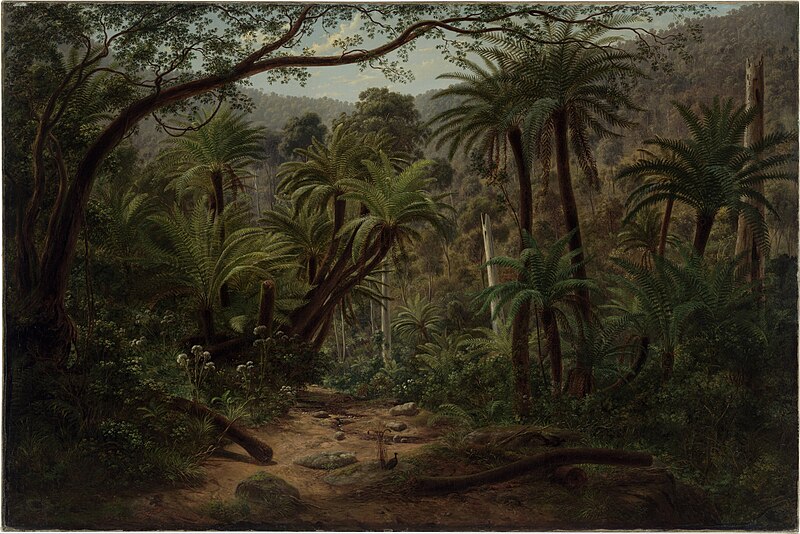 |
Ferntree Gully in the Dandenong Ranges
Eugene von Guerard, 1857 |
The modus operandi of settler society has not changed. Genocide and ecocide practices are still the dominant structure. The social and natural metabolism is intensifying. The gear is changing from business as usual to fast-tracking everything. The distribution of gain and harm of this extractive and exploitative process is made to appear as natural.
An expansionist political agenda increasingly excludes uncomfortable positions by scientists, ecologists, conservation experts and Indigenous peoples with hushing-up tactics. People speaking up about threatened species, mining, logging, carbon credits and other harm to the environment are in danger of becoming a persona non grata. Their voices or studies might just cease to exist, data might just vanish. Many whistleblowers and demonstrators are gagged and are existentially threatened. Resonance spaces for counter narratives shrink in civil society.
An inadequate public discourse and science suppression do not make for a literate citizenry. The absence of the acknowledgment of the truth of the violent legacies cannot break the prevailing ‘code of silence’.
The past still echoes in the collective psyche as unfinished business. There is an unwillingness to properly confront the uncomfortable truths about genocidal colonialism and the extractive relationship towards nature. It takes reparative justice and mindful symmetrical relations to heal the poly-traumas.
Settlers on this Earth need a fundamental reorganisation, a paradigm shift (a Copernican like revolution) to demonstrate that they are not the navel of the universe.
The Eurocentric baggage brings with it epistemic violence, exploitative relationships towards others and the ecosphere. The Western world view and practices curate our habitus and seem to be set on autopilot. Extraction, pollution and exploitation without limits has to end.
It is time to re-imagine the contemporary landscape and reconfigure the connectivity to the natural and social world.
Hore’s Visions of Nature provides another stepping stone on the path of truth telling.