Showing posts with label Coffs_Coast. Show all posts

2.3.17

The Big Blueberry on the North Coast of NSW

The coastline of Spain is known as the ‘Sea of Plastic’ ("Mar de Plástico”) (film)  It is the world’s largest plastic greenhouse complex with 350 square km of fruit and vegetables grown by immigrant  labour for the horticultural industry.

Will the North Coast of NSW become such an industrial plastic wrapped landscape?

This ‘country’ has had 229 years of extractive industries. The extraction and export of natural resources in colonial times and now leads to conflicts with residential areas.

Small scale rural landholdings populate the coast and the hinterland. The commons protects National Parks and reserves to afford biodiversity a home. The interface of nature reserves, human settlement and industrial production is that of conflict. “Residents and council do not know about a blueberry farm development until they are there”. (source)

The high rainfall area has been also ‘discovered’ by multinational agribusiness. Once, some of the Coffs Harbour area was know as the ‘Big Banana’, it seems now the North Coast is being developed into the BIG BLUEBERRY.


The cash crop is grown for export. After the land is cleared (image) and all Australian flora and fauna have been made homeless, the crops are grown with agri-chemicals (pesticide, fungicide etc). Runoff impacts the surrounding areas. The berries and the incorporated water and soil are sent overseas. The legacy remains.

Increased machine noise and traffic impact on residents and remaining wildlife.

The promise of ‘jobs’ reads more like ’The Grapes of Wrath’. It has been found that backpackers and non-English speaking background workers from o.s. are underpaid and exploited. (here, here, here)

The farm workers go, but residents are stuck in a neighbourhood that is becoming an industrial site. The conflict between locals and large corporate agribusiness interests needs attention by the regulatory bodies.

As coastal urbanisation increases, the space and resources shrink. The horticultural industry expands in Bellingen, Boambee Valley, Coffs Coast, Corindi, Crossmaglen, Woolgoolga, Repton, Valla, Valery and Nambucca. At Bruxner Park the views towards Coffs Harbour and the ocean are starting to look like the above plastic netting landscape, white plastic nets are gobbling up the green coastal landscape.

The 21st century could offer a chance to refrain from treating ‘country’ as a BIG QUARRY. A future beyond extraction and exploitation. Care for the commons, the water bodies, soil and biodiversity.

Authorities can regulate and monitor ‘land use’ and prevent abuse in the interest of all.

 
Quotes:
- A meeting at the CWA on Monday, March 13 at 7pm
“Intensive Horticulture is creeping into the Bellinger Valley by stealth and residents across the Shire will gather to discuss largely unmonitored and unregulated development of intensive horticulture as a new plantation has now become evident to worried neighbours from Valery,” Bellingen Environment Centre spokesperson Caroline Joseph said. (source)

- Valla: “There is no visual flow in Deep Creek and still pumping continues" (source)

- Repton: “A key feature of the village is the natural setting, surrounded by the Bongil Bongil National Park and Pine Creek State Forest. The conversion of land zoned R5 to provide for an agricultural development is wholly at odds with the primary objective of the zone.”
Thirty-Two separate chemicals are listed in the NSW Department of Primary Industry’s Blueberry Plant protection Guide 2015-2016 for use on blueberries in NSW to control disease and pests...Of the 32 chemicals approved one third of the chemicals are identified as likely to have a long-lasting, negative off-target impact … most disturbing is that pesticides can have both immediate (acute) effects and long term (chronic) effects on the health of people who are exposed to them. ... (The) main concern is spray drift over to nearby houses whose only water is collected in tanks and consequently we will drink.” (source)

- Woolgoolga: “The development of a blueberry farm near his property further west on Newmans Rd resulted in a reduction of kangaroos in that area.” (source)

Links:
Blueberry farm in the Shire reignites the debate, Bellingen Courier, 28.02.2017
Repton resistance  Bellingen Courier, 29.11.2015 
Like living in a war zone, abc 01.03.2017 
Australian agriculture safeguarding against climate change. Structures for larger-scale growers to cover whole paddocks or orchards. abc 04.03.2017
Warning against the deliberate exploitation of young people and visa holders, Bellingen Courier, 06.03.2017

Updates:
 
Blueberry blues: how the cash crop is causing a contamination crisis in Coffs Harbour, 29.09.2022 The Guardian  
 
Calls for royal commission as report details allegations blueberry farmers pay workers $3 an hour 3.12.2020

 Concerned residents want blueberry farms to need a DA 
“We were shocked to learn that there is no monitoring or compliance required at a local (council) level to clear privately owned,forested land or to establish intensive horticulture plantations and that this concern about unregulated development is being shared across the region,” Bellingen Environment Centre’s Caroline Joseph said... Pine Creek is dying ..." Bellingen Courier, 14.03.2017

Deregulate, deregulate - "Productivity Commission recommends a wide slash of farm red tape, except biosecurity and food safety. It also recommends agricultural land should be used for its highest value, even if that means resource development." abc rural 29.03.2017

"Europe's Dirty Little Secret: Moroccan Slaves and a 'Sea of Plastic' " or landscapes a perennial plastic greenhouses, Ecowatch 2015
 
Marine scientists fingerprint sources of nitrogen on the Coffs coast. Nearly all creeks with agriculture (blueberry, macadamia) and urban land use have (sewage) water quality issues. Bellingen Courier, 16.09.2020


Images:
Greenhouses of the Campo de Dalías, Almería Province, Spain , NASA’s Earth Observatory
Organic blueberries
The March of Business, Bellingen graffiti 
 
More images:

Mar del Plastico, Bernhard Lang

11.9.15

Car Racing in the Home of the Koala

The koala calls the North Coast forests of NSW its home. Coastal sprawl and deforestation fragment and thin their habitat. The path to the next yummy canopy becomes ever longer and more dangerous. Settlers and their industry demand roads that bulldoze their way through forests 'dripping with koalas'. Many animals are injured and killed by motorists in this process. Their packs of roaming dogs hunt and maul the threatened species. Record-breaking temperatures, "extreme weather events, such as killer heat waves, devastating droughts and intense, flooding rains" unleashed by us will not enhance the life of the koala or any other being.

This weekend it is time again to roar racing cars through Coffs Coast subtropical hinterland. The wonder of 'sustainable' motor racing will take place on forest roads between the Nambucca and the Orara river valleys. Motor 'sport' "is a glorious, lovely thing, all noise and violence and sliding sideways between trees at 100 mph." (source) Dust and noise pollution is generated in abundance.

1400 people donate their free labour to showcase this motor spectacle over four days. Wardens "will use airhorns to scare" the marsupials up the trees. "The numbers of animals that get run over are very low" we are told. (source)


"Population numbers on the East Coast fell by 40% between 1990 and 2010, and in other areas like the Pilliga Forest, the population has crashed by 70% in 10 years." (source)

According to the criteria of the Office of Environment and Heritage, NSW this event does not seem to constitute an 'activity to assist a threatened species'.


Koala, threatened species profile 

Car ploughs into spectators at Rally Championship
 
Staging Car Races in Nine State Forests of NSW 2014

Celebrating Fossil Fuel Culture on Forest Roads  2013 

Update:
Racing drivers generated a lot of dust in a landscape cracked by drought. They complained that Valla was too hard “to navigate due to excessive dust and inadequate lighting.” Maybe they will refrain from driving with ‘impaired vision’. 16.09.2015

WRC on collision course in forest habitat : Norwegian rally driver, Mads Østberg was admitted to hospital after a collision with a logging truck. FOUR crashes during September's World Rally Championships have sparked calls for a re-think of next year's event. 17.10.2015 coffs coast advocate

Image:
Koala, Brehm's Life of Animals

12.7.15

The Park Beach Reserve, Coffs Harbour and Land Care

Click to enlarge
The Park Beach Reserve is unusual for NSW because it has a remaining strip of coastal bush separating it from the 'wanna be a Gold Coast'  high rises on Ocean Parade.  In the age of rising sea levels the Australian habit of building ON the beach and erasing protective vegetation barriers should be a thing of the old days.

The mushrooming tall buildings of Ocean Parade have a slim buffer at the front and back separating them from the road (Hogbin Drive) and the glaring light pollution from a bare sport field framed by large weeds (pines). The busy road and the speeding cars gobble up the green margins. Burnout wrecks set the bush alight and garbage is generously dumped by motorists.

A wide strip of vegetation bordering the road is regularly doused with herbicide, giving the edge of the little forest a brown and dead appearance. In the latest addition to 'land care', it seems that the endemic littoral rainforest species were just hacked to the ground with no apparent reason.

Maybe flat dwellers requested a better view of the noisy road and access to the light glare opposite? All weeds have been left standing. They are working hard on making Coffs Harbour even more ugly.

29.3.15

Sponges at Diggers Beach


Coral
Diggers Beach is part of the The Solitary Islands Marine Park Coastal Walk (pdf). A suburban beach where people come to surf, swim, jog, sun-bake and empty their dogs (illegally). Rarely does anyone look at the flora and fauna at the beach. The beach serves as a backdrop for their activities.

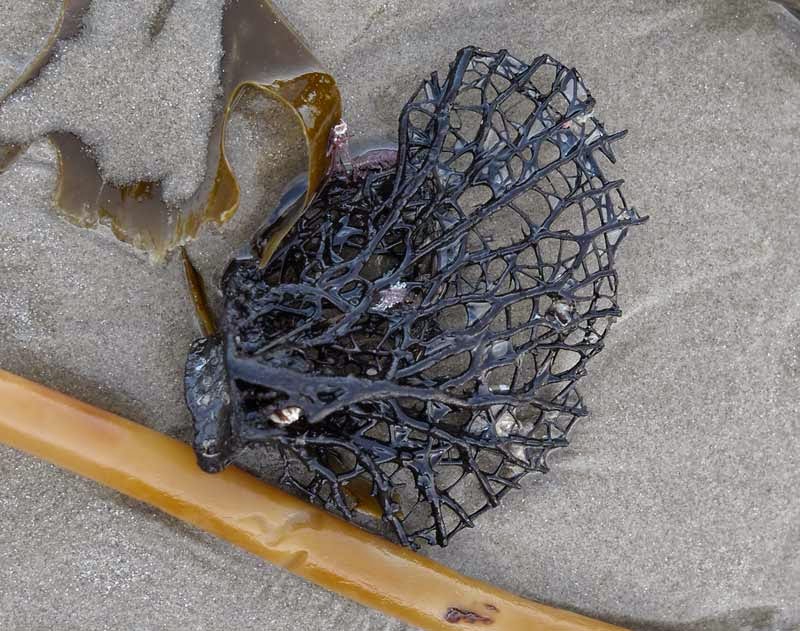
At high tide and during storms sponges are dislodged from their garden communities and end up amongst rocks, seaweed and shells at the beach. If one is observant, these ancient multi cellular organisms (Porifera) can be found in a multitude of colours and structures. They cling to the floor of the ocean and allow nutrient-containing water to circulate through their pores and channels. 

"Like all temperate life forms in the waters of southern Australia the habitat forming invertebrates in sponge gardens rely on clean water and sufficient nutrients and food particles to survive. Because many of the animals are permanently attached to the rock and unable to move around, they cannot go in search of food or flee from harm." (source)

They emerged 700 million years ago, when the oceans contained little oxygen. “The effects we predict suggest that the first animals, far from being a passive response to rising atmospheric oxygen, were the active agents that oxygenated the ocean around 600 million years ago....They created a world in which more complex animals could evolve, including our very distant ancestors.” (source)


http://www.marinespecies.org/porifera/
The WPD, the World Database of all Recent sponges ever described, is part of the World Register of Marine Species (WoRMS), a global initiative to arrive at a register of all marine organisms

http://www.nerpmarine.edu.au/
NERP Marine Biodiversity Hub

https://peerj.com/articles/901/
PeerJ: "Indirect effects of overfishing on Caribbean reefs: sponges overgrow reef-building corals"

17.11.14

Yarrawarra Corindi Beach - A walk through cultural landscapes

A visit to the Yarrawarra Aboriginal Cultural Centre at Corindi Beach. The Wadjar Regional Indigenous Gallery showcases the works of regional Indigenous artists, artisans and craftspeople.

"The Gumbaynggirr peoples have occupied the Mid North Coast from the Nambucca to the Clarence River since the Yuludarla or the Dreaming."  A persistent caring for country manufactured some stunning culturescapes. A sustainable way of life enables various biological communities to flourish in diverse abundance.

A few walks through some of the habitats in the area:
A pandanus studded coast, rich with estuaries for fishing in canoes. Elaborate stone fish traps and shell middens tell of the abundance of harvesting these waters.


The Wallum (indigenous word for Banksia aemula occuring there) heath (pdf) vegetation on coastal dunefields is stunning and unique. Wallum Heathland is unrivalled for its wealth of biodiversity. Pockets of coastal rainforest.


Plants provide rich food sources:
Yams, Blue Flax Lilies, Pandanus, Banksias and Giant Waterlies to name just a few - provide 'bush tucker'.


Many of the plant fibers are woven into strings and rope for fishing implements, carrying bags and beautiful fiber craft.


Stunning Aboriginal scarred trees remain in the coastal forests despite the deforestation, land clearing and slash and burn culture of the present day 'life style' of settler monoculture.


The Coffs Harbour Local Aboriginal Land Council just successful reclaimed a 3.7 km stretch of beach and fore dune known as Red Rock Beach (located between Red Rock and Corindi.) Hopefully, this unique environment will be safe from 'development'.


'Red Rock' or Blood Rock is a reminder of the 1880s massacres of British colonisation. (pdf)
The Aboriginal Australia Information Deficit Syndrome (AAIDS) suffers from amnesia and denialism.

The point has been reached in the anthropocene where humanity now willfully, with eyes wide open, discontinues the age old existence of humans on the Earth in a habitable and benign climate. The co-existence with other species is also terminated - bio-diversity is kicked off the planet.

With the ship of fools or Shipwreck With Spectator ( H Blumenberg ) we are steering into the end phase of a bare survival mode. So much could have been learned from a sustainable way of interacting with the indigenous Australian people and their land.


Links
Aboriginal history of the Coffs Harbour region pdf

Coastal Walks:
Yuraygir coastal walk, map
Mulloway to Red Rock Walk, pdf


Images:
All images from the outside walls of the Yarrawarra Aboriginal Cultural Centre, @InfoYarrawarra, Corindi Beach


16.11.13

Sawtell Hail Storm


Toormina and Sawtell battered by mid-afternoon hailstorm 16.11.13
Severe weather: alert for Coffs Coast and eastern seaboard. Golfball-sized hail has been reported at Bellingen. (again!) 16.11.13
Massive hail buckets down on Queensland's Sunshine Coast abc 16.11.13 
Hail damage to Coffs Coast worst outside metropolitan area 17.11.13 
Weekend hailstorm on the Coffs Coast causes millions of dollars worth of damage 18.11.13 
Hail at Sawtell November 16, 2013, 18.11.13 
Dorrigo's town centre has been blanketed in hail as a severe thunderstorm continues to track over the coast. 18.11.13
Dorrigo hail storm - 181113 
Sawtell hail,16.11.13 video

And here we go again 21.11.14 
Brisbane hail: "We had to run to get out of there, the speed of the hailstones were like bullets. The place looked like a warzone." 281114 

2021:"Apocalyptic" hailstorm. Hail up to 30cms deep in the Coffs Harbour region. The roof in Toormina mall collapses and turns into a waterfall. Any link to climate disruption?

12.9.13

Celebrating Fossil Fuel Culture on Forest Roads

The International Automobile Federation is showcasing car culture on forest roads in the Coffs Coast region. The spectacle of conspicuous consumption of fossil fuel will attract 10,000 motor enthusiasts arriving with their vehicles to enjoy the "quiet country roads and an endless network of forest trails, lush green hinterland roads, creeks and rainforest drives." They will encounter "a variety of beautiful bush settings and will find tranquil spots in the towns of Nana Glen, Glenreagh, Lowanna, Bellingen, Valla, Raleigh and Bowraville and Argents Hill." There will be the breath-taking landscapes of the Newry State Forest, Tuckers Nob State Forest and the Wedding Bells State Forest


The Mid North Coast of NSW, still has various protected refuges for Australian fauna and flora. The rich biodiversity of life is able to coexist in more or less fragmented habitats. Sprawl and the arteries of automobile dependency etch their way through 'the bush'". Logging, mining and speeding cars already encroach on the environment.

Residents living in little towns, rural dwellings or bush blocks seem to be used to the roar and dust of speeding vehicles and the local wildlife smeared across the roads. The noise pollution generated by racing cars might hardly outdo the daily chainsaws/slashers/mowers/whippersnippers/trail bikes etc.

One just tolerates things in the country...

Once the bushfire smoke from three hundred and fifty escaped hazard reductions has dissipated motorised business as usual can continue.


Traffic-Related Air Pollution, Particulate Matter, and Autism
Exposure to traffic-related air pollution, nitrogen dioxide, PM2.5, and PM10 during pregnancy and during the first year of life was associated with autism. Further epidemiological and toxicological examinations of likely biological pathways will help determine whether these associations are causal.

See also
Staging Car Races in Nine State Forests of NSW, 2014 

Noise Pollution and Vibration in the Bellingen Shire, 2015 

Update
One child dies and two other children injured in Rally Championship spectacle, the guardian 10.05.2015