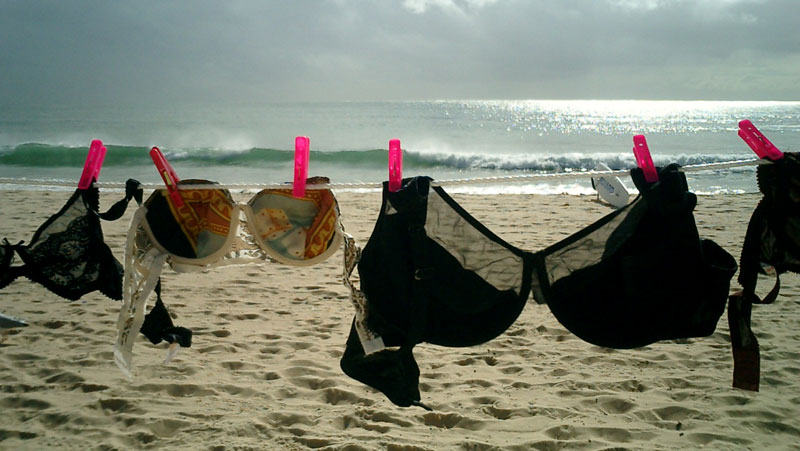
The beach is without a doubt the playground for Australians. The formation of national identity is pinned on beach culture. "Australians are islanders and we've come to expect - almost as a kind of birthright, as much as a lifestyle - a certain kind of access to open beaches..." (source) From family holidays (if not in Bali) to national surf events and festivals it is the space to be in. On 2,000 kilometres of New South Wales coast, locals and visitors showcase their beach bodies, swim, surf, play sport and empty their dogs. It appears to be the place of equality. 'Our beach' turf is fiercely defended against 'the other' (Cronulla riots). Its is the only place of summer culture.
The beach as money-making machine
Urban beaches are manicured with fossil fuel and 'renourished' with sand when climate extremes gnaw on the edges. They are artifacts with fences, furniture, nets, signs and flags. Business, surf /events/ competitions - culture, recreation space: gym/sports groups etc monetize this space and depend on it functioning. When the 'cash cow' is closed there is an outcry.
Coastal sprawl and marine urbanisation
Historically the beach turned from a place of work to a (commercialised) leisure ground with the urbanisation of the coast. 85% of people live within 50 kilometres of the coastline today. Coastal sprawl and marine urbanisation seem to concrete the coast from Cairns to Melbourne merging swelling urban centers. The large cities boast degraded biodiversity (and shark nets) and it has become relatively safe to use the beach as if it is a pool. Polluting jet skis, inflatable rescue boats and helicopters are buzzing around swimmers at city beaches for the 'safety of beachgoers'. "Beaches around Sydney, Newcastle and the Central Coast are protected by shark nets, but there is no meshing on beaches in the far north." (source)

More people in shark habitats
Population growth (sea change /tree change etc) on the north coast of NSW brings more human beings into the ocean than ever before. "Data from the Australian Shark Attack File indicates the increase in Australian shark attacks coincides with the increasing human population, more people visiting beaches, a rise in the popularity of water-based fitness and recreational activities and people accessing previously isolated coastal areas." (source)
Swimming, diving and some surfing take place in the shallow water. In the deeper water, the ocean is conquered by new adventurous forms of activities going deeper and further in (paddle ski, kayaking, surfing, diving, windsurfing and whale watching in tinnies etc) These plastic-aided adventure activities take place well beyond the flags and far from the mainland.
"Let's not forget the ocean is the domain of the shark." (source)
Various (no take) refuges for marine biodiversity have been established along the coast. Sharks keep the ocean healthy. "Sharks and other ocean predators help protect the ocean's carbon stores by keeping other wildlife in check." (source)
How the presence of sharks and risks are further increased
Heating the ocean through our combustion of biomass seems to benefit the ancient marine predator that has been in the ocean for the last 400 million years. Various human activities, like polluting rivers, throwing fish offal into the beach, fishing or tourism operators using bait to deliberately attract sharks increase the presence of sharks and risks.

Shark encounters
Recently there have been 13 shark encounters, including one death off the north coast of NSW this year. (source) Various groups react in fear and want sharks culled or repelled. "Surfers on NSW north coast call for partial cull of sharks after recent months" (source) "Long-time surfers say they are now scared to get into the water." (source) The "far north NSW communities call for shark nets, immediate action to prevent shark attacks." (source)
Extinction - we are working on it...
"Australians in particular have a peculiar, pathological feeling about sharks." (source) Ideally the species should be wiped out (like so many other Australian species) so that man can industrialise the aquatic territory without fear. In the marine habitat, the shark is framed as usual as 'the problem' that needs a 'solution'. A feel-good self-deception, also known as denial could serve to kill this 'monster' and conquer the space for human purposes once and for all. Whatever 'fix' will win, it must be cost effective and be based on technology or fossil fuel. The aim is to 'cleanse' the 'playground' of the competing apex predators (sharks, crocodiles, etc.) so that no people or business interests are harmed. It is known that there is "no “silver bullet” for deterring sharks or stopping attacks." (source). No method is 100% effective, but doing anything would soothe the mind and business as usual could continue. To turn the ocean into a shark-free pool might continue to be a pipe dream.
 Risks
RisksThe comparative 'tolls' for shark mauling, dog attacks and killings by motor cars makes one wonder, that if by that logic one ought to cull dogs and take these deadly combustion machines off the roads:
- There have been 15 shark-related incidents on the NSW coastline this year, 12 of them on the north coast. (source)
- There were 1,191 dog attacks in the 3rd quarter of 2014/2015 in NSW. (source)
- There have been 260 people killed in NSW from crashing vehicles so far this year (the injured are not included) (source)
"The day you fail to find sharks cruising your favourite beach is the day you should really start to worry." (source)
Resources:
Concrete coastlines: it’s time to tackle our marine ‘urban sprawl’
http://theconversation.com/concrete-coastlines-its-time-to-tackle-our-marine-urban-sprawl-38175
Australian Shark Attack File
https://taronga.org.au/conservation/conservation-science-research/australian-shark-attack-file
New South Wales beaches closed for 24 hours after shark attack
http://www.theguardian.com/australia-news/2015/aug/23/new-south-wales-beaches-closed-for-24-hours-after-shark-attack?CMP=soc_568
Surfers on NSW north coast call for partial shark cull
http://www.abc.net.au/worldtoday/content/2015/s4291914.htm
There is deep unease about sharks in northern New South Wales, 02.10.2015
http://www.theguardian.com/environment/2015/oct/02/could-big-game-fishing-solve-the-problem-of-shark-attacks
Ballina Mayor David Wright fears Richmond River water quality could be to blame for shark activity
http://www.abc.net.au/news/2015-07-21/shark-meeting/6635678
Recreational fishermen may have unwittingly helped attract sharks to Coffs Harbour beach 16.06.2015
http://www.abc.net.au/news/2015-06-16/recreational-fishermen-might-have-unwittingly-helped-attract-sh/6549142
A dramatic increase in shark fishing, fuelled by the lucrative shark fin market, is threatening already endangered species along the NSW coast
http://www.smh.com.au/news/national/fears-for-endangered-species-as-shark-fin-market-grows/2007/08/11/1186530673607.html
Man bites shark, The day you fail to find sharks cruising your favourite beach is the day you should really start to worry.
http://conservationbytes.com/2009/01/07/man-bites-shark/
Ellison, Elizabeth (2014) On the beach : exploring the complex egalitarianism of the Australian beach. In Horatschek, Anna-Margaretha, Roseberg, Yvonne, & Schaebler, Daniel (Eds.) Navigating Cultural Spaces : Maritime Places. Rodopi, Amsterdam, Netherlands, pp. 221-235. (PDF)
Updates:
Shields and smart buoys: new technology to protect sharks and people 06.10.2015
WA Premier tells Broome to 'quietly get rid of crocodiles' on Cable Beach to protect tourism abc 09.10.2015
One of the Margaret River region's two surf life saving clubs is experiencing a downturn in membership due to increased shark activity."Going to the beach is an inherent part of the West Australian lifestyle" abc 15.10.2015
Darimont CT, Fox CH, Bryan HM, and Reimchen TE (2015) The unique ecology of human predators. Science 21: 858-860.
The NSW government announces a $16m high-tech strategy to combat shark attacks along the 2,000 kilometres of beach line. 25.10.2015 SMH
"Recreational users want to go and enjoy the water undisturbed or without the fear of being disturbed by a shark." Professor Bax 28.10.2015 abc
Shark attacks hit NSW North Coast tourism’s bottom line 30.11.2015 coffs coast advocate
Shark nets used at most beaches do not protect swimmers, research suggests Guardian 09.02.2016
Two rare Japanese stingrays killed by Queensland's shark control program on the Gold Coast
"Successive governments have recognised the vital role the shark control program has played in protecting human life at those beaches which attract tourists from all over the world and throughout the year.” abc 22.02.2016
A crowded ocean, tiles Sydney
Man in Ocean, tiles
Shark mural, Coffs Harbour
Shark without a fin, Coffs Harbour Jetty