Showing posts with label sprawl. Show all posts

10.3.25

Floods and the Perilous March of Australian Sprawl

Australia’s urban sprawl into flood-prone regions presents a profound case of civilisation’s unchecked expansion colliding with the very processes of nature. In the philosophy of organism the world is not a static entity but an unfolding process, a constant interplay of forces. The spread of human habitation into precarious landscapes—buoyed by a reliance on fossil fuels that further intensify climatic volatility—is a prime example of what I have termed the “fallacy of misplaced concreteness”: the tendency to treat abstracted human aspirations as if they exist apart from the living, shifting reality of nature.

Cities and suburbs stretch outward in search of economic growth and comfortable living, yet the land itself is not a passive receptacle for human will. The dynamism of rivers, floodplains, and weather systems does not submit to the rigid grids of development. The increasing frequency and severity of floods, driven in part by the very fossil-fuel-intensive activities that enable this expansion, illustrate the failure to integrate our urban ambitions within the deeper rhythms of an evolving planet.

There is an irony here—a civilisation that prizes rational planning is, in fact, perpetuating a chaotic and unsustainable trajectory. This is a problem of abstraction divorced from process. The concrete realities of atmospheric instability, rising sea levels, and the saturation of flood-prone soils are ignored in favor of a narrow economic calculus that sees only the immediate, not the emergent.

What, then, is the remedy? It is not merely a technical fix but a reorientation of thought. True wisdom does not impose an artificial stasis upon a dynamic world but seeks harmony with its processes. A city that respects the patterns of water, that adapts rather than resists, is one that aligns itself with the creative advance of nature rather than standing in opposition to it. If we are to avoid catastrophe, we must cease treating the world as an inert backdrop to human activity and recognize it as the active, evolving reality in which our own future is enmeshed.

(Curated text by Alfred North Whitehead, Process & Reality, Cyclone Alfred, Bellingen Area and ChatGPT.)

24.11.23

Toxic Contamination and Dead Mangroves at Boambee Creek

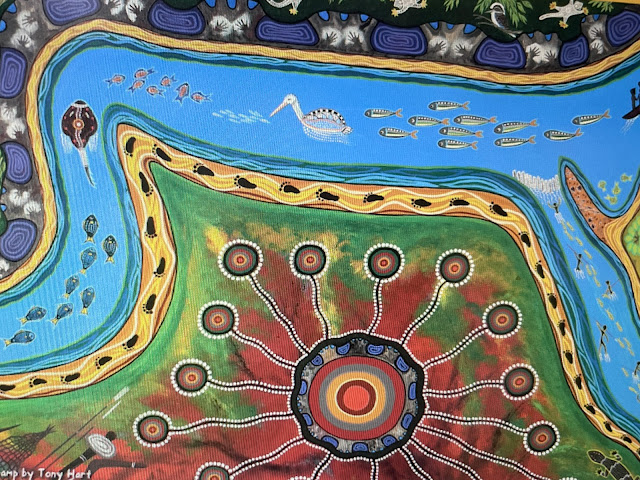
Mural, Solitary Island Coastal Walk, Bonville creek

Recently we observed  'A Cooked Intertidal Ecosystem at Sawtell Beach'. Today's local paper (Coffs Coast News of the Area) reports about 'Dead Mangroves at Boambee Creek'

The Boambee Creek Estuary is just north of Sawtell and south of Coffs Harbour airport. The creek traverses the suburbs of Boambee, Sawtell and Toormina, many roads and highways, industrial estates and resorts till finally it reaches the Pacific ocean.

The shoreline of the Boambee Creek Estuary and Boambee Beach is used as a playground for fishermen, dog owners and SUV owners.

Recently Kirsten Benkendorff (Professor at the National Marine Science Centre, Southern Cross University) and a Gumbaynggirr ranger of the Traditional Owners (Indigenous Protected Area Sea Country program) discovered the dead mangroves and neurotoxic contaminants at Boambee Creek.

"Most of the mangroves were rotting and the mud underneath was black and stinking and no live forms were visible. There was a smell of sulphur and petrol." 

"There was a range of toxic chemicals in the rotting mangrove roots, including carbon disulphide and petrochemicals like naphthalene, furan, xylene and cresol...Many are neurotoxic to the eyes, skin and lung."

"The site is not safe for people or aquatic life." (Coffs Coast News of the Area, 24.11.2023)

Update:

New research led by Southern Cross University has found a cocktail of nasty pesticides in oysters and water from one of the NSW North Coast’s dominant rivers. 12.12.2023
https://www.scimex.org/newsfeed/that-really-shucks-pesticide-pollution-threatens-shellfish-safety 

Pesticide residue from farms and towns is ending up in fresh oysters, 13.12.2023

https://theconversation.com/pesticide-residue-from-farms-and-towns-is-ending-up-in-fresh-oysters-219395

The old camp mural, Coffs Harbour, (no longer exists)dl


11.9.15

Car Racing in the Home of the Koala

The koala calls the North Coast forests of NSW its home. Coastal sprawl and deforestation fragment and thin their habitat. The path to the next yummy canopy becomes ever longer and more dangerous. Settlers and their industry demand roads that bulldoze their way through forests 'dripping with koalas'. Many animals are injured and killed by motorists in this process. Their packs of roaming dogs hunt and maul the threatened species. Record-breaking temperatures, "extreme weather events, such as killer heat waves, devastating droughts and intense, flooding rains" unleashed by us will not enhance the life of the koala or any other being.

This weekend it is time again to roar racing cars through Coffs Coast subtropical hinterland. The wonder of 'sustainable' motor racing will take place on forest roads between the Nambucca and the Orara river valleys. Motor 'sport' "is a glorious, lovely thing, all noise and violence and sliding sideways between trees at 100 mph." (source) Dust and noise pollution is generated in abundance.

1400 people donate their free labour to showcase this motor spectacle over four days. Wardens "will use airhorns to scare" the marsupials up the trees. "The numbers of animals that get run over are very low" we are told. (source)


"Population numbers on the East Coast fell by 40% between 1990 and 2010, and in other areas like the Pilliga Forest, the population has crashed by 70% in 10 years." (source)

According to the criteria of the Office of Environment and Heritage, NSW this event does not seem to constitute an 'activity to assist a threatened species'.


Koala, threatened species profile 

Car ploughs into spectators at Rally Championship
 
Staging Car Races in Nine State Forests of NSW 2014

Celebrating Fossil Fuel Culture on Forest Roads  2013 

Update:
Racing drivers generated a lot of dust in a landscape cracked by drought. They complained that Valla was too hard “to navigate due to excessive dust and inadequate lighting.” Maybe they will refrain from driving with ‘impaired vision’. 16.09.2015

WRC on collision course in forest habitat : Norwegian rally driver, Mads Østberg was admitted to hospital after a collision with a logging truck. FOUR crashes during September's World Rally Championships have sparked calls for a re-think of next year's event. 17.10.2015 coffs coast advocate

Image:
Koala, Brehm's Life of Animals

16.7.14

Hazard reduction burning kills

Particle matter pollution (PM2.5 & PM10) from 'unavoidable' burning is killing and hospitalising people every year. All beings that breathe are affected but those who are vulnerable, such as children, the elderly and sick people are more affected. Not only do they kill people who are already not in perfect adult health but they also cause illnesses including coughs, asthma and other lung conditions. They may also trigger heart attacks.

"Particles smaller than 10 micrometres (µm) in diameter (PM10) are consistently associated with increased mortality and hospital admissions for people with both heart and lung disease."

"Because of their smaller size, these particles can be inhaled more deeply into the lungs where the irritation can cause coughs, asthma and other lung conditions. Some are small enough to pass into the bloodstream through the finest blood vessels of the lungs where they can trigger heart attacks in people with existing lung or heart conditions and impact more severely on children and the elderly."
Harmful ozone causing further respiratory damage is also promoted by burning. "Hazard reduction burns are potentially significant sources of ozone precursors".

"Emissions from human activities are sufficient to cause regular exceedances of the AAQ NEPM standards."

When compared, it would appear that hazard reduction burning is more dangerous to human life than bushfires are, but that bushfires are more hazardous to property. Especially heap fires which are not 'unavoidable' could immediately be stopped to protect the air quality in rural areas. But perhaps hazard reduction burning might also be minimised to save lives with property as collateral.


Source:
http://www.epa.nsw.gov.au/soe/soe2012/chapter2/chp_2.1.htm#2.1.9

More on the rendering of large parts of the earth uninhabitable:
Many fires in New South Wales, Australia, NASA's Aqua satellite, July 11

Hazard reduction in Bongil Bongil National Park.

Local residents welcome new vegetation clearing laws with open arms.

Scientists show a drier Australia is primarily caused by greenhouse gases, thinning in ozone layer

Rainfall decline in south-west Australia linked to climate change 


Updates:
Mark Z. Jacobson. Effects of biomass burning on climate, accounting for heat and moisture fluxes, black and brown carbon, and cloud absorption effects. Journal of Geophysical Research: Atmospheres, 2014; DOI: 10.1002/2014JD021861

Sydneysiders choking on the air they breathe, SMH 082014

Hazard Reduction burns rescheduled due to health warnings about smoke, rfs. NSW, 0814

Increased air pollution from bushfires is among the rising threats facing NSW residents as global warming makes blazes more likely, according to a new report by the Climate Council. SMH 1014

Smoke from agricultural land-clearing fires linked to tornado intensity, 022015

P. E. Saide, S. N. Spak, R. B. Pierce, J. A. Otkin, T. K. Schaack, A. K. Heidinger, A. M. da Silva, M. Kacenelenbogen, J. Redemann, G. R. Carmichael. Central American biomass burning smoke can increase tornado severity in the U.S. Geophysical Research Letters, 2015; DOI: 10.1002/2014GL062826

"There is nothing left of an emu-wren after a fire, not even a pile of ash" inappropriate fires  abc

Fire hazard reduction strategy
in Tasmania targets private land for first time. Asthma sufferers have been warned to expect more smoke."You may be killed by flame, but you can just as easily be killed by smoke and you're just as dead," Mr Dow-Sainter said. abc 23.03.2015

4.11.13

Snippets

No lawn without fossil fuel

Climate
Science-denying -  production of ignorance and the public right to know.
Big Australian media reject climate science. It is not surprising therefore that levels of acceptance of anthropogenic climate change have dropped in Australia, where we have the highest emissions per person in the world.  The Conversation  011113

Mega footprint, fossil fuel turf
Sprawl
A 200 lot sub-division was approved at the site near Woolgoolga in 2010, and the developers now want to expand it to 280 lots. They also want to see a restriction on domestic cats and dogs lifted."It's a delicate ecosystem in Hearnes Lake, because it feeds into the Solitary Islands Marine Park, into an area near Flat Top Rock" abc 041113

Bushfires
threaten World Heritage wilderness west of Kempsey. The Racecourse Trail and Dungay Creek fires have now burned across almost seven thousand hectares of mainly public forest."The conditions are that dry that it's just burning through all of those normal good containments. "There are no properties under threat but there is of course World Heritage listed areas in there and the environmental impact is quite serious." abc 041113

Slash & Burn
New arson laws could see farmers charged with criminal offences. Farmers involved in approved fuel reduction burns could be charged with arson if the burns get out on control and cause unforseen damage. abc rural 041113

Meat
Growth promotants (HGP) in beef. "I've worked in the meat packing plants for many years and when beta agonists first came on the market I started seeing problems I'd never seen before, stiff sore footed cattle that kinda hurt all over, just don't want to move." China, Taiwan and Russia have also banned US beef that's been treated with beta agonists. abc rural 041113
Rural
Higher death rate for rural cancer patients. Rural patients lagging behind city counterparts on cancer treatment abc, 041113