Showing posts with label beach. Show all posts

4.10.15

The Shark Free Beaches of NSW


The beach is without a doubt the playground for Australians. The formation of national identity is pinned on beach culture. "Australians are islanders and we've come to expect - almost as a kind of birthright, as much as a lifestyle - a certain kind of access to open beaches..." (source) From family holidays (if not in Bali) to national surf events and festivals it is the space to be in. On 2,000 kilometres of New South Wales coast, locals and visitors showcase their beach bodies, swim, surf, play sport and empty their dogs. It appears to be the place of equality. 'Our beach' turf is fiercely defended against 'the other' (Cronulla riots). Its is the only place of summer culture.

The beach as money-making machine
Urban beaches are manicured with fossil fuel and 'renourished' with sand when climate extremes gnaw on the edges. They are artifacts with fences, furniture, nets, signs and flags. Business, surf /events/ competitions - culture, recreation space: gym/sports groups etc monetize this space and depend on it functioning. When the 'cash cow' is closed there is an outcry.

Coastal sprawl and marine urbanisation
Historically the beach turned from a place of work to a (commercialised) leisure ground with the urbanisation of the coast. 85% of people live within 50 kilometres of the coastline today. Coastal sprawl and marine urbanisation seem to concrete the coast from Cairns to Melbourne merging swelling urban centers. The large cities boast degraded biodiversity (and shark nets) and it has become relatively safe to use the beach as if it is a pool. Polluting jet skis, inflatable rescue boats and helicopters are buzzing around swimmers at city beaches for the 'safety of beachgoers'. "Beaches around Sydney, Newcastle and the Central Coast are protected by shark nets, but there is no meshing on beaches in the far north." (source)

 
More people in shark habitats
Population growth (sea change /tree change etc) on the north coast of NSW brings more human beings into the ocean than ever before. "Data from the Australian Shark Attack File indicates the increase in Australian shark attacks coincides with the increasing human population, more people visiting beaches, a rise in the popularity of water-based fitness and recreational activities and people accessing previously isolated coastal areas." (source)
Swimming, diving and some surfing take place in the shallow water. In the deeper water, the ocean is conquered by new adventurous forms of activities going deeper and further in (paddle ski, kayaking, surfing, diving, windsurfing and whale watching in tinnies etc) These plastic-aided adventure activities take place well beyond the flags and far from the mainland.

"Let's not forget the ocean is the domain of the shark." (source)
Various (no take) refuges for marine biodiversity have been established along the coast. Sharks keep the ocean healthy. "Sharks and other ocean predators help protect the ocean's carbon stores by keeping other wildlife in check." (source)

How the presence of sharks and risks are further increased
Heating the ocean through our combustion of biomass seems to benefit the ancient marine predator that has been in the ocean for the last 400 million years. Various human activities, like polluting rivers, throwing fish offal into the beach, fishing or tourism operators using bait to deliberately attract sharks increase the presence of sharks and risks.

 
Shark encounters
Recently there have been 13 shark encounters, including one death off the north coast of NSW this year. (source) Various groups react in fear and want sharks culled or repelled. "Surfers on NSW north coast call for partial cull of sharks after recent months" (source) "Long-time surfers say they are now scared to get into the water." (source) The "far north NSW communities call for shark nets, immediate action to prevent shark attacks." (source)

Extinction - we are working on it...
"Australians in particular have a peculiar, pathological feeling about sharks." (source) Ideally the species should be wiped out (like so many other Australian species) so that man can industrialise the aquatic territory without fear. In the marine habitat, the shark is framed as usual as 'the problem' that needs a 'solution'. A feel-good self-deception, also known as denial could serve to kill this 'monster' and conquer the space for human purposes once and for all. Whatever 'fix' will win, it must be cost effective and be based on technology or fossil fuel. The aim is to 'cleanse' the 'playground' of the competing apex predators (sharks, crocodiles, etc.) so that no people or business interests are harmed. It is known that there is "no “silver bullet” for deterring sharks or stopping attacks." (source). No method is 100% effective, but doing anything would soothe the mind and business as usual could continue. To turn the ocean into a shark-free pool might continue to be a pipe dream.

Risks

The comparative 'tolls' for shark mauling, dog attacks and killings by motor cars makes one wonder, that if by that logic one ought to cull dogs and take these deadly combustion machines off the roads:

  • There have been 15 shark-related incidents on the NSW coastline this year, 12 of them on the north coast. (source)
  • There were 1,191 dog attacks in the 3rd quarter of 2014/2015 in NSW. (source)
  • There have been 260 people killed  in NSW from crashing vehicles so far this year (the injured are not included) (source)


"The day you fail to find sharks cruising your favourite beach is the day you should really start to worry." (source)


Resources:
Concrete coastlines: it’s time to tackle our marine ‘urban sprawl’
http://theconversation.com/concrete-coastlines-its-time-to-tackle-our-marine-urban-sprawl-38175

Australian Shark Attack File
https://taronga.org.au/conservation/conservation-science-research/australian-shark-attack-file

New South Wales beaches closed for 24 hours after shark attack
http://www.theguardian.com/australia-news/2015/aug/23/new-south-wales-beaches-closed-for-24-hours-after-shark-attack?CMP=soc_568

Surfers on NSW north coast call for partial shark cull
http://www.abc.net.au/worldtoday/content/2015/s4291914.htm

There is deep unease about sharks in northern New South Wales, 02.10.2015
http://www.theguardian.com/environment/2015/oct/02/could-big-game-fishing-solve-the-problem-of-shark-attacks

Ballina Mayor David Wright fears Richmond River water quality could be to blame for shark activity
http://www.abc.net.au/news/2015-07-21/shark-meeting/6635678

Recreational fishermen may have unwittingly helped attract sharks to Coffs Harbour beach 16.06.2015
http://www.abc.net.au/news/2015-06-16/recreational-fishermen-might-have-unwittingly-helped-attract-sh/6549142

A dramatic increase in shark fishing, fuelled by the lucrative shark fin market, is threatening already endangered species along the NSW coast
http://www.smh.com.au/news/national/fears-for-endangered-species-as-shark-fin-market-grows/2007/08/11/1186530673607.html

Man bites shark, The day you fail to find sharks cruising your favourite beach is the day you should really start to worry.
http://conservationbytes.com/2009/01/07/man-bites-shark/

Ellison, Elizabeth (2014) On the beach : exploring the complex egalitarianism of the Australian beach. In Horatschek, Anna-Margaretha, Roseberg, Yvonne, & Schaebler, Daniel (Eds.) Navigating Cultural Spaces : Maritime Places. Rodopi, Amsterdam, Netherlands, pp. 221-235. (PDF)

Updates:
Shields and smart buoys: new technology to protect sharks and people 06.10.2015
WA Premier tells Broome to 'quietly get rid of crocodiles' on Cable Beach to protect tourism abc 09.10.2015

One of the Margaret River region's two surf life saving clubs is experiencing a downturn in membership due to increased shark activity."Going to the beach is an inherent part of the West Australian lifestyle" abc 15.10.2015

Darimont CT, Fox CH, Bryan HM, and Reimchen TE (2015) The unique ecology of human predators. Science 21: 858-860.

The NSW government announces a $16m high-tech strategy to combat shark attacks along the 2,000 kilometres of beach line. 25.10.2015 SMH

"Recreational users want to go and enjoy the water undisturbed or without the fear of being disturbed by a shark." Professor Bax 28.10.2015 abc

Shark attacks hit NSW North Coast tourism’s bottom line 30.11.2015 coffs coast advocate

Shark nets used at most beaches do not protect swimmers, research suggests  Guardian 09.02.2016

Two rare Japanese stingrays killed by Queensland's shark control program on the Gold Coast
"Successive governments have recognised the vital role the shark control program has played in protecting human life at those beaches which attract tourists from all over the world and throughout the year.” abc 22.02.2016


IMAGES:
A crowded ocean, tiles Sydney
Man in Ocean, tiles
Shark mural, Coffs Harbour
Shark without a fin, Coffs Harbour Jetty

27.8.15

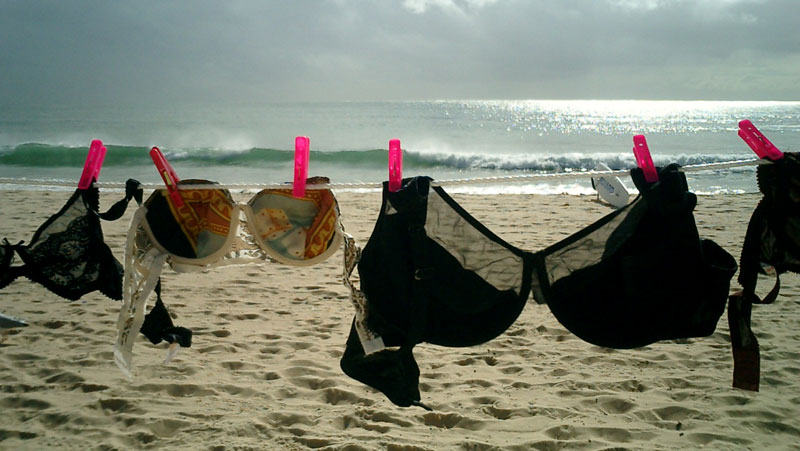
Microplastic from Clothing is Accumulating on Shorelines Woldwide


60-85 percent of human-made material found on shorelines consists of micro fibers from clothing. (source)

Plastic clothing has become the norm. From lingerie to outdoor gear, synthetic garments fill shops and wardrobes, cling to bodies and households. Synthetic fabrics (polyester, acrylic, nylon, rayon, acetate, spandex, latex, etc) are convenient and just require a quick spin.

The bright, fashionable colours of the season make the textiles obsolete by the time they leave the shop. Mending is out in a throw-away society. Mountains of old rags go into 'landfill' or end up in smelly second hand shops.

Synthetic and some natural fibers are often pickled in chemicals: toxic dyes, flame retardants, nano -silver and other chemicals in stain-proof textiles and waterproof clothing.


Garments that are washed by hand or machine shed fibers and chemicals/detergents into the water. As there is a paucity of sewerage systems in rural areas like Bellingen and the mid north coast, the effluent drains into the catchment. "Wastewater from domestic washing machines demonstrated that a single garment can produce 1900 fibers per wash." (source)

The shed micro fibers reach the shorelines. They are "micron-scale synthetic fibers, mostly polyester and acrylic, in sediments along beaches the world over." (source)

The invisible contamination of soil, water catchment and marine habitat with microplastic enters the food chain of all living creatures.


Natural fibers, untreated and of organic origin produced and tailored under ethical conditions (no land grab or exploitation) is the right choice to make...


Sources:
Accumulation of Microplastic on Shorelines Woldwide: Sources and Sinks
The Damage I Cause When I Wash My Clothes
Chemicals in clothing, Choice
Two-thirds of new clothing is plastic


Updates:

What does micro plastic less than 1mm do to animals?
Linking effects of anthropogenic debris to ecological impacts
Mark Anthony Browne, A. J. Underwood, M. G. Chapman, Rob Williams, Richard C. Thompson, Jan A. van Franeker, Published 22 April 2015.DOI: 10.1098/rspb.2014.2929

Chris Wilcox, Erik Van Sebille, and Britta Denise Hardesty. Threat of plastic pollution to seabirds is global, pervasive, and increasing. PNAS, August 31, 2015 DOI: 10.1073/pnas.1502108112
( 99 per cent of the world's seabirds species will be ingesting plastic by 2050 if current marine pollution trends continue. They starve to death from plastic fibres from synthetic clothes an other 'junk food'.)
or
Almost all seabirds to have plastic in gut by 2050, CSIRO


2.5.15

Dogs or Australian Wildlife

The majority of Australians 'vote with their feet' against biodiversity and for a monoculture of pets. Modern humans (Homo sapiens) formed an alliance with dogs early on to eradicate the local population.

Through a long process of domestication (dysgenics) they erased the wolf out of the ancient canine and ended up with an obedient dog that satisfied the desires of the master.

From the beginning, colonial society took a "dog-privileged view of the Australian landscape...The story begins with the arrival of the First Fleet. ‘From the earliest watercolours of the former prisoners, captains and surveyors, we get dogs as part of colonial life' " (source). After the introduction of 'English breeds', national identity could be established. (Leaving aside the Aboriginal Australians' culture and the dingo here).

"By the 1950s Australia ‘rode on the sheep’s back’; those who grew the wool had come to symbolise and epitomise what it was to be Australian." (source) The dog became an important factor of production to whom one could outsource mustering introduced hoofed animals.


By now one could say, the country is 'riding on the dog's back'. Having largely deserted agriculture and manufacturing, avoiding value-added activities and resorting to digging big holes, or clear cutting forests, the service industry is the sector where identity is established.

At the end of the mining boom wealth has been established for some.  For the great majority, "pets continue to power the economy". This country has one of the highest rates of pet ownership in the world, spending $1.4 billion p.a. Goods and services previously afforded for human beings only are now spent on dogs.

The dog, unlike non-human members of the great ape family, (Hominidae) has been truly included in the 'human family'. Being 'one of us', pets live the consumer's way of life and fuel the economy. The daily meat, mostly repurposed wildlife, accessories, bedding, clothing, prams, toys, medical services, insurances, vets, pet shops, dog trainers, therapists, medication, minders, groomers, hairdressers, canine boutiques, dog manicure, cafe access, tailored holiday accommodation and dogs' frequent flyers etc etc. And of course the right cars or taxi to drive the pack to the public 'loo'. Councils hold special events for dog lovers. Government collects tax. A serious economic factor with very strong interests and a lobby.

For the master the captive creature is in a hierarchical relation of permanent access. Unlike wildlife, the subordinate beast promises instant gratification for the mistresses' commands. The animal serves as a projection surface for human needs - as a friend, toy, partner, security guard, lover or punching bag. The pet owner can for once bathe in fantasies of omnipotence and power. Images of wet kisses are all-pervasive, sharing one's bed with the pack is also common. After centuries of removing the human out of the stable, people turn their dwellings back into stables for leisure pets.

The days of owning one dog are long gone, now they are hoarded in human housing, one can see dog walkers with four in harness, or outsourced to dog walkers with eight. Couples seem to express their individuality by each having two distinctive dogs. Whether people get their identity from the their decorative ornaments or priced commodity, all appear low maintenance compared to human offspring or friends.


In the 36,000 years of co-evolution of dogs and humans, the wolf has learned to manipulate the human via eye-gazing behaviour, 'puppy eyes' release a "love hormone" or "cuddle hormone" in the human being. The zombified pet owners structure their life to suit their pack. The dogs take charge.

Most pet owners in NSW seem to belong to a stay-at-home cast that service these animals 24/7. Only the best of the native landscapes will do for their 'darlings': beaches, national parks and nature reserves. They take 'a dog’s eye view of the landscape'. As the dog is mistaken for 'nature', one wouldn't want to restrain it, but let it become one with it. Unleashed, they hunt wildlife (koalas, cassowaries, little penguins, shorebirds etc) and quite frequently maul toddlers and joggers/ walkers. Should a pedestrian approach the owner, pointing out that 'dogs are not allowed here', they mutate into vicious pit bulls. Forests of signs are ignored, authorities are turning 'a blind eye' and fines are paltry.

In sub-urbia they prefer to unload  their sewage near the beach, unpack the van and let them go. The backyard does become rather smelly after some time. Full plastic bags are found on the beach, hang in vegetation or are in the drains. The majority does not pick up the sloppy poo, it stays as dung on the endless lawns on which people have their zoonotic picnics. The giant amounts of recycled meat also fuel the toxic algal blooms in the surf nicely.

Should the owners have other commitments (work) or have to attend parties, the dogs are left at home barking for hours and hours. (video) Sometimes a family toy disappoints, as puppy changes its form, it becomes a throw-away toy and a new cute baby dog is consumed. The market is also very determined by fashion influences. Should one have an outdated brand, it is time to update and dump the old one in a pound. In the holiday season many just open the door on the highway and 'the problem' is solved.


The dumped, neglected and roaming dogs in rural and peri-urban regions are then termed 'ferals'. The unwanted ballast is socialised. The 'set-free' dogs are a threat for people, wildlife and the livestock industry. From time to time mass poisoning (1080) actions take place that kill mainly the Australian endemic dingoes. No word is lost on the roaming and dumped pets gone feral.

"Australia has the worst mammal extinction rate in the world" (source) As a mega diverse, developed country people choose to entertain huge menageries of introduced animals detrimental to the endemic biodiversity. The current Australian business- as-usual trajectory will make the harsh continent even more hostile for all living beings. The intentional ignorance on climate disruption even further accelerates the extinction risk for Australian animals.

But they want pampered pooches.....


More on the family package: And then?


Updates:
The roaming dogs of Bellingen mauling livestock and pets The Bellingen courier, 19.05.2015
Have we turned dogs into lazy thinkers through domestication?
When dogs look back: inhibition of independent problem-solving behaviour in domestic dogs (Canis lupus familiaris) compared with wolves (Canis lupus)
Exporting dogs to Asia, abc 12.12.2015 
PNAS: "Bottlenecks and selective sweeps during domestication have increased deleterious genetic variation in dogs" 
 

IMAGES:
Titian, Detail of Venus and the Organ Player c. 1550 
(with Coffs Harbour sound sample, but it could be in Bellingen too)
Riding on the Sheep's Back, Blue sheep and golden dog sculpture
Public mural
Public service to collect dog feces
Trübner, Heinrich Wilhelm, Great Dane with Sausage, 1878

See also
Cura, A story about care for biodiversity
Hungry Head Beach Going to the Dogs

29.3.15

Sponges at Diggers Beach


Coral
Diggers Beach is part of the The Solitary Islands Marine Park Coastal Walk (pdf). A suburban beach where people come to surf, swim, jog, sun-bake and empty their dogs (illegally). Rarely does anyone look at the flora and fauna at the beach. The beach serves as a backdrop for their activities.

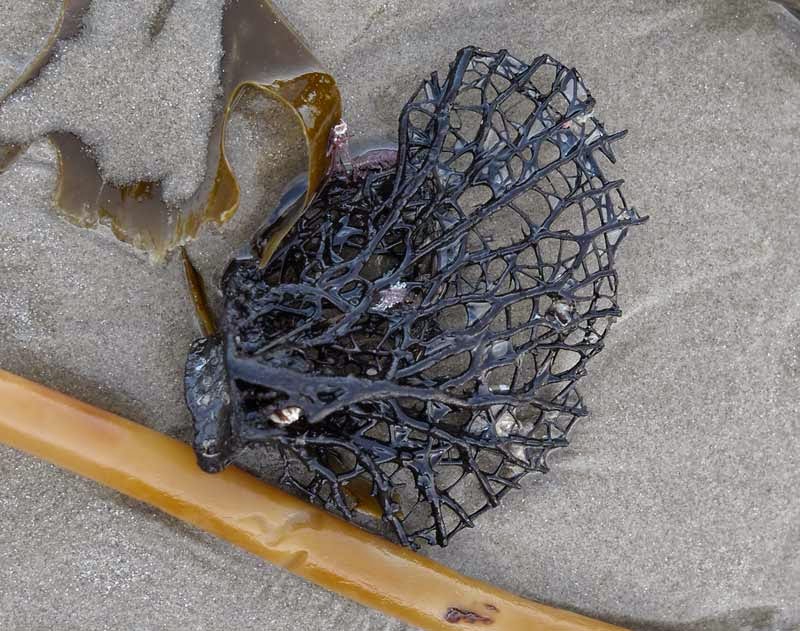
At high tide and during storms sponges are dislodged from their garden communities and end up amongst rocks, seaweed and shells at the beach. If one is observant, these ancient multi cellular organisms (Porifera) can be found in a multitude of colours and structures. They cling to the floor of the ocean and allow nutrient-containing water to circulate through their pores and channels. 

"Like all temperate life forms in the waters of southern Australia the habitat forming invertebrates in sponge gardens rely on clean water and sufficient nutrients and food particles to survive. Because many of the animals are permanently attached to the rock and unable to move around, they cannot go in search of food or flee from harm." (source)

They emerged 700 million years ago, when the oceans contained little oxygen. “The effects we predict suggest that the first animals, far from being a passive response to rising atmospheric oxygen, were the active agents that oxygenated the ocean around 600 million years ago....They created a world in which more complex animals could evolve, including our very distant ancestors.” (source)


http://www.marinespecies.org/porifera/
The WPD, the World Database of all Recent sponges ever described, is part of the World Register of Marine Species (WoRMS), a global initiative to arrive at a register of all marine organisms

http://www.nerpmarine.edu.au/
NERP Marine Biodiversity Hub

https://peerj.com/articles/901/
PeerJ: "Indirect effects of overfishing on Caribbean reefs: sponges overgrow reef-building corals"

18.3.15

Korora - The Solitary Islands Marine Park Coastal Walk


One stop along the Solitary Islands Marine Park coastal walk (map) is Korora. It is a small ocean-side suburb to the north of Coffs Harbour. Approaching from Charlesworth Bay the walk follows a steep littoral rainforest track. One knows when one is near dwellings as the weeds multiply and the sound of yapping dogs can be heard. All over NSW it seems a tradition to chuck the 'garden clippings' over the fence, into the 'bush'. They strain to distinguish themselves from this amorphous  'bush' of bio-diversity to grow a mono-culture of lawn and pretty weeds. The only welcomed animals are dogs, stuffed with native marsupial meat. The barking cacophony is not the only extension beyond their fence posts, but the diverse bush is also simply annexed as a tip. The chuck and grab formula applies all over coastal Australia - it is a frame of mind.


When the McMansions are 'just in your face' on the cliff top, there are only dead trees and stumps providing ocean 'views'. The bush reserve is simply disposed over by private interests. Coal- powered air conditioners hum along to the barking audio pollution. No solar ever in sight. The thick line of weeds emanating from these non-places get a regular dousing of pesticide. A sign reads 'These trees have been poisoned'.  Juvenile brush boxes hug the edge of the cliff site,  retaining the soil close to the walk way. This endemic coastal rain forest tree has a colourful bark and white flowers.

Leading down steep stairs to the lagoon more tree stumps grace the walk and indicate that it is a culture scape. Till in the 70s this water body has been described as 'a pristine water hole'. Now it stinks and appears to be a health hazard. "A decade on and the lagoon is choked with silt, weeds, pollution and rubbish." It is still fringed by a bit of native vegetation, if not annexed by the properties hugging the stream. A shy yellow-billed spoonbill (Platalea flavipes) is wading in the foul slime-covered waters searching for food. What option has it got but this human sewer?


More houses are directly ON the beach sprouting stumps and green lawn. Unusual white quartz, pumice accumulates here on the sand. Native Pandanus and Crinum pedunculatum scent the air in a positive way - but the stench wins.


At the beach packs of dogs are let loose. Wildlife like plovers and goannas flee to make way for these feces and urine depositing machines. Most of the poo remains. Even as a human being one does not feel that one's safety is guaranteed. The hyper abundance of canines without effective enforcement makes this a 'backgarden of pet enthusiasts' only. Australian wildlife and walkers/ visitors find themselves in a stinking, noisy and threatening place.


The ocean/surf also smells off-putting which makes one wonder about the sewage arrangements of concrete coastal sprawl. Looking back to the cliff one has spectacular views of the human-made erosion from eradicating the cliff vegetation. Landslides are just there where trees have been poisoned and killed. The beach also seems to erode rapidly in this coal-fuelled climate.


6.9.13

Hungry Head Beach Going to the Dogs

Cars shoot through Hungry Head Road, killing wildlife to get to the beach or lookout quickly.

Coastal sprawl pushes into the endemic bush sprouting lawns and exotic flora, fauna and packs of dogs.

At the beach off leash dogs run riot, most pet owners are entertaining 2-3 often large dogs. The dogs urinate and defecate as they go along the beach. Large packs of dogs roam the dunes for any possible Australian wildlife surviving there. Sunseekers do not seem to mind baking in the drenched sand.

Severe erosion, 2- 3 m high the sand has washed away. Very large wildlife supporting banksias collapse onto the beach. Black Cockatoos feed in the last remaining tall trees.
The Surf Life Saving Australia building seems to be melting into the beach. A few rocks thrown at the supporting stumps might not halt the sea level riseCollapsed stairs will soon provide easy access for motorists and their dogs again.


At all points of entry are huge signs that dogs are not allowed in this delicate area. The pet owners arriving via fossil fuel power to empty their dogs where others swim or surf must be either illiterate or lawless.

Enforcement does not seem to go further than the signs as with each year the number of exotic canines relieving themselves seems to double.

Gone are the days of Bluetounge lizards racing over the beach sand, sea shore birds resting or even nesting. Biodiversity is sacrificed to a monoculture of 'man and his best friend' from suburbia.

There is always a slight unrelaxed feeling walking along the beach as it is really a highway. Fast and powerful SUVs fly in all directions endangering the life of walkers, beach users and wildlife.

Update:
Wild dog pack ‘hunted’ down grandmother at Casuarina beach, NSW 24032015

See
Valla Nature Reserve and Urbanisation