
Image: Highway roundabouts for birds, Promted by Bellingen Area and ChatGPT
Image: Highway roundabouts for birds, Promted by Bellingen Area and ChatGPT

This 'production of space' opened up the space for burning some tyres throughout the night. Far away from civilisation and enforcement the drivers are racing though the denuded koala habitat and residential areas.
It is futile to deliberate whether the suicides of young men are unintentional or intentional. The mobility infrastructure design demands automobility and speed. The active transport desert repels pedestrians and slow (e)mobility. The traffic jam spurs rage and violence.
Society demands the acceleration of the pace of life. Commercial combustion racing events encourage all petrolheads in petrotopia.
Driving always entails a latent ‘suicide risk' in this given system. The ‘integral accident’ is inherently woven into this mode of transport and technological acceleration. It is the 'collateral damage’ tolerated by all.
Mainstream media bombards us with ‘news’ of ‘accidents’. The overexposure to the daily slaughter on the roads leads to its normalisation. Only spectacles and superlatives can demand any attention now.
Daily reporting of a house that has 'collided' with a speeding car. A group of people without armouring that 'collided' with a flying car. Just another hit-and-run. Just another normal hit-and-run. A few walking school kids ploughed off the footpath while mounting the kerb. No road is ever wide enough or has enough bollards to protect living beings from these machine operators on autopilot mode.
The concepts of the all-terrain vehicle (ATV) and the 'Sports Utility Vehicle’ (SUV) destroyed all mental guardrails for the motorist. Roads became 'so yesterday'. The 4x4 combustion machine was liberated to conquer the rugged terrain (car ads) of all non road spaces. A mindscape of ‘without any limits’ was born.
This allocation of space/time means that humans and other animals now have to dodge these ubiquitous flying bullets. Living beings are literally out of a habitat, considering how many cars end up on top of their homes.
Cars doing burnouts at night are just a matter of degree to the ‘normal’ daytime traffic of a commercialised and heavily industrialised sub-urban Bellingen/Gleniffer area now.
Links:
Suicide or accident? The hidden complexities of intentional road crashes in Australia
https://theconversation.com/suicide-or-accident-the-hidden-complexities-of-intentional-road-crashes-in-australia-248673
The Original Accident, Paul Virilio, 2007
https://www.wiley.com/en-us/The+Original+Accident-p-9780745636146
"The authors of "The Vermin of the Street: The Politics of Violence and the Nomos of Automobility" analyze how the dominance of automobiles has transformed the world into a space of exception. They argue that, since the rise of the automobile, road violence has become normalized, reducing humans to "bare life" who can be killed without consequence. Drawing on Carl Schmitt's concept of the "nomos," they argue that the road functions as a "bracketed space" where laws and ethics are suspended, similar to the "state of exception" found in concentration camps. The authors ultimately conclude that the automobile has not simply changed the landscape, but our very way of being-in-the-world, transforming the entire globe into a "global nomos" governed by the constant threat of automobility violence."
(NotebookLM summary)
Robert Braun & Richard Randell (2022) The vermin of the street: the politics of violence and the nomos of automobility, Mobilities, 17:1, 53-68
https://www.sciencedirect.com/org/science/article/pii/S1745010122007299#ks0010
After the logging and clear felling of Bellingen's forests, koalas find themselves wandering around homeless. Desperate to find suitable (private) land that has not been cleared, they have to cross an array of roads with speeding trucks and cars. Navigating this terrain they find that most '5 acre kingdoms' are sprouting monocultures of lawns and exotic weeds. The majority of local landowners keep introduced canines that keep their places wildlife free. Additionally, these pet owners walk their dogs unleashed through the 'bush' to be emptied. Delighted to spot a koala they take snapshots of the horrified marsupials clinging to a tree by the roadside. They are then tagged and spread around on proprietary platforms.
Data from the South-East Queensland Wildlife Hospital Network could be an indication about the main mechanisms that are making koalas in 'the wild' extinct. Although there is a sparsity of data for the Bellingen/Gleniffer area, one could assume similar trends for this area. Industrial logging of 'The Great Koala park' is a rapid disruption to all forest biodiversity. Unrestrained sprawling human settlements with their associated roads/cars and dogs are also making Australian species extinct.
"After European colonization in 1788, more species have become extinct in Australia than in any other country on Earth (Australian Government Department of Agriculture Water and the Environment, 2022)."
VEHICLES
The wildlife around Gleniffer Rd. and Roses Rd. have experienced a 'massacre' after the 'upgrades' (for logging machinery and tourist access). Australian wildlife are smeared along the asphalt on a daily basis. The externality of this mobility form is called 'roadkill'.
When koalas are hit by motor vehicles they are predisposed to head trauma and fractures to the skull and jaw. "Koalas who had been attacked by a dog, fallen from a tree, and/or been hit by a motor vehicle were more likely to be euthanized or found deceased than released."
DOGS
For koalas, the main complications of a dog bite injury often include infection, torso fractures and zoonotic organisms carried by dogs. "Despite almost 50% of households in Australia having a pet dog, there is limited research on the human management of pet dog and wild koala interactions." The system is also lacking management strategies to prevent dog attacks on koalas.
This area has no wildlife hospital nearby and no data/ studies have been conducted on the impacts of sprawl ( logging, settlements, roads, cars and dogs).
In 2020, the NSW Parliamentary Inquiry into Koalas found that koalas will become extinct before 2050 with the present regime of 'business as usual'. First the thylacine, then the koala, then...
Charalambous, R., Descovich, K. A., & Narayan, E. J. (2024). Identifying Trends in Admission and Release of Wild Koalas in Veterinary Clinics Throughout Queensland, Australia. Society & Animals (published online ahead of print 2024). https://doi.org/10.1163/15685306-bja10220
Road and dog density contribute to the extinction of koalas
https://www.nature.com/articles/s41598-023-40827-w
Dissanayake, R.B., Stevenson, M., Astudillo, V.G. et al. Anthropogenic and environmental factors associated with koala deaths due to dog attacks and vehicle collisions in South-East Queensland, Australia, 2009–2013. Sci Rep 13, 14275 (2023).
Bellingen area stripped bare?
Bellingen council is in the process of producing a CBD Master Plan for Bellingen, Dorrigo and Urunga. “A long-term vision and implementation strategy will be outlined for guiding growth and change in an area." The plan will be used to implement “ land use, building density, public spaces, mobility, sustainability, and heritage.”
These long-term 'visions' and actions will have implications for settlers, Indigenous peoples, visitors and more-than-human lifeforms. Stakeholders were asked to ‘share their ideas’ (consultation) with consultants and council. Biodiversity was rendered voiceless.
A strategy for growth (business as usual) and change (unspecified) ”will influence the future appearance, atmosphere, and functionality of the town centres”
Bellingen is a small town, located on the Mid North Coast of New South Wales. It has a long history of (rainforest) timber extraction. Like most other Australian sprawling towns it is (totally) fossil fuel/ car dependent. Users of the CBD obtain their stuff there and drive to their homes or short term accommodation. All roads are congested and constantly have to be rebuilt to accommodate the increasing traffic.
The idyllic scenery
A drive in the scenic countryside used to be a big drawcard for visitors and boosted the income for the service industry. The cruise past forest canopy from the coast to mountain rivers and waterfalls funneled money into town.
It is these surroundings, the ambient milieu, that gave the small town its charm. Showcasing its physical (rich biodiversity) or social settings (some non mainstream culture) put the place ‘on the map'. It is not a few shops, but the setting, the relational context that gives a 'thing' its value.
Stripped bare - Native forest governance
The NSW state government’s Forestry Corporation has made the decision now to log and clear-fell vast areas of forests surrounding the area before some are declared a Great Koala National Park. Bellingen/ Gleniffer is now surrounded and locked in by industrial forest logging sites for years.
The degradation and destruction of Bellingen’s 'frame' will have impacts on the “the future appearance, atmosphere, and functionality of the town centres.”

The habitats of plants and animals are being stripped bare while timber is being extracted with the aid of fossil fuel machinery and tax dollars to subsidise these destructive projects. Untold living creatures lose their homes and are being pushed onto the newly updated logging roads to become 'roadkill'. Diverse and endemic remnant flora and fauna are wiped out to make way for a monoculture plantation with the aid of pesticides and lingering fires and smoke pollution.
Residents, visitors and businesses that have chosen this country location find themselves next to industrial sites with mega industrial machine pollution, eroded, dangerous extraction roads and stranded assets. This invasion disrupts and absorbs the lifetime of the residents and carers who are committed to refraining from degrading Australia any further.
The violent destruction of bulldozing ecosystems entails noise, dust clouds, pollution and expulsion. It is the offloading of the externalities, so that the native forests can be sent overseas in the form of wood chips. Voiceless nature undergoes 'dispersal'.
Forest logging robs Australian animals of food, shelter, and breeding areas and threatens their survival. Unique endemic plants and remnant vegetation ‘get under the wheels’ of logging machinery.
Even in 'normal times’ forest-dependent biodiversity is threatened by out of control land clearing, invasive species, cars, pets, pollution, disease and weather extremes due to climate disruption cause by burning fossils.
Native forest logging makes bushfires worse and renders bushfires harder to control. Out of control fires hasten ecosystem collapse.

Wipe out
The industrial extraction of the 'stuff' called timber is torn out of the heart of a complex web of life. The irretrievable evolutionary process of 3.7 billion of years which appears to us as imperceptibly slow motion is just wiped out.
Our present (perception) has an endless past incorporated in it. The bureaucrats/loggers are only able to see the thing called ‘wood' for export income and votes. With this mind frame an open future is foreclosed and the future takes on a necessary trajectory.
Land use vs Country care
Country was managed for 65.000 years (long-termism) with Indigenous knowledge systems of relationality and connectivity. Settler-colonial society encountered a 'pristine' environment. In a very short time of 236 years since European settlement the 'state of the environment' can be summed up as one of degradation and extinction. "More than half of NSW forests were lost since 1750 and logging ‘locking in’ species extinction". (source)
“Our inability to adequately manage pressures will continue to result in species extinctions and deteriorating ecosystem condition, which are reducing the environmental capital on which current and future economies depend. Social, environmental and economic impacts are already apparent.” (source)
The entire Australian environment is deteriorating due to pressures from rapid resource extraction and expansion, climate disruption, habitat destruction, invasive species and pollution.
To squander one’s own environmental capital is maladaptive behaviour, that prevents one from making adjustments that are in one’s own best interest. To destroy the basis of existence is suicidal, unless there is more ‘new found land’ or another planet waiting around the corner.
The speed of exploitation and its associated expansion in spacetime are escalated by the ubiquitous economic dictates. It is an out of control system without functioning guardrails.
“That things are "status quo" is the catastrophe.”
― Walter Benjamin, The Arcades Project
Polycrisis
Ruthless extraction and degradation of one's own existential basis is taking place in the context of an emerging polycrisis, the simultaneous occurrence of several catastrophic events.
Global warming from fossil fuels, putting the chain saw to the tree of life (biodiversity) and pollution of the biosphere are just a few of the intersecting global environmental crises of the collective impacts of one species.
The ongoing ecological depletion on local, regional, and global scales, is seen as normal. The next generations of living entities will just have to deal with this ‘shifting baseline’ of a scorched, barren Earth, devoid of any life as far as the eye can see.
This project is threatening the fabric of complex life on Earth. A 'long-term vision' of a 'master plan', even of a local area, must take the existential risks to humanity and life into account.
It is essential to invoke the precautionary principle to do no social harm and environmental damage in the light of an avalanche of scientific reports and pledges.
Growth, intensification of extraction and expansion of living space constitute the script and the mental landscape of the settler.
The 'superior land use' argument has been used to justify the genocidal violence and ecocide of the colonised diversity of life, replacing it with a monoculture of livestock, plantation crops and pets.
The “logic of elimination”, (Patrick Wolfe, 2006) of the expanding colonial scheme goes hand in hand with the denial of existence (e.g. Indigenous peoples, referendum, forest surveys, data sparsity etc) and imperial governmentality.
The state of the planet demands attention and care. A facing up to the unsettling 'long present' of denial. Ending the undisturbed slumber of collective amnesia.
“Australians haven’t actually started living on this continent like they are from here and they have a responsibility of custodianship.” Richard Swain
As we are sliding into creeping collapse at an accelerated speed the presuppositions of the global governance of the biosphere have to be interrogated to produce strategies of bare survival possible in a post-democratic society where regulatory capture is the norm.
The council, Bellingen Chamber of Commerce, the tourism industry, the short stay lobby and all the other ‘stakeholders’ could position themselves to keep Bellingen’s ecosystems in a healthy state. Eradicating forests around Bellingen/ Gleniffer will not foster place identity.
Bellingen placemaking without the buffer of healthy forests and ecosystems would just be another bare drive-though town ‘in the middle of nowhere'.
"First life, then spaces, then buildings – the other way around never works” Jan Gehl
Links:
M.Ward et al., 2023, The impacts of contemporary logging after 250 years of deforestation and degradation on forest-dependent threatened species
DOI:10.1101/2023.02.22.529603
Patrick Miner et al., 2024, Car harm: A global review of automobility's harm to people and the environment, Journal of Transport Geography, Volume 115, February 2024
Patrick Wolfe, 2006, Settler colonialism and the elimination of the native, Journal of Genocide Research Volume 8, 2006 - Issue 4
When I hear Waterfall Way (drive) in Bellingen, I think road building, road widening, giant fossil fuel machinery, yet another upgrade, congestion, aggro motorists, speeding drivers, 'accidents', dead motorists and roadkill.

WFW is the main road into the SUV-centric town with either no or very few footpaths and cycle paths. A little town where time stands still, where climate change and extinctions are foreign gobbledygook.
As the population growth outpaces local infrastructure, ongoing 'upgrades' are taking place. The latest is to sink a footpath/cyclepath along WFW, on the tree lined Heritage Avenue between the Butter Factory and the CBD. Trouble is, the 'living heritage' has to go. Anyway, these old trees "reached the natural conclusion of their life cycles" They clashed with the “proposed footpath alignment and infrastructure of power lines and road widening” added to their demise. Many trees will have to go so we can “breathe new life into this important entry statement for Bellingen township.”
Standing in the traffic jam motorists seem oblivious to the numerous fossil fuel machines slowing traffic and engulfing wood ducks and people in dust and pollution.
After the 'living heritage' is ripped out, chopped or mulched, the construction of the 2.5-meter-wide shared cement path for pedestrians, cyclists, and wheelchairs is taking place.
A thick layer of 'the most destructive material on Earth' is smeared over the soil. Carbon dioxide emissions, climate change, topsoil and urban heat were off the agenda in this mobility design.

Of course there will be an offset for the lost canopy/habitat elsewhere. Where is the energy consumption balance sheet for all the fossil fuel machinery, the concrete, the idling vehicles to make walkability and 'connectivity' possible? Why were permeable surfaces not considered?
I can see golf carts racing along the footpath now and 'enhanced safety' in “the pedestrian-vehicle conflicts near sporting fields," by just parking on the new footpath.
Make Bellingen a carpark! More roads, wider roads and more parking Pt. 2
 |
| Pedestrian access to the toilets, Church St. |
 |
| Parking on tree roots and garbage, Church St. |
 |
| Bellingen car park, Creek Ln, still with trees. Google image 03.2023 |
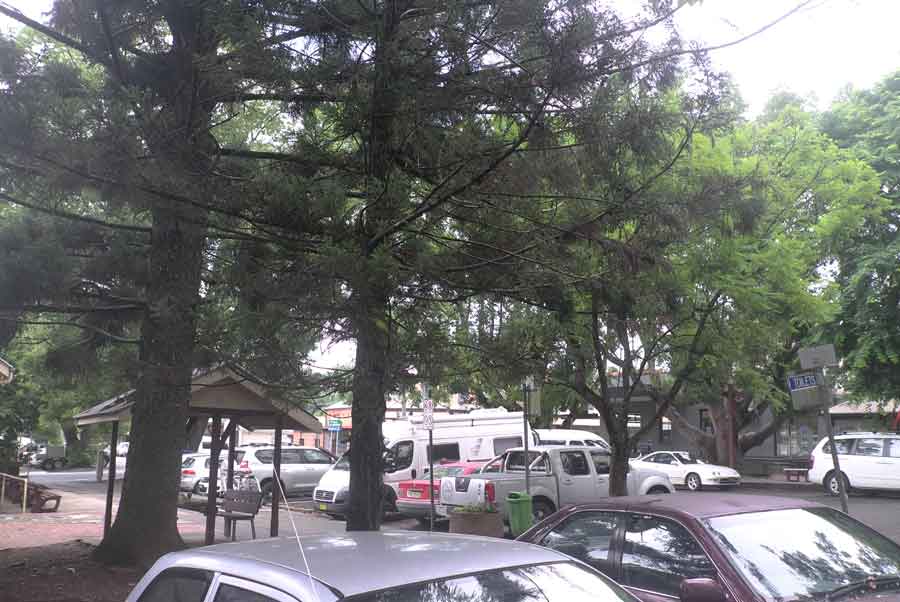
Sprawling suburbia is deprived of public forms of transport. Private fossil fuel mobility is encouraged and choosen. The town runs on petrol, plonk, meat and timber. Motorists' expectation is carpet to carpet mobility to not get their R.M.Williams muddy. In between there is a lot of AC idling and cruising to find a big enough parking spot. Monstrous SUVs speed though town to fight for parking. Tree roots are crushed by the weight of 2,000 kilograms of vehicles. The oversized tanks park right across the access route to the toilets as well.
With the growth of the obese-sized vehicles grows the hunger for more and wider roads. It is insatiable. Above all parking, getting stuff or dumping the kids or dogs is the most important issue in town.
Roads are congested and aggressive, frustrated motorists harass non motorised living entities and smaller, slower vehicles. The jam-packed CBD roads are rich in ambient particulate matter pollution. The Al fresco crowds seem to suffer from anosmia and look the other way when large bull haulers and timber trucks fly through the narrow main street.
There are already many free car parking opportunities to store private vehicles in public spaces. But now there is a brand new car park smashed into the landscape. Residents seem blissfully unaware that in the middle of a climate emergency many native mature trees magically disappeared and the soil surface was sealed. One just smeared asphalt over the 'dirt'. A very large area of impervious surfaces has been constructed after months of heavy fossil fuel equipment made a racket next to the adjoining park and creek. The new treeless hardscape will not provide any shading canopy and there will be no extra cost of blowing nasty leaves from the car park.
 |
| New car park adjoining creek and park, Bellingen |
This diy urban heat island will increase temperatures, leading to heat stroke and heat exhaustion. Deprived of shade (which previously existed) in a concrete, tar and asphalt environment it will directly influence the health and welfare of residents and wildlife. Rain and runoff will run over the hot surfaces, drain into the creek and increase the water temperature there. Biodiversity will exit, despite the beautification of three lomandras.
Leafy affluent neighborhoods are shady and have resilient mental health. Bare degraded surfaces go with deprived neighborhoods. They do harm to all people and other animals.
 |
| Car park beautification, 03.2023 |
Car centric culture demands more of the same: 'Fix the roads' (lobby), free parking everywhere and no speed checks OK! It is desperately hanging on to dinosaurian ways.
Elsewhere in the civilised world they are phasing out private fossil combustion mobility in urban centers. They are creating equitable public spaces that are safe for all participants. Enforced speed reductions are now widespread. Shady footpath (What's that?) and cyclepath infrastructure joins sustainable public transport. Bicycle parking racks encourage pollution free mobility. Road trauma in the form of 'the daily death toll', maiming and roadkill could even be eliminated as well.
It is not called ’ man-made climate change' for nothing.
Community Climate Action Plan
https://www.bellingen.nsw.gov.au/Community/Sustainable-Living/Community-Climate-Action-Plan
"We are now in a critical decade for urgent action with the window to keeping global warming to below 1.5°C and to averting devastating climate impacts rapidly closing."
Bellingen Shire Climate Emergency Program, 2020 – 2030
https://www.bellingen.nsw.gov.au/files/sharedassets/public/files/environment/adopted-corporate-carbon-plan-final.pdf
“Are we building harder, hotter cities?
https://pce.parliament.nz/publications/are-we-building-harder-hotter-cities-the-vital-importance-of-urban-green-spaces/
Update: Residents elsewhere swap parking spaces for extra trees "We are really starting to see trees become essential elements of streets”
https://www.abc.net.au/news/2023-03-25/trees-replace-parking-spaces-hobart-street/102135698

A system can only see what it can see. It cannot see what it can't see. Nor can it see that it cannot see what it can't see. Niklas LuhmannWarehouse logistics topography

 |
| “Not TV or illegal drugs but the automobile has been the chief destroyer of American communities.” ― Jane Jacobs, Dark Age Ahead |

The touristic gaze and imaginary shape and mediate our knowledge of and desires about the rest of the planet. (Franklin and Crang 2001 PDF )Masses on the move
"In this young, mostly white, ahistorical, neoliberal utopia of the imagination, anyone can go anywhere."( source)

Words can be like tiny arsenic capsules; they are swallowed unnoticed, they seem to have no effect, and after some time the poison effect is there. (own translation) Victor Klemperer, Lingua Tertii Imperii LTIFraming semiotic landscapes of the self
If we manage to persuade a Democrat every day to use a word we have given him, we can win. Michela Murgia
The frames, or semantic networks
have a plasticity. The coherent structure of reasoning, language,
memory can be re-framed within the cerebral localization. The recipient's internal structures of the mind
can be changed. Agenda setting mainstream media, political campaigns,
ubiquitous ads and think tanks flood our minds. Time poor and desperate
to reduce complexity, we lack the resources to stop, filter and evaluate
our resonance to the information and pictorial avalanche. 'Advertisers '
operating with the power of the narrative reduce complexity for us
and bind the message to our emotions. The in- and exclusion mechanism of
our filter (reframing) and the resulting actions are not always
rational. (source)

Story-telling fiction
The spaces of the landscape and mind travelled through here without
CO2 mileage have aimed to demonstrate that language determines thought and
that linguistic categories limit and determine cognitive categories and
actions. (source) The grand narrative of (neoliberal) economic theory might just turn out to be another story-telling fiction giving legitimacy to the present governance regime.
The
beautification of places and its representation on social media has
become an integral part of driving the growth machine."The
aestheticisation of the economy delivers the motivational fuel. We
could say that homo aestheticus has become homo oeconomicus’s best
friend." (source)
Incalculable risks
Instead
of hastening into more business as usual, one could stop and
examine the underlying presuppositions of life. At the moment we are sawing off the branch we are sitting on in order
to sell it. The happy few benefit from the destruction of our life support system the biosphere. There is a lot of
unfinished
business: Extinction, Hothouse Earth,
confronting the silence of the colonial past,
inequality, depriving future biota, the 'collateral damage' of mass
mobility, the withering of
rights and the nation state and a voiceless nature. At the moment we are
steering head on into incalculable catastrophic risks on a global
scale. (source)
Transformation
“To secure a sustainable future, we
must change how we live. [This] entails major transformations in the
ways our global society functions and interacts with natural
ecosystems.”(source) The possibility of visualising a future at all, a will to care for the self and country. Naming a telos, free speech (parrhesia) and the refusal to react to pressures.
Not in our name!
In various cities (Barcelona, Hamburg, Venice, etc) people resist "turning the whole city into a
brand for the benefit of wealthy residents, business elites and
tourists." Not in our name! is jamming the gentrification machine. (source)
Putting the home and the self under the hammer Pt.I
Links:
Pierre Bourdieu and Loic Wacquant, NewLiberalSpeak, 2001 Radical Philosophy
Adrian Franklin and Mike Crang, The trouble with tourism and travel theory? 2001 PDF
Victor Klemperer, Language of the Third Reich, LTI: Lingua Tertii Imperii. Continuum Impacts. ( A Philologist's Notebook")
Andreas Reckwitz: “Creativity has become a kind of performance pressure”, The Goethe-Institut interview 2013
Spratt,
David; Dunlop, Ian. (2019). 'The Third Degree: Evidence and
implications for Australia of existential climate-related security risk (PDF) (Report). Breakthrough - National Centre for Climate Restoration.
Thurlow, C., and Jaworski, A. (2011). Tourism discourse: Languages and banal globalization.
Vogl, J. (2019).
(History of) Economic Knowledge Freed from Determinism. Erasmus Journal for Philosophy and Economics, 12(1), 73-92.
https://doi.org/10.23941/ejpe.v12i1.409 (PDF)
Rich Things: How Tourism, Sneakers, and Museums Make the Economy of Enrichment, Interview with Luc Boltanski and Arnaud Esquerre, 2019, 032c
The fall of Prague: ‘Drunk tourists are acting like they’ve conquered our city’ The Guardian, 2019
Gold Coast has 'lost its mojo' as development and population boom throws character into question, The Guardian 2019
Climate crisis: 11,000 scientists warn of ‘untold suffering’, The Guardian 2019
Flooded Venice had tourists taking selfies and residents in tear, The Washington Post, 2019

Images:
Fibre structure over water, EU
Make Art not War, public mural, EU
Car poster, AU
Tourist gaze, EU
Pixel man, street art, Berlin
Homo sapiens skeleton, church installation, Adel Abdessemed, Berlin
Thylacine hide, EU
Update Nov. 2020:
Ecotourism fans may be in it for the social posts
Justin M. Beall, B. Bynum Boley, Adam C. Landon, Kyle M. Woosnam. What drives ecotourism: environmental values or symbolic conspicuous consumption? Journal of Sustainable Tourism, 2020; 1 DOI: 10.1080/09669582.2020.1825458
Update Feb. 2021
Bellingen Shire branding strategy seeks to capture the spirit of our place. Gumbaynggirr people: ""Truth-telling is what will define our spirit," Bernard said, citing the need for acknowledgement of the old wrongs, like the massacre in Fernmount, the destruction of songlines, the felling of ancient trees.There's also the fact that we have a plaque dedicated to the first white child born in Bellingen, but nothing commemorating the strength of the Indigenous women who have birthed children in the valley for millennia." Bellingen Courier, 6.2.2021
Bellingen Shire Branding Project

“Fine particles show larger health impacts compared to their larger counterparts and at the young age children are more susceptible to particulate pollution, suggesting a clear need for precautionary measures to limit their exposure during their transport along the busy roadsides…Children could be at risk of breathing in some nasty and harmful chemical species…One of the simplest ways to combat this is to use a barrier between the in-pram children and the exhaust emissions, especially at pollution hotspots such as traffic intersections, so parents should use pram covers if at all possible.” (Source)




 Risks
Risks

