
The camphor trees of Church Street, Bellingen are to be cut down. ”The war of the camphor laurels” has been causing local outrage for years. The large trees are throwing some shade on cafe visitors and motorists on a side road reducing the heat island effect.
In the collective imagination, the iconic ornamental giants are synonymous with ‘the beautiful pristine picturesque Bellinger valley’. Postcard-views show cow pastures framed by thick stands of camphor trees hugging the waterways.

For others they are an out of control invasive noxious weed that have reduced local biodiversity of the entire area. When bush regenerators eradicated camphor trees and planted endemic species, heritage enthusiasts sprang into action: “ In some cases, bollards were burned out and boundary chains cut to allow visitors to drive their vehicles onto the fragile banks, crushing native seedlings and causing erosion damage in the process.” (source)
In the social imaginary the introduced flora belongs to the foundation myth of the region. After white settlers cleared the biodiversity of the rainforest valley and replaced it with a pastoralist monoculture, the need for shade became apparent. The giant trees promised instant shade in the fertile flood plains for the British antipodeans and their cattle.

”Ruthless clearance of native vegetation in the late nineteenth and early twentieth centuries created the desire to plant exotic trees such as Cinnamomum camphora in urban and rural settings for practical and aesthetic purposes… (The tree ) “was also highly esteemed for its ability to quickly provide shade for dairy cattle in the denuded former-rainforest lands of sub-tropical north-eastern New South Wales…” ( B. J. Stubbs, 2012)
The Asian tree was intentionally introduced in 1822 as an ornamental tree for use in gardens and public parks. Additionally colonial Acclimatization Societies founded after 1860 aimed to ‘acclimatise’ the European settlers by introducing foreign flora and fauna. Botanic gardens aided in the human-mediated introduction and spread of the species.
Settlers longed for ornamentals “throughout the Australian colonies to enrich the Australian flora” (source).

The 19th Century ‘panacea’ became entirely out of control after the demise of the dairy industry. “It was generally recognised by the late 1990s that camphor laurel was well and truly out of control and had become a major environmental problem in parts of eastern Australia. This was a consequence of several decades of landuse change accompanying the decline of dairy farming, and the associated lessening of weed control on the former dairying lands… It has spread uncontrollably across that region, competing successfully with native regrowth, and forming veritable forests on abandoned pasture. “ ( B. J. Stubbs, 2012)

The neglected and degraded pastures were then bought up and planted with bamboo and other exotics, while the other invasive weed problem remained. Today the mainstream public and private ’solution’ to the river-hugging non-native species is pesticide. In the war on weeds all unwanted growth is doused with a glyphosate-based weed killer, a 'probable human carcinogen'. The new ‘panacea’ to get rid of the last/past folly.

"Inter-continental and inter-taxonomic variation can be largely attributed to the diaspora of European settlers in the nineteenth century and to the acceleration in trade in the twentieth century. " The European diaspora creates an "unprecedented intensity of human-mediated species exchange (which) leads to the homogenization of floras and faunas, re-defines the classical boundaries of biogeography and has far-reaching implications for native biota, ecosystem functioning, human health and economy...The pathways by which alien species are introduced into new areas are also changing rapidly, in particular through increased global trade, tourism, agriculture, horticulture, and the construction and formation (for example, through climate change) of new transportation corridors, such as the opening of the Arctic Ocean shipping routes.” (Source)

Cacti are the contemporary 'must have' 'must spread' alien species wave unleashed on the area.
Deregulation of biosecurity and the hunger for horticultural exotics prepare for the extinction of endemic biodiversity. “…There is an urgent need to implement more effective prevention policies at all scales, enforcing more stringent national and regional legislations, and developing more powerful international agreements.” (Source)
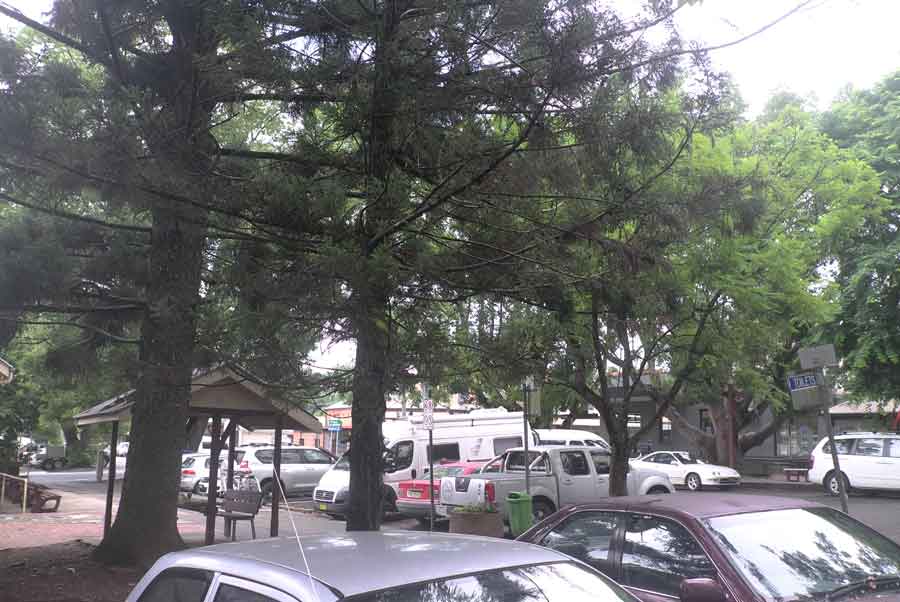
Back to the iconic heritage trees in Church St and the false dilemma in the collective imagination.
The street is the only shaded cafe strip in town where cars should go 10 km/h but 40 km/h is recommended. A giant car park come turning circle where motorists sit with their packs of dogs and blow exhaust fumes into each others' lungs.

The large camphors are caged in planter boxes. (bollards) The roots lifting the pavers have been lovingly smeared over with tar. Like many other mature trees (crammed in cement) in Bellingen they do not look healthy. Their branches are mutilated so not to interfere with dangling power lines and property.
On the opposite side of the cafe strip the toilet block is also set among large trees. Their root network is abused as an overcrowded car park. ‘Access’ to the amenities means dodging a lot of SUVs.

Chopping the giant weeds would liberate Church St. for more fossil fuel vehicles. More neatly paved impervious spaces for cars. A car-centric tabula rasa. In a town where nothing goes without fossil fuel mobility this is the most likely outcome. After the $836,175 chop all motorists, shade hugging or biodiversity loving will be able to park there at ease. Should anything crack though the cement - a good spray will help.

Walkable, car-free and livable environments are as yet unthinkable in this cultural artifact. People-centred public lounge rooms with street furniture, designed to ‘human scale’ with endemic tree shade coverage optimised and impervious surfaces eliminated to stem the uncanny anthropogenic heatwaves are in the realm of dreaming.

Sources and inspirations:
Brett J. Stubbs, Saviour to Scourge: a history of the introduction and spread of the camphor tree (Cinnamomum camphora) in eastern Australia , 2012 (pdf) (flipbook)
"No saturation in the accumulation of alien species worldwide" Nature Communications 8, Article number: 14435 (2017) doi:10.1038/ncomms14435
http://www.nature.com/articles/ncomms14435
Heritage trees are on the chopping block, The Bellingen Shire Courier-Sun, 13.02.2017
Bellingen Town Centre Beautification, create.bellingen.nsw.gov.au
Henri Lefebvre's The Production of Space, Donald Nicholson-Smith trans., Oxford: Basil Blackwell. Originally published 1974. 1991, (pdf)
John Urry, Consuming Places (1995), (pdf)
Global movements and funding cuts a threat to biosecurity in Australia, abc 02.2017
Review of Australia's Intergovernmental Agreement on Biosecurity, IGAB, 12.2016 (pdf)
The Cars and Trucks That Ate Bellingen
Updates:
"Suitable replacement trees" will morphe into more car parking: “Affiliated works included formalising car parking and planting of replacement trees which occurred by way of community input via a working party." Bellingen Courier, 13.03.2017


