Showing posts with label pesticides. Show all posts

2.3.17

The Big Blueberry on the North Coast of NSW

The coastline of Spain is known as the ‘Sea of Plastic’ ("Mar de Plástico”) (film)  It is the world’s largest plastic greenhouse complex with 350 square km of fruit and vegetables grown by immigrant  labour for the horticultural industry.

Will the North Coast of NSW become such an industrial plastic wrapped landscape?

This ‘country’ has had 229 years of extractive industries. The extraction and export of natural resources in colonial times and now leads to conflicts with residential areas.

Small scale rural landholdings populate the coast and the hinterland. The commons protects National Parks and reserves to afford biodiversity a home. The interface of nature reserves, human settlement and industrial production is that of conflict. “Residents and council do not know about a blueberry farm development until they are there”. (source)

The high rainfall area has been also ‘discovered’ by multinational agribusiness. Once, some of the Coffs Harbour area was know as the ‘Big Banana’, it seems now the North Coast is being developed into the BIG BLUEBERRY.


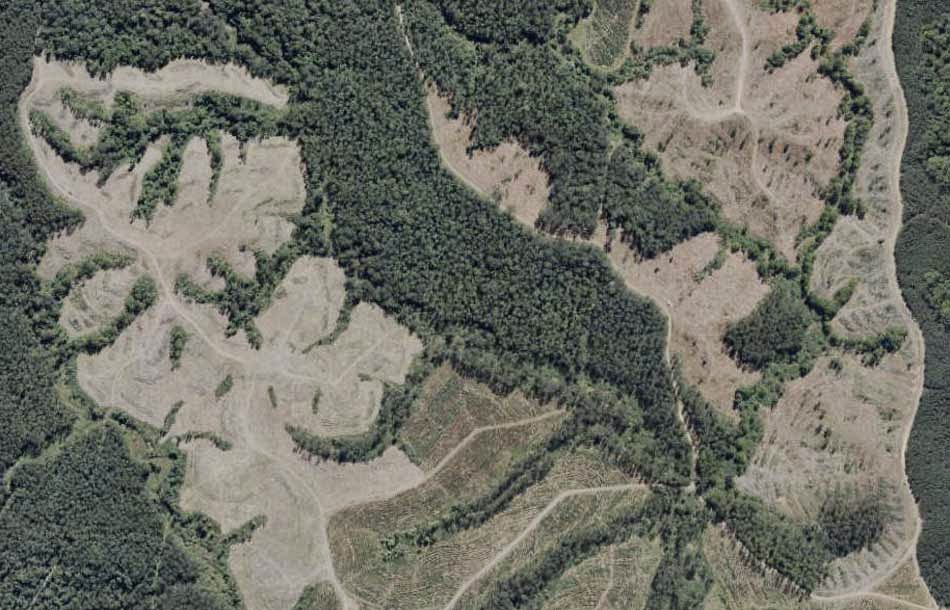
The cash crop is grown for export. After the land is cleared (image) and all Australian flora and fauna have been made homeless, the crops are grown with agri-chemicals (pesticide, fungicide etc). Runoff impacts the surrounding areas. The berries and the incorporated water and soil are sent overseas. The legacy remains.

Increased machine noise and traffic impact on residents and remaining wildlife.

The promise of ‘jobs’ reads more like ’The Grapes of Wrath’. It has been found that backpackers and non-English speaking background workers from o.s. are underpaid and exploited. (here, here, here)

The farm workers go, but residents are stuck in a neighbourhood that is becoming an industrial site. The conflict between locals and large corporate agribusiness interests needs attention by the regulatory bodies.

As coastal urbanisation increases, the space and resources shrink. The horticultural industry expands in Bellingen, Boambee Valley, Coffs Coast, Corindi, Crossmaglen, Woolgoolga, Repton, Valla, Valery and Nambucca. At Bruxner Park the views towards Coffs Harbour and the ocean are starting to look like the above plastic netting landscape, white plastic nets are gobbling up the green coastal landscape.

The 21st century could offer a chance to refrain from treating ‘country’ as a BIG QUARRY. A future beyond extraction and exploitation. Care for the commons, the water bodies, soil and biodiversity.

Authorities can regulate and monitor ‘land use’ and prevent abuse in the interest of all.

 
Quotes:
- A meeting at the CWA on Monday, March 13 at 7pm
“Intensive Horticulture is creeping into the Bellinger Valley by stealth and residents across the Shire will gather to discuss largely unmonitored and unregulated development of intensive horticulture as a new plantation has now become evident to worried neighbours from Valery,” Bellingen Environment Centre spokesperson Caroline Joseph said. (source)

- Valla: “There is no visual flow in Deep Creek and still pumping continues" (source)

- Repton: “A key feature of the village is the natural setting, surrounded by the Bongil Bongil National Park and Pine Creek State Forest. The conversion of land zoned R5 to provide for an agricultural development is wholly at odds with the primary objective of the zone.”
Thirty-Two separate chemicals are listed in the NSW Department of Primary Industry’s Blueberry Plant protection Guide 2015-2016 for use on blueberries in NSW to control disease and pests...Of the 32 chemicals approved one third of the chemicals are identified as likely to have a long-lasting, negative off-target impact … most disturbing is that pesticides can have both immediate (acute) effects and long term (chronic) effects on the health of people who are exposed to them. ... (The) main concern is spray drift over to nearby houses whose only water is collected in tanks and consequently we will drink.” (source)

- Woolgoolga: “The development of a blueberry farm near his property further west on Newmans Rd resulted in a reduction of kangaroos in that area.” (source)

Links:
Blueberry farm in the Shire reignites the debate, Bellingen Courier, 28.02.2017
Repton resistance  Bellingen Courier, 29.11.2015 
Like living in a war zone, abc 01.03.2017 
Australian agriculture safeguarding against climate change. Structures for larger-scale growers to cover whole paddocks or orchards. abc 04.03.2017
Warning against the deliberate exploitation of young people and visa holders, Bellingen Courier, 06.03.2017

Updates:
 
Blueberry blues: how the cash crop is causing a contamination crisis in Coffs Harbour, 29.09.2022 The Guardian  
 
Calls for royal commission as report details allegations blueberry farmers pay workers $3 an hour 3.12.2020

 Concerned residents want blueberry farms to need a DA 
“We were shocked to learn that there is no monitoring or compliance required at a local (council) level to clear privately owned,forested land or to establish intensive horticulture plantations and that this concern about unregulated development is being shared across the region,” Bellingen Environment Centre’s Caroline Joseph said... Pine Creek is dying ..." Bellingen Courier, 14.03.2017

Deregulate, deregulate - "Productivity Commission recommends a wide slash of farm red tape, except biosecurity and food safety. It also recommends agricultural land should be used for its highest value, even if that means resource development." abc rural 29.03.2017

"Europe's Dirty Little Secret: Moroccan Slaves and a 'Sea of Plastic' " or landscapes a perennial plastic greenhouses, Ecowatch 2015
 
Marine scientists fingerprint sources of nitrogen on the Coffs coast. Nearly all creeks with agriculture (blueberry, macadamia) and urban land use have (sewage) water quality issues. Bellingen Courier, 16.09.2020


Images:
Greenhouses of the Campo de Dalías, Almería Province, Spain , NASA’s Earth Observatory
Organic blueberries
The March of Business, Bellingen graffiti 
 
More images:

Mar del Plastico, Bernhard Lang

20.2.17

The Camphor Trees of Bellingen


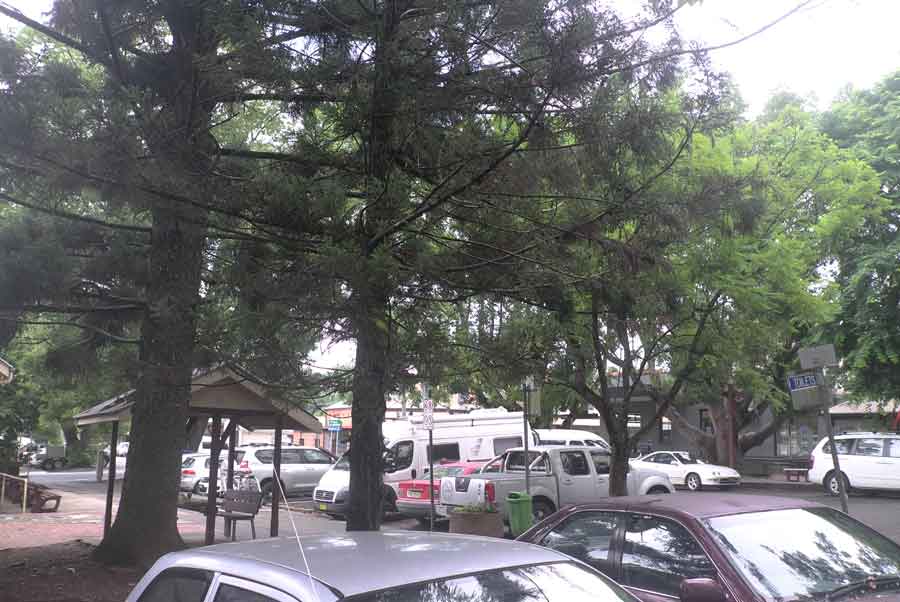
The camphor trees of Church Street, Bellingen are to be cut down. ”The war of the camphor laurels” has been causing local outrage for years. The large trees are throwing some shade on cafe visitors and motorists on a side road reducing the heat island effect.

In the collective imagination, the iconic ornamental giants are synonymous with ‘the beautiful pristine picturesque Bellinger valley’. Postcard-views show cow pastures framed by thick stands of camphor trees hugging the waterways.


For others they are an out of control invasive noxious weed that have reduced local biodiversity of the entire area. When bush regenerators eradicated camphor trees and planted endemic species, heritage enthusiasts sprang into action: “ In some cases, bollards were burned out and boundary chains cut to allow visitors to drive their vehicles onto the fragile banks, crushing native seedlings and causing erosion damage in the process.” (source)

In the social imaginary the introduced flora belongs to the foundation myth of the region. After white settlers cleared the biodiversity of the rainforest valley and replaced it with a pastoralist monoculture, the need for shade became apparent. The giant trees promised instant shade in the fertile flood plains for the British antipodeans and their cattle.


”Ruthless clearance of native vegetation in the late nineteenth and early twentieth centuries created the desire to plant exotic trees such as Cinnamomum camphora in urban and rural settings for practical and aesthetic purposes… (The tree ) “was also highly esteemed for its ability to quickly provide shade for dairy cattle in the  denuded former-rainforest lands of sub-tropical north-eastern New South Wales…” ( B. J. Stubbs, 2012)

The Asian tree was intentionally introduced in 1822 as an ornamental tree for use in gardens and public parks. Additionally colonial Acclimatization Societies founded after 1860 aimed to ‘acclimatise’ the European settlers by introducing foreign flora and fauna. Botanic gardens aided in the human-mediated introduction and spread of the species.

Settlers longed for ornamentals “throughout the Australian colonies to enrich the Australian flora” (source).


The 19th Century ‘panacea’ became entirely out of control after the demise of the dairy industry. “It was generally recognised by the late 1990s that camphor laurel was well and truly out of control and had become a major environmental problem in parts of eastern Australia. This was a consequence of several decades of  landuse  change  accompanying  the  decline  of  dairy  farming,  and  the associated lessening of weed control on the former dairying lands… It  has spread uncontrollably  across  that  region,  competing  successfully  with  native  regrowth,  and  forming  veritable  forests  on  abandoned  pasture. “ ( B. J. Stubbs, 2012)


The neglected and degraded pastures were then bought up and planted with bamboo and other exotics, while the other invasive weed problem remained. Today the mainstream public and private ’solution’ to the river-hugging non-native species is pesticide. In the war on weeds all unwanted growth is doused with a glyphosate-based weed killer, a 'probable human carcinogen'. The new ‘panacea’ to get rid of the last/past folly.


"Inter-continental and inter-taxonomic variation can be largely attributed to the diaspora of European settlers in the nineteenth century and to the acceleration in trade in the twentieth century. " The European diaspora creates an "unprecedented intensity of human-mediated species exchange (which) leads to the homogenization of floras and faunas, re-defines the classical boundaries of biogeography and has far-reaching implications for native biota, ecosystem functioning, human health and economy...The pathways by which alien species are introduced into new areas are also changing rapidly, in particular through increased global trade, tourism, agriculture, horticulture, and the construction and formation (for example, through climate change) of new transportation corridors, such as the opening of the Arctic Ocean shipping routes.” (Source)


Cacti are the contemporary 'must have' 'must spread' alien species wave unleashed on the area.

Deregulation of biosecurity and the hunger for horticultural exotics prepare for the extinction of endemic biodiversity. “…There is an urgent need to implement more effective prevention policies at all scales, enforcing more stringent national and regional legislations, and developing more powerful international agreements.” (Source)


Back to the iconic heritage trees in Church St and the false dilemma in the collective imagination.

The street is the only shaded cafe strip in town where cars should go 10 km/h but 40 km/h is recommended. A giant car park come turning circle where motorists sit with their packs of dogs and blow exhaust fumes into each others' lungs.


The large camphors are caged in planter boxes. (bollards) The roots lifting the pavers have been lovingly smeared over with tar. Like many other mature trees (crammed in cement) in Bellingen they do not look healthy. Their branches are mutilated so not to interfere with dangling power lines and property.

On the opposite side of the cafe strip the toilet block is also set among large trees. Their root network is abused as an overcrowded car park. ‘Access’ to the amenities means dodging a lot of SUVs.


Chopping the giant weeds would liberate Church St. for more fossil fuel vehicles. More neatly paved impervious spaces for cars. A car-centric tabula rasa. In a town where nothing goes without fossil fuel mobility this is the most likely outcome. After the $836,175 chop all motorists, shade hugging or biodiversity loving will be able to park there at ease. Should anything crack though the cement - a good spray will help.


Walkable, car-free and livable environments are as yet unthinkable in this cultural artifact. People-centred public lounge rooms with street furniture, designed to ‘human scale’ with endemic tree shade coverage optimised and impervious surfaces eliminated to stem the uncanny anthropogenic heatwaves are in the realm of dreaming.


Sources and inspirations:
Brett J. Stubbs,  Saviour to Scourge: a history of the introduction and spread of the camphor tree (Cinnamomum camphora) in eastern Australia , 2012 (pdf) (flipbook)

"No saturation in the accumulation of alien species worldwide" Nature Communications 8, Article number: 14435 (2017) doi:10.1038/ncomms14435
http://www.nature.com/articles/ncomms14435

Heritage trees are on the chopping block, The Bellingen Shire Courier-Sun, 13.02.2017

Bellingen Town Centre Beautification, create.bellingen.nsw.gov.au

Henri Lefebvre's The Production of Space, Donald Nicholson-Smith trans., Oxford: Basil Blackwell. Originally published 1974. 1991, (pdf)

John Urry, Consuming Places (1995), (pdf)

Global movements and funding cuts a threat to biosecurity in Australia, abc 02.2017

Review of Australia's Intergovernmental Agreement on Biosecurity, IGAB, 12.2016 (pdf)

 The Cars and Trucks That Ate Bellingen 

Updates:
"Suitable replacement trees" will morphe into more car parking: “Affiliated works included formalising car parking and planting of replacement trees which occurred by way of community input via a working party." Bellingen Courier, 13.03.2017

9.3.15

Bellingen - No Spray, No Way or Land Use Conflict


Bellingen is a small logging town in Gumbaynggirr Country. In the 1840s the Bellinger Valley was so "rich in cedar that it was estimated that over 2 million feet of cedar were being extracted each year." (source) By the early 1900s, the red cedars were depleted and cattle hit the cleared areas. By 1975, there were only sclerophylls left to log. After the degradation of frontier colonisation, other extractive industries besides logging such as mining came on the scene. Pebbles from the Bellinger river and gold further 'opened' up the land. The ethos of 'dig it up, cut it down' permeates into the 21st Century where the whole country is truly 'open for business'.


Today Bellingen is surrounded by an array of state forests and national parks. The state forests are intensively worked with heavy machinery, agri-chemicals and fire. They are industrial forests. Clear felling is widely practised. The national parks are seen as a storehouse for the remaining biodiversity and a cash cow for 4W Drive Tours for tourists. Even car races are staged through some of the state forests. Unregistered, uninsured and unlicensed dirt bike riders harass bushwalkers and wildlife. Horse enthusiasts feel free to go anywhere. Other 'recreational activities' consist of shooting and fishing.


Chasing the fairy-tale dream
Amongst the remaining forest mosaic, more and more settlers try to live the 'Aussie dream' or are 'getting away from it all'. Retirees want a tree change with a lot of lawn. City dwellers are fatigued from house flipping and a cut-throat work culture and seek the stay-at-home lifestyle of the sleepy town.  Old hippies, retired surfers, hipsters without contraceptives, underachievers, young heirs, drop outs and oddballs all seek some acres where the packs of kids, dogs, horses or livestock can roam. 5 to 100 acre kingdoms promise a rootedness in land ownership for fringe dwellers.
Peri-urbanisation or the quest for a cheap dwelling might also be a driving force for the ever-growing community. Degraded land is converted into a real estate Eldorado.


The conquered bush: fossil fuels, pesticides and fire
Many bring their sub-urban mental landscape with them. Everything is done in the same way but only on a bigger scale. Sprawl and automotive dependency require active denial about climate disruption. 'Land management', private or by authorities or corporations, consists of two 'magic wands': fossil fuels and pesticide. If it can't be done with heavy machinery, 2-stroke 'gardening' equipment (pdf), slashers, mowers, blowers and chainsaws and 'spray' - it won't be done. Beside petrol, herbicide and 1080, fire is another tool to 'clean up the land' to make it fit for human habitation. Private piles burn regularly and smouldering forest fires burn over months, they are part of 'normal' culture. Seasonal incineration of Australian flora and fauna, known as 'backburning' turns the air into a deadly smog.


Out here in 'the middle of nowhere' one can 'break free', free themselves from all restraint. Monster houses, monster SUVs, why have one dog, when one can have 3 and a few cats. The dogs gang up and go for the remaining wildlife. Bored fun-seeking teens organise 'out-of-control' parties in the forests. 'Freedom' to be the one exempt form the law - to be wild. Yes, there is no police station within an hour's drive.


The scenic 'little town' with an 'old world ambiance' has endless long quarry and logging trucks with multiple trailers shooting through the 'sleepy little town', down the Dorrigo mountains, along Waterfall Way to 'upgrade' an XXL Pacific Highway which pushes all endemic bio-diversity out of the way. Tabula rasa  for more of the same. Even when these 'trains' don't push through the village road the daily vehicle exhaust is breath-taking. So much for fresh country air.


The modern fairy tale is of endless growth on a finite planet. Fossil-fuel reliance puts the world on track for 4-degree rise in temperature. Most dwellings in the area have coal-powered air-conditioning but not solar. The refrigerated humans are OK so far, but the cattle in the 'great outdoors' are semi cooked, goats are hammered by hail and even roos and the eucalyptus suffer. Bats drop out of the trees stone dead. Turtles go blind and are starving. The disappearing endemic biodiversity is invisible. This is a pet-loving country. But Australia appears free of climate angst and goes: Great day for the beach! and drives the meat gobbling dogs to the beach to chase a few little terns or oyster catchers.


Back to the bush settlements - The land-use conflict
Various rural residential acres or hobby farms are scattered through the area. Many borders are in proximity to a patchwork of industrial forests. The presence of intense agro-chemical forestry, large scale fires and residential areas can only generate conflict due to their potential incompatibility. Both parties seek expansion, forestry and roads and increasing subdivisions of unplanned developments and residential agglomerations. The conflict laden interface erupts when for example State Forests wants to do aerial spraying via helicopters of a cocktail of pesticides near dwellings. The majority of residents are already affected by the air and noise pollution of clear felling that lasts for months. Giant machinery is ploughing up the ground from the early mornings. The subsequent spraying of toxins and fires, as well as increased traffic take the charm out of 'country living'. The heavy logging machinery leaves behind puddles of stagnant water that become mosquito-infested (pdf).  Living in a spray and logging zone with hovering helicopters and braking trucks is more reminiscent of the much publicised Amazon basin, rather than a developed country.


Most people seem to be teflon-coated and tolerate it all, many sell up and some protest about the doings in their backyard.


Like the original owners, residents feel disenfranchised about the invasion of their properties. Koalas and the rest of biodiversity do not get a 3 day notice about the toxic shower and the elimination of their habitat. They are chased by packs of dogs and cars in a tree-less and fragmented environment.


But a booming population is hungry for building materials and infrastructure. The State Forest is already eyeing the steep slopes of the native forests for cable logging. Private loggers might get the idea too. But a few more landslides, erosion or flooding - who cares.


The dispersal of bio-cides on the land, water and from the air is ubiquitous in Australia (map). National parks, councils, private individuals and agri-forestry almost all do it. The 'precautionary principle' is foreign lingo for humans or wildlife.


The latest case of land-use conflict came to a head between residents near the Gladstone State Forest between Bowraville and Bellingen. Forests NSW was going to aerial sprays herbicide over 175ha of logged eucalyptus plantation. They argued that

"There is nothing unusual about what we are proposing – farmers all over Australia control weeds using helicopters" (source)

The spray would be a "combination of glyphosphate (RoundUp), Metsulfuron Methyl, Fluoroxypr Methy lheptyl, Simazine and other chemicals from a helicopter" (source)

The Bellingen Green Action Group is concerned about the pesticide drift and the impact on the many waterways. Although aerial spray is so 'cost effective' SF will do ground spraying now.

The land use conflict between human demands will continue. The interests and culture of big quarry Australia will follow its logic till all is sold, unless the paradigm is changed.


Images:
Bellingen mural of settlers with axe
Bellingen downtown with logging truck
Bellingen logging images
Aerial sightseeing of some of the (random) forests bordering Bellingen town, all Google maps


Update:
Now for the steep slopes west of Urunga and Nambucca Heads. Cable logging... coffs coast advocate 15.03.2015

Stop Cable Logging on Steep Slopes in NSW Public Forests 

Roundup weedkiller 'probably' causes cancer, says WHO study."The weedkiller has been detected in food, water and in the air after it has been sprayed, according to the report from WHO. However, glyphosate use is generally low in and near homes where the general public would face the greatest risk of exposure, the report said." The Guardian 22.03.2015


http://www.iarc.fr/en/media-centre/iarcnews/pdf/MonographVolume112.pdf
WHO, IARC Monographs Volume 112: Evaluation of five organophosphate insecticides and herbicides 20.03.2015

http://www.stoptheaerialspray.org/

Improved protection from pesticides for NSW landowners, with new legislation passing Parliament PDF via @MarkSpeakman 14.05.2015


Culturing Ross River  and Barmah Forest viruses?

5.11.13

Bats and birds increase crop yield in tropical agroforestry landscapes


"Ecology Letters": Bats and birds increase crop yield in tropical agroforestry landscapes. Abstract
 
"We found that bat and bird exclusion increased insect herbivore abundance, despite the concurrent release of mesopredators such as ants and spiders, and negatively affected fruit development, with final crop yield... Our results highlight the tremendous economic impact of common insectivorous birds and bats, which need to become an essential part of sustainable landscape management."


Insect-munching bats spare the chemicals. abc 240305

"Farmers can reduce the need to spray their crops with insecticide by encouraging insect-eating bats to roost in old hollow trees in their properties...There are about 90 species of bats in Australia, three quarters of which subsist solely on insects and spiders...The smallest species of bat in south-eastern Australia is the little forest bat (Vespadelus vulturnus), weighing in at just four grams. It gorges itself on mosquitos, while the southern free tailed bat (Mormopterus) feasts on the destructive Rutherglen, or seed bug ( Nysius vinitor)."

"Many farmers are unaware of the benefits of insect-eating bats... and often don't even know they have the tiny nocturnal mammals on their properties. Dr Lindy Lumsden "is encouraging them to preserve old dead trees on their properties so that bats can roost and breed in their hollow trunks...People often see a dead tree as just being good for firewood or a bit of an eyesore and cut them down...The main thing that farmers can do is maintain the remnant vegetation on their properties so the bats can breed themselves up....It takes around 80 to 100 years for tree hollows to develop, so farmers need to revegetate to ensure the trees that fall down and die, leaving bats homeless, are replaced in years to come."

Images:
Pisanello, Detail of Madonna of the Quail, 1420
Kaki Persimmon fruit, (Diospyros kaki)

Updates:
Native birds provide crop benefits, but Australian farmers treat them as a pest, abc 022014 

"Effects of land use on bird populations and pest control services on coffee farms” Railsback, S. F. and M. D. Johnson. Proceedings of the National Academy of Sciences USA, DOI: 10.1073/pnas.1320957111.  042014

Downturn in shade-grown coffee putting forests, wildlife, people at risk, mongabay, 07.2014

Shade coffee is for the birds 05022015

 Why shade-grown coffee is good for birds and farmers, The Conversation 26.02.2015

8.10.13

Retreat

A long weekend in a retreat (60-something kms from Bellingen). Multiple huts in a rural landscape.

On arrival multiple fossil fuel powered machinery made the landscape 'tidy'. The disturbing and excessive noise and dust pollution hogged the attention.

On opening the door to the premises, one was hit by an intense cloud of synthetic fragrances that was cooking on a power point. All textiles were drenched in these potentially hazardous synthetic chemicals. Curtains and furniture seemed to be dipped in fire foam and flame retardants. The bedsheets smelled perfumed. The kitchen cupboard had, as in most Aussie kitchens, the well-used spray can of pesticide handy. The water, without a filter, tasted foul and metallic.

The closeness of the  neighbouring huts tried to emulate a feeling of a tight-knit sub-urbia back home. Families wanting a "getting away from it all" feeling ended up in the confinement of 'family cabins'. "Loudness-as-an-inalienable-right “(Wallace, David Foster) of families one might add. Large unplanned families with the full package of pets and all the baggage. Parents intensely interacting with their wearables. Many mouths scream. The child that cannot use language cries and screams.

The dads of instant culture pour petrol, meths or other accelerants on the meat altar. The incinerated meat stands in the form of cows not far off. They are usually pre-cooked in the shelter-less Australian sun.

The toy pets bark and squeal from the abuse of being mistaken for a horse. Agitated the free range dog chases the only Australian native fauna in sight, a brush turkey. For short minutes distraction culture goes sensation seeking and then they sprawl and sprawl.

The use of the veranda is impossible and the hut smells toxic. The entire night the resident rooster claims his territory over the visiting Koel and the array of family dogs bark and yap and yap and yap.

Next idyllic morning the neighbouring fence is being drenched with toxins trailing in a large dust drift. The posts are meters away from the line of huts. Copious amounts of herbicide/pesticide is being doused, the diesel of the tractor fills the 'shelter' up with thick clouds of diesel fumes.

We retreat to a coastal eatery.  A deafening aural ambiance from families being fed. In the food preparation area a white, plastic auto mist box disperses pesticides totally unmanned round-the-clock! At short intervals poison is being released on to 'bugs', staff and customers. Enthusiasts of old car wrecks generously share the fumes of their old timers which fill the entire cafe.

People just seem to tolerate the ubiquity of pesticides and noise pollution

We disappeared through the sanitised, chemicalised agricultural acres which stretch for mile upon mile. Australian flora and fauna has been eradicated or only fragments are left as retreats.

Images: 
Cicada, domesticated silkmoth, Bombyx mori and a diversity of flies, Alfred BrehmBrehm's Life of Animals

Even ‘environmentally protective’ levels of pesticide devastate insect biodiversity. 
 Common insecticide used in homes associated with delayed mental development of young children

Update
Pyrethroid insecticides exposure increasing in homes and people,
07022014