Showing posts with label Coffs_Harbour. Show all posts

9.3.25

At the museum...

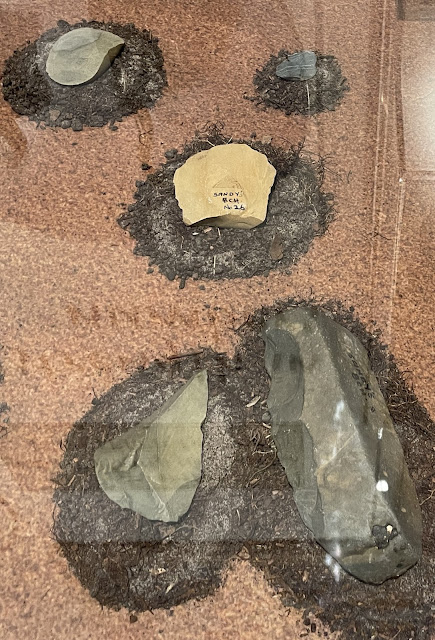
Stone tools,
Bellinger Valley Historical Society Museum

"At the museum, 

this means seeing the objects where they are, and simultaneously seeing them where they no longer are, that is to say, in the regions from which they were taken. It means enjoying the beauty and the knowledge that have been accumulated in our cities over centuries, but enjoying them with full awareness of the conditions in which these objects were collected, in asymmetrical economic, military and epistemological contexts. It means rendering visible, in order to master them better, the internal contradictions and the glaring tensions that have been at work in the very idea of museums since its origin. It means paying close attention, in this context, to the gazes and voices of the dispossessed."   Bénédicte Savoy

Bénédicte Savoy, Objects of Desire, Desire for Objects: Inaugural lecture delivered at the Collège de France on Thursday 30 March 2017

Bénédicte Savoy, Objects of Desire, Desire for Objects, Inaugural lecture, Open Edition

Sandy Beach, NSW artefacts display in the Yarrila Arts and Museum (YAM)

24.11.23

Toxic Contamination and Dead Mangroves at Boambee Creek

Mural, Solitary Island Coastal Walk, Bonville creek

Recently we observed  'A Cooked Intertidal Ecosystem at Sawtell Beach'. Today's local paper (Coffs Coast News of the Area) reports about 'Dead Mangroves at Boambee Creek'

The Boambee Creek Estuary is just north of Sawtell and south of Coffs Harbour airport. The creek traverses the suburbs of Boambee, Sawtell and Toormina, many roads and highways, industrial estates and resorts till finally it reaches the Pacific ocean.

The shoreline of the Boambee Creek Estuary and Boambee Beach is used as a playground for fishermen, dog owners and SUV owners.

Recently Kirsten Benkendorff (Professor at the National Marine Science Centre, Southern Cross University) and a Gumbaynggirr ranger of the Traditional Owners (Indigenous Protected Area Sea Country program) discovered the dead mangroves and neurotoxic contaminants at Boambee Creek.

"Most of the mangroves were rotting and the mud underneath was black and stinking and no live forms were visible. There was a smell of sulphur and petrol." 

"There was a range of toxic chemicals in the rotting mangrove roots, including carbon disulphide and petrochemicals like naphthalene, furan, xylene and cresol...Many are neurotoxic to the eyes, skin and lung."

"The site is not safe for people or aquatic life." (Coffs Coast News of the Area, 24.11.2023)

Update:

New research led by Southern Cross University has found a cocktail of nasty pesticides in oysters and water from one of the NSW North Coast’s dominant rivers. 12.12.2023
https://www.scimex.org/newsfeed/that-really-shucks-pesticide-pollution-threatens-shellfish-safety 

Pesticide residue from farms and towns is ending up in fresh oysters, 13.12.2023

https://theconversation.com/pesticide-residue-from-farms-and-towns-is-ending-up-in-fresh-oysters-219395

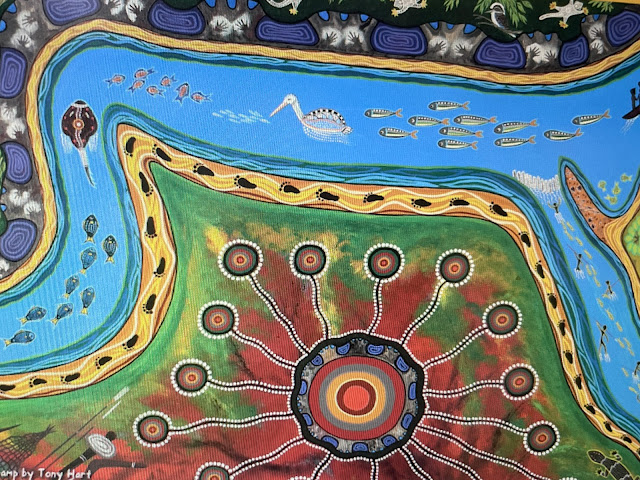
The old camp mural, Coffs Harbour, (no longer exists)dl


8.11.23

A visit to the YAM (Yarrila Arts and Museum)

“Yaamanga Around here is a permanent exhibition exploring the history and identity of the Coffs Coast through themes of place, community and belonging, with Gumbaynggirr culture at its heart." (source)

The gallery, museum and library are housed in a new bright green building that even has bike racks in front. Culture is free there.

At the entry a film is shown: Daalga Nginundi Wajarr (Sing your Country) Gumbaynggirr artist Birrugan Dunn-Velasco uses modern instrumentation and sounds from Country.

The bulk of the museum is devoted to settler culture. Displays of deforestation tools, logging implements, barbed wire and cattle images. Frugal craftiness textiles.

One could say it is an obsession with stuff, with material culture and the hoarding of possessions. Collections of tools, shells, food implements from a nostalgic bygone era.

The only First Nations 'stuff' is showcased in a glass cabinet. Some dusty stone tools are lined up out of context (as seen in most Australian museums). To counter-pose a huge array of settler implements with Aboriginal stone tools could lead one to misleading conclusions.

Missing and therefore invisible in this display of material cultures is the greatest achievement of the Indigenous Peoples, that is having managed Country for 60.000 years without degrading it.

There are some beautiful paintings, glass and textile installations to see..

Suzanna Knight, Shearwater tapestry


16.5.17

East Coast Encounter from Coffs Harbour


A visit to the East Coast Encounter at the Coffs Harbour art gallery. Inspiring artists are depicting the 1770 dialogue from the perspective of the boat or/and the shore. A ‘Visions of Australia program’ that takes Cook's journey through Solitary Island Marine Park as a focal point. His log reads:
“From what I have said of the Natives of New-Holland they may appear to some to be the most wretched people upon Earth, but in reality they are far happier than we Europeans; …. They live in a Tranquillity which is not disturbed by the Inequality of Condition: The Earth and sea of their own accord furnishes them with all things necessary for life; they covet not magnificent houses & Household-stuff they live in a warm and fine climate and enjoy a very wholesome air, so that they have very little need of clothing and this they seem to be fully sensible of, for many to whom we gave cloth, left it carelessly upon the sea beach and in the woods as a thing they had no manner of use for. In short they seemed to set no value upon any thing we gave them, nor would they ever part with any thing of their own for any one article we could offer them; this, in my opinion argues that they think themselves provided with all the necessities of life and that they have no superfluities.”
Extract from Captain Cook’s journal


Stepping outside of the art gallery /library to the great outdoors of the carpark, the contemporary dialogue between indoors and outdoors landscapes continues. The Fitzroy Oval framed by Coffs Creek used to be know as the Old Camp of the Gumbaynggirr Nation. It is now being bricked up. Even the Aboriginal Heritage Signs have disappeared into invisibility....


Images:
Mural, NSW
Old Camp, Fitzroy Oval Aboriginal History Sign 
Fitzroy Oval, Coffs Harbour, Google
Brick by brick The Old Camp ('Yaam Nguura Jalumgal’) and open space disappears

Update:
The Coffs Harbour’s Gumbaynggirr community can call the remains of ‘The Old Camp', also known as  Fitzroy Oval  – 'Yaam Nguura Jalumgal’. The prerogative of interpretation will go to the Geographical Names Board of NSW for approval...  Coffs – Aboriginal Site Recognised with New Name, Bellingen Courier, 26.05.2017

12.7.15

The Park Beach Reserve, Coffs Harbour and Land Care

Click to enlarge
The Park Beach Reserve is unusual for NSW because it has a remaining strip of coastal bush separating it from the 'wanna be a Gold Coast'  high rises on Ocean Parade.  In the age of rising sea levels the Australian habit of building ON the beach and erasing protective vegetation barriers should be a thing of the old days.

The mushrooming tall buildings of Ocean Parade have a slim buffer at the front and back separating them from the road (Hogbin Drive) and the glaring light pollution from a bare sport field framed by large weeds (pines). The busy road and the speeding cars gobble up the green margins. Burnout wrecks set the bush alight and garbage is generously dumped by motorists.

A wide strip of vegetation bordering the road is regularly doused with herbicide, giving the edge of the little forest a brown and dead appearance. In the latest addition to 'land care', it seems that the endemic littoral rainforest species were just hacked to the ground with no apparent reason.

Maybe flat dwellers requested a better view of the noisy road and access to the light glare opposite? All weeds have been left standing. They are working hard on making Coffs Harbour even more ugly.

2.5.15

Dogs or Australian Wildlife

The majority of Australians 'vote with their feet' against biodiversity and for a monoculture of pets. Modern humans (Homo sapiens) formed an alliance with dogs early on to eradicate the local population.

Through a long process of domestication (dysgenics) they erased the wolf out of the ancient canine and ended up with an obedient dog that satisfied the desires of the master.

From the beginning, colonial society took a "dog-privileged view of the Australian landscape...The story begins with the arrival of the First Fleet. ‘From the earliest watercolours of the former prisoners, captains and surveyors, we get dogs as part of colonial life' " (source). After the introduction of 'English breeds', national identity could be established. (Leaving aside the Aboriginal Australians' culture and the dingo here).

"By the 1950s Australia ‘rode on the sheep’s back’; those who grew the wool had come to symbolise and epitomise what it was to be Australian." (source) The dog became an important factor of production to whom one could outsource mustering introduced hoofed animals.


By now one could say, the country is 'riding on the dog's back'. Having largely deserted agriculture and manufacturing, avoiding value-added activities and resorting to digging big holes, or clear cutting forests, the service industry is the sector where identity is established.

At the end of the mining boom wealth has been established for some.  For the great majority, "pets continue to power the economy". This country has one of the highest rates of pet ownership in the world, spending $1.4 billion p.a. Goods and services previously afforded for human beings only are now spent on dogs.

The dog, unlike non-human members of the great ape family, (Hominidae) has been truly included in the 'human family'. Being 'one of us', pets live the consumer's way of life and fuel the economy. The daily meat, mostly repurposed wildlife, accessories, bedding, clothing, prams, toys, medical services, insurances, vets, pet shops, dog trainers, therapists, medication, minders, groomers, hairdressers, canine boutiques, dog manicure, cafe access, tailored holiday accommodation and dogs' frequent flyers etc etc. And of course the right cars or taxi to drive the pack to the public 'loo'. Councils hold special events for dog lovers. Government collects tax. A serious economic factor with very strong interests and a lobby.

For the master the captive creature is in a hierarchical relation of permanent access. Unlike wildlife, the subordinate beast promises instant gratification for the mistresses' commands. The animal serves as a projection surface for human needs - as a friend, toy, partner, security guard, lover or punching bag. The pet owner can for once bathe in fantasies of omnipotence and power. Images of wet kisses are all-pervasive, sharing one's bed with the pack is also common. After centuries of removing the human out of the stable, people turn their dwellings back into stables for leisure pets.

The days of owning one dog are long gone, now they are hoarded in human housing, one can see dog walkers with four in harness, or outsourced to dog walkers with eight. Couples seem to express their individuality by each having two distinctive dogs. Whether people get their identity from the their decorative ornaments or priced commodity, all appear low maintenance compared to human offspring or friends.


In the 36,000 years of co-evolution of dogs and humans, the wolf has learned to manipulate the human via eye-gazing behaviour, 'puppy eyes' release a "love hormone" or "cuddle hormone" in the human being. The zombified pet owners structure their life to suit their pack. The dogs take charge.

Most pet owners in NSW seem to belong to a stay-at-home cast that service these animals 24/7. Only the best of the native landscapes will do for their 'darlings': beaches, national parks and nature reserves. They take 'a dog’s eye view of the landscape'. As the dog is mistaken for 'nature', one wouldn't want to restrain it, but let it become one with it. Unleashed, they hunt wildlife (koalas, cassowaries, little penguins, shorebirds etc) and quite frequently maul toddlers and joggers/ walkers. Should a pedestrian approach the owner, pointing out that 'dogs are not allowed here', they mutate into vicious pit bulls. Forests of signs are ignored, authorities are turning 'a blind eye' and fines are paltry.

In sub-urbia they prefer to unload  their sewage near the beach, unpack the van and let them go. The backyard does become rather smelly after some time. Full plastic bags are found on the beach, hang in vegetation or are in the drains. The majority does not pick up the sloppy poo, it stays as dung on the endless lawns on which people have their zoonotic picnics. The giant amounts of recycled meat also fuel the toxic algal blooms in the surf nicely.

Should the owners have other commitments (work) or have to attend parties, the dogs are left at home barking for hours and hours. (video) Sometimes a family toy disappoints, as puppy changes its form, it becomes a throw-away toy and a new cute baby dog is consumed. The market is also very determined by fashion influences. Should one have an outdated brand, it is time to update and dump the old one in a pound. In the holiday season many just open the door on the highway and 'the problem' is solved.


The dumped, neglected and roaming dogs in rural and peri-urban regions are then termed 'ferals'. The unwanted ballast is socialised. The 'set-free' dogs are a threat for people, wildlife and the livestock industry. From time to time mass poisoning (1080) actions take place that kill mainly the Australian endemic dingoes. No word is lost on the roaming and dumped pets gone feral.

"Australia has the worst mammal extinction rate in the world" (source) As a mega diverse, developed country people choose to entertain huge menageries of introduced animals detrimental to the endemic biodiversity. The current Australian business- as-usual trajectory will make the harsh continent even more hostile for all living beings. The intentional ignorance on climate disruption even further accelerates the extinction risk for Australian animals.

But they want pampered pooches.....


More on the family package: And then?


Updates:
The roaming dogs of Bellingen mauling livestock and pets The Bellingen courier, 19.05.2015
Have we turned dogs into lazy thinkers through domestication?
When dogs look back: inhibition of independent problem-solving behaviour in domestic dogs (Canis lupus familiaris) compared with wolves (Canis lupus)
Exporting dogs to Asia, abc 12.12.2015 
PNAS: "Bottlenecks and selective sweeps during domestication have increased deleterious genetic variation in dogs" 
 

IMAGES:
Titian, Detail of Venus and the Organ Player c. 1550 
(with Coffs Harbour sound sample, but it could be in Bellingen too)
Riding on the Sheep's Back, Blue sheep and golden dog sculpture
Public mural
Public service to collect dog feces
Trübner, Heinrich Wilhelm, Great Dane with Sausage, 1878

See also
Cura, A story about care for biodiversity
Hungry Head Beach Going to the Dogs

26.1.15

Australia stock-taking


Gumbayngirr country, today called Coffs Harbour. Where the original inhabitants were pushed into fringe camps. A detailed account of this time can be found here.


Expansion seems to be hard wired to the European project, or even 'man'. Grabbing the neighbour's stuff, walking into other people's places and behaving like 'vandals'. The new 'living space' is always gotten by military aggression. The world is a playground to extract and enlarge the pursuit of more and more. A planet becomes tabula rasa to subdue and treat as a quarry in the metabolism (pdf) of rapidly multiplying flag-waving chest-pounding nationalists in a post-nationalist world. The 'blank slate' to project the pathologically insatiable hunger for more is actually a bio-diverse array of life and culture which is eradicated to convert all into a machinery of fossil fuels, stuff, meat and profit. "Nothing but bush" thinks the Australian mindset and bulldozes bio-diversity and replaces it with a dull and impoverished mono-culture. Land, water, ocean and air degradation follows. The unique Australian flora and fauna is replaced with poodles, ponies, meat, and pink weeds.

Pandanus
The project of 'civilisation' comes to a grinding halt as it becomes obvious that the 'stuff' is running out, the bills are piling up for the heritage damage and pollution. The planet itself has been brought to the tipping point of becoming uninhabitable ( for life as we know it).  A culture of mean stewardship and dysfunctional oikos management is a bankrupt 'lifestyle'. As we drive our only home against the wall with eyes wide open, we are already eying the next habitable planets for evasion and expansion.

So much could have been learnt from the way of life of indigenous peoples, living in small populations and valuing human culture and law...


More viewings:
I am Aboriginal, film by John Pilger
Australia Day,  Ken Oathcarn, Rap News Video
"Nothing but bush" cartoon


More readings:
Aboriginal history of the Coffs Harbour region, PDF
Australia Day is a time for mourning, not celebration, Guardian,  260115
Henry Reynolds: If We Are To Re-Think Australia Day, Where Should We Begin, New Matilda, 220115
Galarrwuy Yunupingu, Tradition, Truth & Tomorrow, The Monthly


Audio:
Padraic Gibson / Paddy Gibson, 1788: War for Eora Country - Genocide and resistance in early colonial Sydney


There could be 50 C days in Sydney and Melbourne... Guardian / CSIRO


Images
via Old Camp at Coffs Creek, Tony Hart 

10.9.14

Staging Car Races in Nine State Forests of NSW


200 kilometres of NSW forest roads will be used for a three-day car race on 11-14 September. The public is being denied access to various state owned forests.

Nine State Forests are effectively privatised:
Bagawa,
Lower Bucca,
Nana Creek,
Newry,
Orara East,
Pine Creek,
Tarkeeth,
Tuckers Nob and
Wedding Bells State Forests.

The racing cars will shoot at high speed through 'dirt roadways'. The "roads are lined by trees close to the edge in many places... they will travel through dense rainforest." These forests are the habitat for a rich biodiversity. Flora, fauna and fungi mingle in this refuge. To stage a high speed fossil fuel orgy amongst this diverse habitat and 'boost' greenhouse gases will leave all living beings with an inhospitable home. Australia is well known for working hard on making its unique species rapidly extinct.
The roaring noise pollution can be heard over kilometres, the dust generation is a hazard. Housing adjoining the State Forest are already challenged by ongoing logging pollution and breaking mining trucks. As well as the acoustic pollution on the land, the air space is filled with hovering air craft noise. The house-shaking sounds of the helicopter/s ( in the age of uavs ) over 'lifestyle' properties make any creature want to flee the area. To add such a combustion event probably will flood the market with 4sale signs and dissuade visitors that might 'boost the local economy' in the long run in a sustainable way.

Youth on (unregistered) trailbikes and bombs already doing wheelies in forests and residential areas take it as a go ahead. Such mass spectacles demonstrates to them, that it is ok to speed.

The price is too high to be 'put on the map' in such a way.


See also
Celebrating Fossil Fuel Culture on Forest Roads, 2013
Noise Pollution and Vibration in the Bellingen Shire, 2015


Images
Australian fauna, Brockhaus encyclopedia
Large frogmouth, (Batrachostomus auritus), Brehm's Life of Animals

31.8.14

Coffs Harbour: A place for whales and birds?


Coffs Harbour has been put on the map for watching whales and birds. Between June and November migrating humpback whales can be watched. The Solitary Islands Marine Park provides a refuge for them and many other marine species.

Also in August thousands of wedge-tailed shearwaters travel thousands of kilometres each year to return to the same burrows on Muttonbird Island Nature Reserve. It is the only easily-accessible place in NSW where the migratory wedge-tailed shearwaters nest.

Just when these migratory species dwell in the region, fossil fuel enthusiasts and the associated industries stage a 1000-horsepower speed boats race in the privatised 'natural amphitheatre' of Coffs Harbour. Rockets 'get airborne' and therefore are not supposed to shred any marine mammals. Sea creatures will simply get replaced by 'high horsepower marine monsters'. Local businesses are waving shopping bags and put up dysfunctional 'fairy lights' in trees to 'draw the crowds' to a run-of-the-mill town.

In a 100 % automobile dependent society with few footpaths and hardly any bike paths petrol runs in the veins of the population. Daily and recreational racing kill the dullness of a marginal existence. 'Boys with toys' are good consumers. They race the atmosphere-polluting machines on the Pacific Ocean and in the scenic hinterland of Coffs Harbour.


Having just thrown billions at the Pacific Highway one could have at least used this purpose-built road which is hacking its way through numerous wildlife habitats as a human-made race course 'amphitheatre'. Just privatise the space and let the benefiting industries pay for the usage. At the moment billboards along the highway appeal to motorists to reduce speed while the next billboards advertise car racing.

Staging such polluting and noisy events discourages visitors to come to the area for its natural aspects. Locals are deprived of a livable place and might move on or avoid shops sponsoring combustion festivals. It is the rapid conversion of a 'special place' to a non-place.

But in the country one just tolerates things ...


See also
Celebrating Fossil Fuel Culture on Forest Roads

Convention on the Conservation of Migratory Species of Wild Animals