Showing posts with label landscape. Show all posts

9.3.25

At the museum...

Stone tools,
Bellinger Valley Historical Society Museum

"At the museum, 

this means seeing the objects where they are, and simultaneously seeing them where they no longer are, that is to say, in the regions from which they were taken. It means enjoying the beauty and the knowledge that have been accumulated in our cities over centuries, but enjoying them with full awareness of the conditions in which these objects were collected, in asymmetrical economic, military and epistemological contexts. It means rendering visible, in order to master them better, the internal contradictions and the glaring tensions that have been at work in the very idea of museums since its origin. It means paying close attention, in this context, to the gazes and voices of the dispossessed."   Bénédicte Savoy

Bénédicte Savoy, Objects of Desire, Desire for Objects: Inaugural lecture delivered at the Collège de France on Thursday 30 March 2017

Bénédicte Savoy, Objects of Desire, Desire for Objects, Inaugural lecture, Open Edition
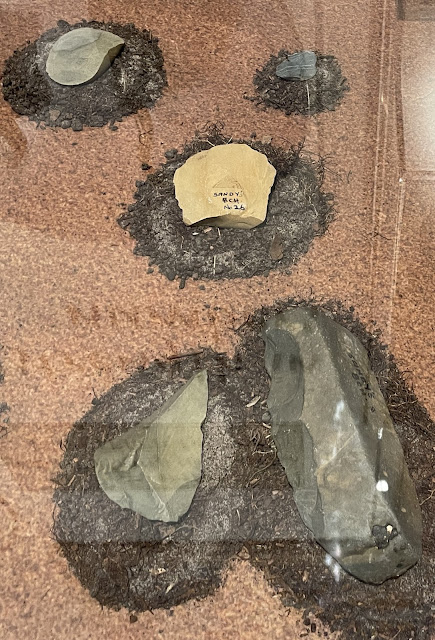
Sandy Beach, NSW artefacts display in the Yarrila Arts and Museum (YAM)

1.9.19

Gleniffer quilts - a cover for the bed and a landscape cover

Sandy Corry quilt
Another Gleniffer Quilt and Craft Fair took place in Gleniffer Hall. A large array of quilts was on display. The star of the show was the 'quilting queen' wearing her diamond tiara and demonstrating her 'doodling' on the sewing machine. Sandy Corry's work has a very haptic quality. Here are some of her pieces:
Click to enlarge pictures

Meat on the BBQ and the car park was full. Years ago the non-quilting crafts had a greater representation. A gang of unregistered trail-bikes demanded attention and disrupted the peace, as it is common in this area.

S.Corry quilt

The landscape cover setting
The Never Never Creek flows behind the Gleniffer Hall and a very small church. The gardens of the buildings 'reject the local environment' like most Australian gardens do. Lichen covered fences frame foreign grasses, known as lawns. A patchwork of Chinese camellia plants were planted in all colours from pink to red. The Japanese azaleas keep to this popular colour scheme too, a comforter landscape. An agave from central Mexico is tended to in a flower pot.


Outside the 'cage', trees drip with epiphytes. Tongue orchids (Dockrillia linguiformis) crawl along branches and pencil orchids (Dendrobium schoeninum) fall like stiff sticks from the tree. Shade!

Nearby stands a very large and lonely red cedar (Toona ciliata). A host for aerophytes and fauna. Did the cedar industry overlook this 'red gold'? Soon after European arrival the cedar forests lining all major rivers were eliminated by an extractive colonial industry. Cedar getter gangs stripped their way from Sydney through all rivers, right up to Queensland.
"An entire species of tree was just about wiped out on the NSW coast during the first 100 years of settlement." (source
The cutters would float the 'filet' pieces down the rivers to go to merchants in Sydney or England. The indiscriminate removal of the timber made way for the settlers/ pastoralists.


Most texts (pdf) of the 'In Search of Red Gold' stress the pioneering spirit of the frontier mentality in a people-free El Dorado. The First Nation Peoples, in this case the Gumbaynggirr of the Billengen River are invisible in the narratives.