Showing posts with label denial. Show all posts

28.4.24

Visions of Nature - How Landscape Photography Shaped Settler Colonialism by Jarrod Hore - A commentary

Jarrod Hore is an environmental historian of settler colonial landscapes, nature writing, and geology. ’Visions of Nature How Landscape Photography Shaped Settler Colonialism' elucidates cultural techniques used in the Anglo-American settler empire over various centuries. The Pacific Rim Nations (North America, Aotearoa/NZ and Australia) command the most attention of the critical historical image research. It is a historical elaboration of pictorial imagery (iconography), mainly photography, paintings, but also texts.

At the time of steam trains, photos were a novelty with which to view exotic locations. Photography and paintings informed worldviews and worldmaking practices. Visual cultural analysis can reveal the power relations that are embedded in the narrative knowledge that these images and publications entail.

Hore’s text emphasises the underlying scaffolding of presence and absence in the visual realm, textual narrations and the world. The unseen is rendered visible through an apparatus of in- and exclusion. The dominant motif is the binary opposition of existence and non-existence, life and erasure, being and necropolitics.

In 500 years of European expansion, the legal myth of ‘terra nullius’  (‘nobody's land' or ’uninhabited land’) was a foundational imperative. Settlers transferred the ‘empty land’ or ‘natural environment’ into their possession. The human absence of a ‘disembodied land’ was not a given but was achieved by on-going violence and exploitation by the global settler community.

The ‘wide-open spaces’ depicted in images of the time lacked any human trace. They were selling tales of empty land to satisfy settlers/farmers driven by an expanding ‘land hunger’. The ‘empty spaces’ were ‘yearning’ to be filled with plant and animal mono-cultures from the mother country.

Images of this environmental transformation had to depict the taming of a ‘wilderness’ not as the degradation that it was by then, but as a J Locke-style “clothed in the language of improvement” and thereby value creating.

Spatial politics was composed of cultural practices, monotheistic belief systems and iconoclastic enactments. The dominant culture usurps interpretive sovereignty over all cultural artefacts.

Later, new customers were assured of an empty and available commodity to project their imagination upon. “Rampant land speculation” chopped up the land into square rectilinear bits and put it on the market.

Upper Orara 1912

After this period of utility came the romantic idyllic scenery with nationalism to foster belonging. Pictures drove the real estate industry and satisfied “European expectations of the scenic” for leisure. The spatial production of ‘wilderness’ opened up new possibilities for recreation.

National Parks were declared in Australia as primarily for settlers to access recreational spaces, whereas in the US they were set aside for the conservation of biodiversity primarily. “Wilderness was violently, legislatively and spatially produced before it could be preserved.” (Hore, 2022, p.106)

To the same degree as Indigenous mobility was restricted and confined, settlers' mobility was increased. It was time for explorative drives into the countryside. “Pioneering settlers constructed new environmental regimes that improved the prospects for settler mobility and constrained Indigenous movement.” (Hore, 2022, p. 211)  First Nations peoples and Australian flora and fauna were by now “outside the frame” of the settler society's gaze.

When nationalism severed ties from the mother country, some floral and faunal emblems were allowed to impregnate the hearts and minds and stand for the new nation.

While this new national identity was manufactured, a new wave of exclusion and denial was pursued for people not of the Anglo-Saxon ‘race’ - a ‘neo-European nationalist destiny’ was to be established.

A hierarchisation of ‘races’ discouraged settlers from non-European origins, as well as ranking European ‘ethnics’. Newcomers should have been preferably "white/British" or Anglo-Celtic peoples to make up a monocultural ‘white ethnostate'. 

Coffs Harbour, 1924

The entanglement of nationalism and colonialism continued for the ‘chosen people of the promised land’. An expansionist Manifest Destiny excluded non-white settlers from entry and/or citizenship. The White Australia policy was ended in 1973. In 1967 they finally acknowledged the existence of First Nations people of Australia and started to count the survivors.

The presence of First Nation peoples is a “logical anomaly in settler polities - an embarrassment to the sovereign settler state.” (Hore, 2022, p.109) The outstanding business lingers and is unsettling and traumatic. The dispossession and exclusion of Indigenous peoples in this country is like a festering wound rocking the unstable foundation. 

On the biodiversity front it appears that settler society has not stopped rolling up the unique rich ‘carpet’ of Australian animals and plants, and turning them into a fast buck. ‘Superior land use’ consists of having the worst animal extinction rate in the world. Most ecosystems are degraded and collapsing.

“Australia has the worst record of mammal extinctions globally. (It) is regarded as one of the world's 11 deforestation fronts (WWF, 2015) and is likely to suffer widespread biodiversity loss from climate change and habitat loss over coming decades.” (source)
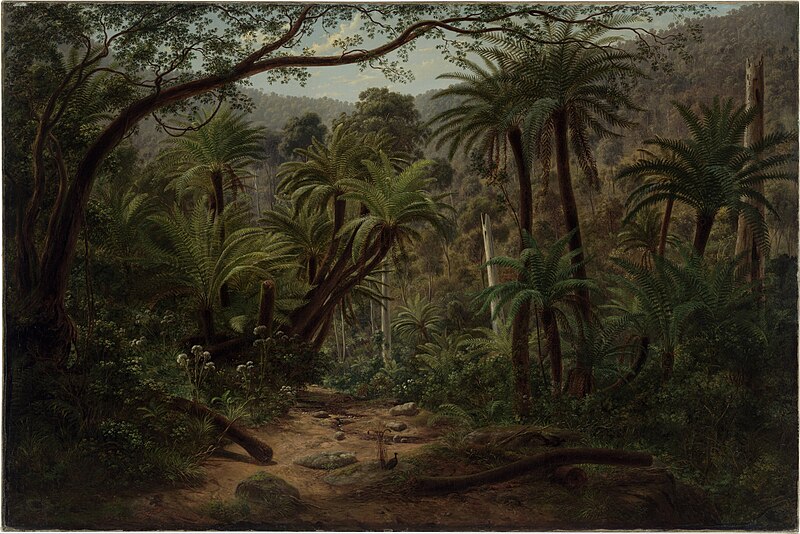

File:Eugene VON GUÉRard - Ferntree Gully in the Dandenong Ranges - Google Art Project.jpg
Ferntree Gully in the Dandenong Ranges
Eugene von Guerard, 1857


The modus operandi of settler society has not changed. Genocide and ecocide practices are still the dominant structure. The social and natural metabolism is intensifying. The gear is changing from business as usual to fast-tracking everything. The distribution of gain and harm of this extractive and exploitative process is made to appear as natural. 

An expansionist political agenda increasingly excludes uncomfortable positions by scientists, ecologists, conservation experts and Indigenous peoples with hushing-up tactics. People speaking up about threatened species, mining, logging, carbon credits and other harm to the environment are in danger of becoming a persona non grata. Their voices or studies might just cease to exist, data might just vanish. Many whistleblowers and demonstrators are gagged and are existentially threatened. Resonance spaces for counter narratives shrink in civil society.

An inadequate public discourse and science suppression do not make for a literate citizenry. The absence of the acknowledgment of the truth of the violent legacies cannot break the prevailing ‘code of silence’.

The past still echoes in the collective psyche as unfinished business. There is an unwillingness to properly confront the uncomfortable truths about genocidal colonialism and the extractive relationship towards nature. It takes reparative justice and mindful symmetrical relations to heal the poly-traumas.

Settlers on this Earth need a fundamental reorganisation, a paradigm shift (a Copernican like revolution) to demonstrate that they are not the navel of the universe.

The Eurocentric baggage brings with it epistemic violence, exploitative relationships towards others and the ecosphere. The Western world view and practices curate our habitus and seem to be set on autopilot. Extraction, pollution and exploitation without limits has to end.

It is time to re-imagine the contemporary landscape and reconfigure the connectivity to the natural and social world.

Hore’s Visions of Nature provides another stepping stone on the path of truth telling.

21.10.23

The Existence of Koalas

 
Can data gathering and the courts save the koala and biodiversity from clear felling?

The koala is an endangered species that is predicted to become functionally extinct in NSW by 2050. The NSW government plans to create The Great Koala National Park, which includes publicly-owned state forests, to halt the extinction trajectory of the marsupial. At the same time the government owned state Forestry Corporation of NSW on the Mid North Coast is planning and actively clear-felling the habitat of this endemic species.

One of the first actions for the 'world leader in mammal extinctions' would have to be to refrain from 'business as usual'. The prime reason for the marsupial's demise is the destruction of its habitat through land clearing, deforestation, logging and rapid urbanisation. The associated road designs, car crashes, mauling by roaming pet dogs shrink and degrade the already fragmented habitat even further. Fossil fuel fanned bushfires further cause death and injuries.

Ecological data is essential for the understanding and the protection of species. The quantification and simplification of ecological complexity can inform decision-makers in government and law to ensure the resilience of ecosystems and genetic diversity.

To establish the existence, distribution and population size of an endangered animal, an array of spotting and monitoring techniques are available. Wildlife monitoring can take the form of spotlighting with 'boots on the ground', searching for koala sightings (image capture), sound (recordings) or scat surveys (poo) collecting around dawn and dusk. Passionate non-expert citizen scientists and consultancy services are involved in this biodiversity data gathering and database collating. Due to resource constraints, data gathering tends to get outsourced to technological techniques that require it to be cost-effective and rapid. The monitoring methods need to be reliable and cause the least harm to wildlife and its ecosystem. Good ethical practice should prevent the risk of unintended consequences.

“Boots on the ground” and spotting koalas in food trees in the daytime is one way. Images (GIS) and searching for scat (poo) is a daytime activity. Nocturnal animals can be spotlighted at night and sound recording can be made. Marsupials can be sensitive to any human disturbance.

Motion sensor high-resolution camera traps can be installed or drones fitted with infrared cameras that buzz an area in a 'lawnmower' pattern to capture the free roaming animals. Sound encroachment by the UAVs tends to cause stress in wildlife.

To fit radio-collars on koalas can be invasive to the animals due to handling.

One of the presently favoured local methods is scent detection by sniffer dogs. Fresh scat can also be used for genetic testing of populations in fragmented habitats. Wildlife perceives introduced dogs as predators leading to stress and negative impacts. Pet dogs will leave their scent in the bush which in turn disrupts the normal cycles of wildlife. Some endemic animals can avoid the area altogether after the presence of dogs.

One less invasive monitoring method of wildlife seems to be bio-acoustics. Soundscape monitoring can detect koala bellows continuously between 8pm and 2am. Low-cost, open source recorders can be used in microphone arrays. Computer algorithms can rapidly analyse thousands of hours of audio recordings to identify specific species' occurrences. Collating the data could also be done with open software under creative commons. Biophony approaches go beyond the 'decontextualized single-species model'.

AudioMoth is such a low-cost acoustic device for monitoring biodiversity. It comes as a small recorder about the size of a credit card and has ‘hearing’ up to 190 kHz.

The urgent need to establish the existence of Australian flora and fauna through expert consultants and their technology is in the light of the continuous assault on Country.

The gathering and collating of this data verifying the existence of ecosystems has the potential to be instrumental in halting the extinction trajectory of biodiversity.

Australia is built on the imaginary foundation of 'terra nullius', an 'empty' land without Indigenous peoples. Today, the 'blind spot' takes the form of an absence or manufactured sparsity of data on Australian native plants and wildlife and justifies the continuous defaunation and eradication of endemic flora.

The sheer existence of threatened species and biodiversity conservation laws appear as an obstacle to the 'business as usual' modus. Extractivism and the financialisation of nature continue to drive the Australian ecosystems into degradation and extinctions.

Reports by scientists and data by citizen scientists are often disregarded. A huge PR industry greenwashes the central issues with 'glossy papers' and 'raises awareness' in the mainstream media channels. A busy and stressed out public is in willful ignorance about the existential issues of their home.

The 'democratic debate' of a concerned public is now replaced by pre-framed issues that have migrated from the arena of political participation into the court rooms. The dialogues of controversial political processes have been shifted from the political arena into the courts (expensive and time consuming litigation). The new terrain for dispute resolution is no longer based on a democratic participatory process, but it is confined to the legal system.

"Ultimately, peaceful political protest should be addressed by politicians. The current government has decided, by making disruption of ‘everyday life’ a criminal act, that it is a matter not of politics but for the police and criminal law. This will have serious implications for society, and for freedom of speech, whether or not you believe it is the right approach."
(source)

In this milieu political protest is forced to take the form of civil disobedience and is viewed as yet another disruption to the flow of a perfect global supply chain. Criminal law takes care of the 'spanners in the works'. It is the criminalisation of voicing dissent to a catastrophic normality.

The actors involved in this sphere are lawyers, judges and (private) ecological consultants. The public has the freedom to participate in this system via user-pays access. There, the experts deliberate about the more-than-human world and its human advocates. The ecology of this social subsystem of environmental justice is made up of ecological justice and social justice.

Constitutional law and courts have to ensure that justice is done towards the past, the present and a future. The process must ensure intergenerational equity, the rights of nature and compliance with international agreements. An array of national law/s written in the past might not be able to take account of the global poly-crisis the planet is facing today.

When human 'developments' replace other species, custodians and their institutions have to decide whether that being exists at all or will be granted the right to continue to exist at all.

Expertise is manufactured by scientists in their field, the validity is established by a community of practice and the law of the time. 500 years of global extractivism history and neo-extractivism have established a clear value system and mindsets of what are the priorities of settler societies.

Under the Myanmar military junta or Amazonian right wing governments for example, the rich and unique biodiverse rainforests of their countries cease to exist and are then transformed into simple timber, crops and cash for a few. Justifying the unjustifiable becomes superfluous.

In the west, the market steers the curating of ecological data and the decision making into the hands of external consultants that are expected to provide accurate and valid data to the courts. Third-party consultants can 'cut corners' and resort to rapid surveys and 'box checking' of bio-diverse assemblages. Problems of reliability and validity remain. Western science is the knowledge system of that very system.

In a recent reproducibility trial for example 246 biologists got widely divergent results from the same data sets. (source)

James J.A.Blair  argues that the 

“practices of accountability prioritize mining interests and enable corporations to define the standards of performance that governments will use to establish compliance”

"In the late petro-capitalist normative order, private purchasing power for short-term profit gains continues to capture data infrastructure and yield influence over public resource management...."

"Environmental “sensing practices” may serve diverse political goals and objectives for humans and more-than-human subjects..., but their ethical and social origins lie in imperial hunting, domestication and policing, rather than principles of reciprocity common to Indigenous hunting and trapping." (source)

It is said that the essential feature of capitalism is the profit motive. The destruction of native forests by the state forest corporation has to be subsidised by the taxpayers. “Over 90% of native forest that is logged in NSW is pulped and sent overseas to be used in wood chips... “ (source)

As an economic project this rationality can only be explained by short-term political gains. Would decision-makers sacrifice a highly interrelated pattern and processes of flora, fauna and ecosystems? Would they exchange highly valuable, irretrievable, unique life forms for a quick 'multiplier effect'?

Could it be that the decision makers sacrifice native forests, (‘collateral damage’) plants and animals to keep a few timber workers and fossil fuel machinery owners in work for just another while longer?

60+ % of settler society recently confirmed a clear 'NO' to the existence and participation of the Indigenous peoples in this country. Australian endemic animals and plants are still largely unknown and can hardly be named by the general public. (Knowledge of the living', Canguilhem) Numerous reports attest to the degradation of the living in settler Australia.

The state of the environment on this continent has been ‘going in the wrong direction’ (Dr Ken Henry) for the last 235 years. (source)

The denial and lack of care for Country in mind, on paper and 'out there' is overwhelming. Only by refusing to acknowledge the existence of Country can the continuing destruction be rationalised.


Links:

AudioMoth: A low-cost acoustic device for monitoring biodiversity and the environment
https://www.sciencedirect.com/science/article/pii/S2468067219300306

Audio similarity search on the Australian Acoustic Observatory media archive. Users can upload audio recordings of an animal species, find similar sounds across the database, filter by location and date, and download the results. Open Source
https://search.acousticobservatory.org/

 
Four-legged friend or foe? Dog walking displaces native birds from natural areas
https://www.researchgate.net/publication/6055768_Four-legged_friend_or_foe_Dog_walking_displaces_native_birds_from_natural_areas

 
(In) tolerance to Civil Disobedience in the UK
https://verfassungsblog.de/civil-disobedience-in-the-uk/

Reproducibility trial: 246 biologists get different results from same data sets
https://www.nature.com/articles/d41586-023-03177-1

Salvaging Empire: Sovereignty, Natural Resources, and Environmental Science in the South Atlantic, James J. A. Blair, 2023 

https://www.jstor.org/stable/10.7591/j.ctv2zmkbzx?typeAccessWorkflow=login

https://www.cornellpress.cornell.edu/book/9781501771545/salvaging-empire/#bookTabs=1

 
Tracking penguins, sensing petroleum: “Data gaps” and the politics of marine ecology in the South Atlantic
https://www.jstor.org/stable/10.7591/j.ctv2zmkbzx?typeAccessWorkflow=login

Worth more standing: As NSW’s debt mounts, NCC calls for an end to subsidies for the logging industry.
https://www.nature.org.au/as_nsw_s_debt_mounts_ncc_calls_for_an_end_to_subsidies_for_the_logging_industry

Australia’s environment must be given legal priority over land-clearing and logging to survive, Ken Henry says
https://www.theguardian.com/environment/2023/aug/25/dr-ken-henry-environment-land-clearing-logging

Updates:

What is the admissibility of expert versus citizen evidence in court? Illawarra housing developer denies presence of platypus despite 'citizen science'. Outraged by the developer's refusal to acknowledge the animal's existence.
https://mastodon.au/@Bellingen/111411065583426641 

Outsourcing koala monitoring to AI (soundscape) sensors, at Western Sydney University, 4.12.2023
https://www.abc.net.au/news/2023-12-04/biodiversity-monitoring-services-ai-track-male-koala-mating-call/103183972

31.5.15

The Bush: Travels in the Mind of Australia, inspired by Don Watson

Some thoughts inspired by Don Watson, interviewed by The World Today at @SydWriters'Fest on soundcloud. His latest book: The Bush: Travels in the Heart of Australia, Penguin Australia. (2014)

First there is the outstanding and unbelievable voracious appetite for destruction of all things Australian by European colonialisation. To 'wipe it all away' in this newly established British colony, also known as the 'blank slate' of Terra nullius. Proceeding with the 'business as usual' expansionist progress paradigm, all endemic flora and fauna had to disappear. The indigenous owners of the land "felt the full force of Australian colonial brutality" (source). The inflexible aliens found themselves in an alien land and strained to recreate their place of origin that they were habituated to.

The amazing point is not only 'the scale of destruction', but its perpetual continuation right into 21st century contemporary society and landscape. 'The Great Australian Silence' permeates and it is coupled with an inability to confront reality. The mental state is one of oscillating between learning disability and ‘intentional ignorance’, commonly known as denial.

The long list of inconvenient truths about climate disruption, massacres of indigenous people, land degradation and biodiversity impoverishment are overwhelming.

The mind manufactures defense mechanisms for a required state of permanent 'feel good' existence. A delusional unwillingness to face reality is coupled with a melancholy across generations. Like a social transgenerational epigenentics the uncleared deeds of the past linger in the minds of the present. Existence in rural and sub-urban isolation, bereft of meaning, populates the minds with roaming packs of 'black dogs': mental illness, depression and suicide. The others busy themselves with Anglo pragmatism to get things done by recreating the status quo.

A bit of bush lore, Aussie 'nature' (45,000 years of Aboriginal land stewardship) or #wildoz add to the pride and puffs up the chest. Most of the time one is propelled by fossil fuel machines, racing through the paved bush at 100 km/h.

Isolation also molded the psyche of national insecurity, stuck on an island in the Asian Pacific region. Sliding from a democracy without a bill of rights into an oligopoly of vested interests. A withering sovereign state replaced by (semi-) private instrumentalities.


'The bush' is still clear felled in the country, native vegetation is bulldozed and residents of the major cities seem to hunger for tree free cities (10/50) to go with the diy heatwaves. The majority of Australians huddle in cities, mostly along the coast. The bush is still unknown to most. It is a place to dump the weedy garden clippings, fly-tipping or empty the dogs.

The mind is caged by fence posts.


Images:
Henri Rousseau,  La Femme en rouge dans le forĂŞt, (detail),1886
Caspar David Friedrich, The Monk by the Sea, 1808


Listen:
After a lot of laughter and giggling, the audience demands 'something positive'! at the end of the interview...


31.8.14

Coffs Harbour: A place for whales and birds?


Coffs Harbour has been put on the map for watching whales and birds. Between June and November migrating humpback whales can be watched. The Solitary Islands Marine Park provides a refuge for them and many other marine species.

Also in August thousands of wedge-tailed shearwaters travel thousands of kilometres each year to return to the same burrows on Muttonbird Island Nature Reserve. It is the only easily-accessible place in NSW where the migratory wedge-tailed shearwaters nest.

Just when these migratory species dwell in the region, fossil fuel enthusiasts and the associated industries stage a 1000-horsepower speed boats race in the privatised 'natural amphitheatre' of Coffs Harbour. Rockets 'get airborne' and therefore are not supposed to shred any marine mammals. Sea creatures will simply get replaced by 'high horsepower marine monsters'. Local businesses are waving shopping bags and put up dysfunctional 'fairy lights' in trees to 'draw the crowds' to a run-of-the-mill town.

In a 100 % automobile dependent society with few footpaths and hardly any bike paths petrol runs in the veins of the population. Daily and recreational racing kill the dullness of a marginal existence. 'Boys with toys' are good consumers. They race the atmosphere-polluting machines on the Pacific Ocean and in the scenic hinterland of Coffs Harbour.


Having just thrown billions at the Pacific Highway one could have at least used this purpose-built road which is hacking its way through numerous wildlife habitats as a human-made race course 'amphitheatre'. Just privatise the space and let the benefiting industries pay for the usage. At the moment billboards along the highway appeal to motorists to reduce speed while the next billboards advertise car racing.

Staging such polluting and noisy events discourages visitors to come to the area for its natural aspects. Locals are deprived of a livable place and might move on or avoid shops sponsoring combustion festivals. It is the rapid conversion of a 'special place' to a non-place.

But in the country one just tolerates things ...


See also
Celebrating Fossil Fuel Culture on Forest Roads

Convention on the Conservation of Migratory Species of Wild Animals

26.1.14

Climate wars


As an update on climate reading, here is some very informative climate listening.

The book:
Climate Wars, by Gwynne Dyer reads:

"From one of the world’s great geopolitical analysts, a terrifying glimpse of the none-too-distant future, when climate change will force the world’s powers into a desperate struggle for advantage and even survival.

Dwindling resources. Massive population shifts. Natural disasters. Spreading epidemics. Drought. Rising sea levels. Plummeting agricultural yields. Crashing economies. Political extremism. These are some of the expected consequences of runaway climate change in the decades ahead, and any of them could tip the world towards conflict. Prescient, unflinching, and based on exhaustive research and interviews, Climate Wars promises to be one of the most important books of the coming years."

Listen to part 1 (2, 3) by Gwynne Dyer

Image:
Boat of Environmental migrants/ climate refugees fleeing the effects of catastrophic climate change and environmental degradation.

Update:
Failure to address global warming could lead to war, F. Hollande at G20, reuters 161114