10.9.14
Staging Car Races in Nine State Forests of NSW
200 kilometres of NSW forest roads will be used for a three-day car race on 11-14 September. The public is being denied access to various state owned forests.
Nine State Forests are effectively privatised:
Bagawa,
Lower Bucca,
Nana Creek,
Newry,
Orara East,
Pine Creek,
Tarkeeth,
Tuckers Nob and
Wedding Bells State Forests.
The racing cars will shoot at high speed through 'dirt roadways'. The "roads are lined by trees close to the edge in many places... they will travel through dense rainforest." These forests are the habitat for a rich biodiversity. Flora, fauna and fungi mingle in this refuge. To stage a high speed fossil fuel orgy amongst this diverse habitat and 'boost' greenhouse gases will leave all living beings with an inhospitable home. Australia is well known for working hard on making its unique species rapidly extinct.
The roaring noise pollution can be heard over kilometres, the dust generation is a hazard. Housing adjoining the State Forest are already challenged by ongoing logging pollution and breaking mining trucks. As well as the acoustic pollution on the land, the air space is filled with hovering air craft noise. The house-shaking sounds of the helicopter/s ( in the age of uavs ) over 'lifestyle' properties make any creature want to flee the area. To add such a combustion event probably will flood the market with 4sale signs and dissuade visitors that might 'boost the local economy' in the long run in a sustainable way.
Youth on (unregistered) trailbikes and bombs already doing wheelies in forests and residential areas take it as a go ahead. Such mass spectacles demonstrates to them, that it is ok to speed.
The price is too high to be 'put on the map' in such a way.
See also
Celebrating Fossil Fuel Culture on Forest Roads, 2013
Noise Pollution and Vibration in the Bellingen Shire, 2015
Images
Australian fauna, Brockhaus encyclopedia
Large frogmouth, (Batrachostomus auritus), Brehm's Life of Animals
Labels:
Bellingen,
Bowraville,
climate,
Coffs_Harbour,
deforestation,
forests,
fossil_fuel,
habitat,
noise,
pollution,
SF,
wildlife,
WRC
31.8.14
Coffs Harbour: A place for whales and birds?
Coffs Harbour has been put on the map for watching whales and birds. Between June and November migrating humpback whales can be watched. The Solitary Islands Marine Park provides a refuge for them and many other marine species.
Also in August thousands of wedge-tailed shearwaters travel thousands of kilometres each year to return to the same burrows on Muttonbird Island Nature Reserve. It is the only easily-accessible place in NSW where the migratory wedge-tailed shearwaters nest.
Just when these migratory species dwell in the region, fossil fuel enthusiasts and the associated industries stage a 1000-horsepower speed boats race in the privatised 'natural amphitheatre' of Coffs Harbour. Rockets 'get airborne' and therefore are not supposed to shred any marine mammals. Sea creatures will simply get replaced by 'high horsepower marine monsters'. Local businesses are waving shopping bags and put up dysfunctional 'fairy lights' in trees to 'draw the crowds' to a run-of-the-mill town.
In a 100 % automobile dependent society with few footpaths and hardly any bike paths petrol runs in the veins of the population. Daily and recreational racing kill the dullness of a marginal existence. 'Boys with toys' are good consumers. They race the atmosphere-polluting machines on the Pacific Ocean and in the scenic hinterland of Coffs Harbour.
Having just thrown billions at the Pacific Highway one could have at least used this purpose-built road which is hacking its way through numerous wildlife habitats as a human-made race course 'amphitheatre'. Just privatise the space and let the benefiting industries pay for the usage. At the moment billboards along the highway appeal to motorists to reduce speed while the next billboards advertise car racing.
Staging such polluting and noisy events discourages visitors to come to the area for its natural aspects. Locals are deprived of a livable place and might move on or avoid shops sponsoring combustion festivals. It is the rapid conversion of a 'special place' to a non-place.
But in the country one just tolerates things ...
See also
Celebrating Fossil Fuel Culture on Forest Roads
Convention on the Conservation of Migratory Species of Wild Animals
Labels:
August,
BigQuarry,
birds,
climate,
Coffs_Harbour,
commerce,
denial,
event,
fossil_fuel,
industry,
marine_mammals,
marine_park,
migratory_species,
noise,
ocean,
pollution,
race,
whales,
wildlife,
WRC
22.8.14
Dr Hewitt's Bellingen Hospital Arboretum
Once upon a time settlers set to work in Billingen (Gumbaynggir name for river) to denude the Bellingen Valley. They logged the rainforest, grazed and razed the waterways with their introduced ungulates. The primary sector, especially livestock production, holds a deep fear of a 'woody plant invasion'. Graziers suffer deeply from dendrophobia. The established extraction industries of intense logging, mining and cattle finally reached a point of depletion.
The 1920s brought a new wave of settlers. One notably one was Dr. George Hewitt, who worked in the Bellingen Hospital. This young doctor set out to plant as many ' woody plants' as he could all over Bellingen. His arboretum hugging the hospital consisted mainly of Australian native plants. A place for the recuperating and visitors to enjoy a beautiful garden walk. He was also planting a sign for the 70's wave of settlers that deforestation does not lead to a more habitable planet.
Today the garden is in unloved decay. Some giant trees still stand in the weed infested place. Social eutrophication dumps excess into the 'backyard' green space. An ambiance of loud humming air conditioners in winter fill the air space. The surrounding area is incessantly scratched 'clean' for yet more parking. Lack of tree cover lays bare the impervious hot asphalt and rubble.
At the dawn of the 21st century yet a new demographic mindset is populating the valley rapidly. Logging and mining trucks shoot through the small 'turn-of-the-century' main street of Bellingen. The few remaining trees look paltry or are dead. They would make wonderful parking. Car exhaust fills the country air. Addicted to automobile dependency all have to top up in the 'scenic town'. Retail reflects the changed demographics: Copious amounts of sugar and plastic for toddlers, pets for all the family and the staple of petrol, meat and beer.
The howls of private and state forest chainsaws are all-pervading. The time is ripe (again) to go for the steep slopes. The new suburbia does not yearn for tree shaded walkability.
Update: 0914
Australia's failure to act on climate pollution gives rise to angst about the hell-fires to come. Two reactions are being offered: Combusting all that is not human settlement and a 'godsend' 10/50 tree felling law that allows for the elimination of all (native) flora and fauna around human settlements and happens to increase the 'value' of the real estate simultaneously. Bingo!
Labels:
10/50_law,
Bellingen,
cars,
cattle,
deforestation,
demographics,
dendrophobia. meat,
flora,
history,
hospital,
trees,
urbanisation
16.7.14
Hazard reduction burning kills
Particle matter pollution (PM2.5 & PM10) from 'unavoidable' burning is killing and hospitalising people every year. All beings that breathe are affected but those who are vulnerable, such as children, the elderly and sick people are more affected. Not only do they kill people who are already not in perfect adult health but they also cause illnesses including coughs, asthma and other lung conditions. They may also trigger heart attacks."Particles smaller than 10 micrometres (µm) in diameter (PM10) are consistently associated with increased mortality and hospital admissions for people with both heart and lung disease."
"Because of their smaller size, these particles can be inhaled more deeply into the lungs where the irritation can cause coughs, asthma and other lung conditions. Some are small enough to pass into the bloodstream through the finest blood vessels of the lungs where they can trigger heart attacks in people with existing lung or heart conditions and impact more severely on children and the elderly."
Harmful ozone causing further respiratory damage is also promoted by burning. "Hazard reduction burns are potentially significant sources of ozone precursors".
"Emissions from human activities are sufficient to cause regular exceedances of the AAQ NEPM standards."When compared, it would appear that hazard reduction burning is more dangerous to human life than bushfires are, but that bushfires are more hazardous to property. Especially heap fires which are not 'unavoidable' could immediately be stopped to protect the air quality in rural areas. But perhaps hazard reduction burning might also be minimised to save lives with property as collateral.
Source:
http://www.epa.nsw.gov.au/soe/soe2012/chapter2/chp_2.1.htm#2.1.9
More on the rendering of large parts of the earth uninhabitable:
Many fires in New South Wales, Australia, NASA's Aqua satellite, July 11
Hazard reduction in Bongil Bongil National Park.
Local residents welcome new vegetation clearing laws with open arms.
Scientists show a drier Australia is primarily caused by greenhouse gases, thinning in ozone layer
Rainfall decline in south-west Australia linked to climate change
Updates:
Mark Z. Jacobson. Effects of biomass burning on climate, accounting for heat and moisture fluxes, black and brown carbon, and cloud absorption effects. Journal of Geophysical Research: Atmospheres, 2014; DOI: 10.1002/2014JD021861
Sydneysiders choking on the air they breathe, SMH 082014
Hazard Reduction burns rescheduled due to health warnings about smoke, rfs. NSW, 0814
Increased air pollution from bushfires is among the rising threats facing NSW residents as global warming makes blazes more likely, according to a new report by the Climate Council. SMH 1014
Smoke from agricultural land-clearing fires linked to tornado intensity, 022015
P. E. Saide, S. N. Spak, R. B. Pierce, J. A. Otkin, T. K. Schaack, A. K. Heidinger, A. M. da Silva, M. Kacenelenbogen, J. Redemann, G. R. Carmichael. Central American biomass burning smoke can increase tornado severity in the U.S. Geophysical Research Letters, 2015; DOI: 10.1002/2014GL062826
"There is nothing left of an emu-wren after a fire, not even a pile of ash" inappropriate fires abc
Fire hazard reduction strategy in Tasmania targets private land for first time. Asthma sufferers have been warned to expect more smoke."You may be killed by flame, but you can just as easily be killed by smoke and you're just as dead," Mr Dow-Sainter said. abc 23.03.2015
2.7.14
Bellingen weather and air quality monitoring
Distributed systems for measuring air quality provide data which complements that collected by government agencies. They monitor the air in places the government can't reach.
A non-profit open source system Air Quality Egg sells sensors to participating smart citizens and networks the information. The funding to start the Air Quality Egg project was crowd-sourced and the necessary capital was quickly raised.
Another citizen-based atmospheric monitoring system is available in a commercial form. Netatmo sells sensors measuring weather and air quality to interested participants and publishes the information as a map. Although the sensors provide information to the user about air quality, including CO2, PM10, PM2.5 and ozone, this information is unfortunately not shared on the map, just the temperatures and rainfall.
Sound is also monitored providing information about ambient noise from machinery such as logging, lawn mowers, chain saws or amplified music nearby. This information can be viewed with an app on a hand held device to determine if noise levels are tolerable. If you had to leave home because of noise, this can tell you from a distance when it is safe to return.
![]() |
| Ubiquitous pile fires of slash and burn culture |
26.1.14
Climate wars
As an update on climate reading, here is some very informative climate listening.
The book:
Climate Wars, by Gwynne Dyer reads:
"From one of the world’s great geopolitical analysts, a terrifying glimpse of the none-too-distant future, when climate change will force the world’s powers into a desperate struggle for advantage and even survival.
Dwindling resources. Massive population shifts. Natural disasters. Spreading epidemics. Drought. Rising sea levels. Plummeting agricultural yields. Crashing economies. Political extremism. These are some of the expected consequences of runaway climate change in the decades ahead, and any of them could tip the world towards conflict. Prescient, unflinching, and based on exhaustive research and interviews, Climate Wars promises to be one of the most important books of the coming years."
Listen to part 1 (2, 3) by Gwynne Dyer
Image:
Boat of Environmental migrants/ climate refugees fleeing the effects of catastrophic climate change and environmental degradation.
Update:
Failure to address global warming could lead to war, F. Hollande at G20, reuters 161114
11.12.13
Climate reading

Hansen J, Kharecha P, Sato M, Masson-Delmotte V, Ackerman F, et al. (2013) Assessing “Dangerous Climate Change”: Required Reduction of Carbon Emissions to Protect Young People, Future Generations and Nature. PLoS ONE 8(12): e81648. doi:10.1371/journal.pone.0081648
Abolishing the Climate Change Authority is a Really Stupid Idea, Senator Scott-Ludlam, WA Greens Speech, video and transcript, 101213
Heatwaves: Hotter, Longer, More Often. Report finds hot weather in Adelaide, Melbourne and Canberra has already reached levels predicted for 2030. Climate Council
Be Prepared: Climate Change and the Australian Bushfire Threat, Climate Council, Bushfire report
State of the Climate - 2014, CSIRO report (update)
War and Peace in Time of Ecological Conflicts, Professor Bruno Latour, Feb 21, 2014 lecture, audio: soundcloud, YouTube, (update)
Coal, dredging and more greenhouse gas emissions in the Great Barrier Reef Marine Park. abc environment, also in the Guardian
Update: (31032014)
The United Nations Intergovernmental Panel on Climate Change (IPCC) 2014 report (by chapters)
Guardian: Climate change report: 'No pause in global warming, the worst is yet to come' – live:
"No-one is safe/ "Nobody on this planet is going to be untouched by the impacts of climate change." - IPCC chairman, Dr Rajendra K Pachauri.
The atmosphere can no longer be used as an open sewer..."
World Bank: Without Action, The Planet Will See 4°C Warming by time teenagers today are in 80's 25112014
Images:
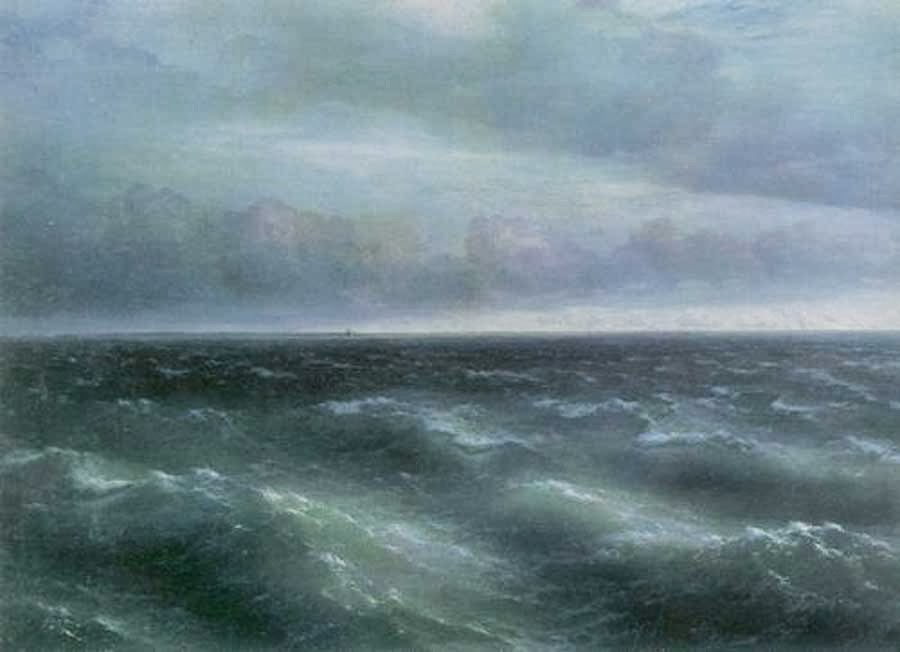
Ivan Konstantinovich Aivazovsky, Black Sea
Leonardo da Vinci, Water and Storm, 1514
See also
Climate wars, Gwynne Dyer, audio
Subscribe to:
Posts (Atom)