24.3.17

Cattle in the Riparian Zones in the Bellinger Valley


Has anything changed for the critically endangered Bellinger River Snapping Turtles in the Bellinger River catchment? 

 
Managing Stock on Waterways and in Wetlands in the Bellinger Valley (pdf)

Why exclude stock from riparian zones? (pdf)


Cattle grazing in arid environments leads to desertification. "Humans as Agents in the Termination of the African Humid Period" (source)

See also:
Healthy Riverbanks Booklet: The Turtle, The Cattle and The Indian Myna (here)

Images:
Turtle and wildlife in clean river, Coffs Harbour mural
Bellinger River banks with cattle, March 2017

10.3.17

Cover In-Pram Children from Car Exhaust Emissions


Children are particularly vulnerable to even low levels of pollution. Psychiatric disorders in children and adolescents are linked to traffic pollution. (source) Air pollution generally demands sacrifices in lives and economic costs. (source) Pollution from combustion (diesel) vehicles/ motors, fires (back-burning) and wood heaters are just a few that shorten lives prematurely.

Now parents are advised to use covers on their prams during toxic school runs to protect their infants from air pollution:
 “Fine particles show larger health impacts compared to their larger counterparts and at the young age children are more susceptible to particulate pollution, suggesting a clear need for precautionary measures to limit their exposure during their transport along the busy roadsides…Children could be at risk of breathing in some nasty and harmful chemical species…One of the simplest ways to combat this is to use a barrier between the in-pram children and the exhaust emissions, especially at pollution hotspots such as traffic intersections, so parents should use pram covers if at all possible.” (Source)


Links:
Use buggy covers to combat air pollution danger, parents warned, The Guardian, 10.03.2017
Exposure of in-pram babies to airborne particles during morning drop-in and afternoon pick-up of school children, Environmental Pollution 06.03.2017

Top tips to avoid getting metal pollution in your brain, New Scientist, 5 September 2016

NICU treatments for improving neurodevelopmental outcomes rely heavily on touch. On the somatosensory scaffolding of later perceptual, cognitive, and social development. Touch is a cornerstone of interpersonal interactions and sensory-cognitive development. Current Biology, DOI: http://dx.doi.org/10.1016/j.cub.2017.02.036

Update:
Air quality concerns spur anti-idling push at schools. Parents who leave their cars idling in school pick-up zones urged to switch off.  abc 12.04.2017


Images:
Mother and child getting poisoned by cars, Street art EU
Plastic covered prams of North Shore jogging mums, Sydney
Tyre Adventure Playground, Bellingen

2.3.17

The Big Blueberry on the North Coast of NSW

The coastline of Spain is known as the ‘Sea of Plastic’ ("Mar de Plástico”) (film)  It is the world’s largest plastic greenhouse complex with 350 square km of fruit and vegetables grown by immigrant  labour for the horticultural industry.

Will the North Coast of NSW become such an industrial plastic wrapped landscape?

This ‘country’ has had 229 years of extractive industries. The extraction and export of natural resources in colonial times and now leads to conflicts with residential areas.

Small scale rural landholdings populate the coast and the hinterland. The commons protects National Parks and reserves to afford biodiversity a home. The interface of nature reserves, human settlement and industrial production is that of conflict. “Residents and council do not know about a blueberry farm development until they are there”. (source)

The high rainfall area has been also ‘discovered’ by multinational agribusiness. Once, some of the Coffs Harbour area was know as the ‘Big Banana’, it seems now the North Coast is being developed into the BIG BLUEBERRY.


The cash crop is grown for export. After the land is cleared (image) and all Australian flora and fauna have been made homeless, the crops are grown with agri-chemicals (pesticide, fungicide etc). Runoff impacts the surrounding areas. The berries and the incorporated water and soil are sent overseas. The legacy remains.

Increased machine noise and traffic impact on residents and remaining wildlife.

The promise of ‘jobs’ reads more like ’The Grapes of Wrath’. It has been found that backpackers and non-English speaking background workers from o.s. are underpaid and exploited. (here, here, here)

The farm workers go, but residents are stuck in a neighbourhood that is becoming an industrial site. The conflict between locals and large corporate agribusiness interests needs attention by the regulatory bodies.

As coastal urbanisation increases, the space and resources shrink. The horticultural industry expands in Bellingen, Boambee Valley, Coffs Coast, Corindi, Crossmaglen, Woolgoolga, Repton, Valla, Valery and Nambucca. At Bruxner Park the views towards Coffs Harbour and the ocean are starting to look like the above plastic netting landscape, white plastic nets are gobbling up the green coastal landscape.

The 21st century could offer a chance to refrain from treating ‘country’ as a BIG QUARRY. A future beyond extraction and exploitation. Care for the commons, the water bodies, soil and biodiversity.

Authorities can regulate and monitor ‘land use’ and prevent abuse in the interest of all.

 
Quotes:
- A meeting at the CWA on Monday, March 13 at 7pm
“Intensive Horticulture is creeping into the Bellinger Valley by stealth and residents across the Shire will gather to discuss largely unmonitored and unregulated development of intensive horticulture as a new plantation has now become evident to worried neighbours from Valery,” Bellingen Environment Centre spokesperson Caroline Joseph said. (source)

- Valla: “There is no visual flow in Deep Creek and still pumping continues" (source)

- Repton: “A key feature of the village is the natural setting, surrounded by the Bongil Bongil National Park and Pine Creek State Forest. The conversion of land zoned R5 to provide for an agricultural development is wholly at odds with the primary objective of the zone.”
“Thirty-Two separate chemicals are listed in the NSW Department of Primary Industry’s Blueberry Plant protection Guide 2015-2016 for use on blueberries in NSW to control disease and pests...Of the 32 chemicals approved one third of the chemicals are identified as likely to have a long-lasting, negative off-target impact … most disturbing is that pesticides can have both immediate (acute) effects and long term (chronic) effects on the health of people who are exposed to them. ... (The) main concern is spray drift over to nearby houses whose only water is collected in tanks and consequently we will drink.” (source)

- Woolgoolga: “The development of a blueberry farm near his property further west on Newmans Rd resulted in a reduction of kangaroos in that area.” (source)

Links:
Blueberry farm in the Shire reignites the debate, Bellingen Courier, 28.02.2017
Repton resistance  Bellingen Courier, 29.11.2015 
Like living in a war zone, abc 01.03.2017 
Australian agriculture safeguarding against climate change. Structures for larger-scale growers to cover whole paddocks or orchards. abc 04.03.2017
Warning against the deliberate exploitation of young people and visa holders, Bellingen Courier, 06.03.2017

Updates:
 
Blueberry blues: how the cash crop is causing a contamination crisis in Coffs Harbour, 29.09.2022 The Guardian  
 
Calls for royal commission as report details allegations blueberry farmers pay workers $3 an hour 3.12.2020

 Concerned residents want blueberry farms to need a DA 
“We were shocked to learn that there is no monitoring or compliance required at a local (council) level to clear privately owned,forested land or to establish intensive horticulture plantations and that this concern about unregulated development is being shared across the region,” Bellingen Environment Centre’s Caroline Joseph said... Pine Creek is dying ..." Bellingen Courier, 14.03.2017

Deregulate, deregulate - "Productivity Commission recommends a wide slash of farm red tape, except biosecurity and food safety. It also recommends agricultural land should be used for its highest value, even if that means resource development." abc rural 29.03.2017

"Europe's Dirty Little Secret: Moroccan Slaves and a 'Sea of Plastic' " or landscapes a perennial plastic greenhouses, Ecowatch 2015
 
Marine scientists fingerprint sources of nitrogen on the Coffs coast. Nearly all creeks with agriculture (blueberry, macadamia) and urban land use have (sewage) water quality issues. Bellingen Courier, 16.09.2020


Images:
Greenhouses of the Campo de Dalías, Almería Province, Spain , NASA’s Earth Observatory
Organic blueberries
The March of Business, Bellingen graffiti 
 
More images:

Mar del Plastico, Bernhard Lang

20.2.17

The Camphor Trees of Bellingen


The camphor trees of Church Street, Bellingen are to be cut down. ”The war of the camphor laurels” has been causing local outrage for years. The large trees are throwing some shade on cafe visitors and motorists on a side road reducing the heat island effect.

In the collective imagination, the iconic ornamental giants are synonymous with ‘the beautiful pristine picturesque Bellinger valley’. Postcard-views show cow pastures framed by thick stands of camphor trees hugging the waterways.


For others they are an out of control invasive noxious weed that have reduced local biodiversity of the entire area. When bush regenerators eradicated camphor trees and planted endemic species, heritage enthusiasts sprang into action: “ In some cases, bollards were burned out and boundary chains cut to allow visitors to drive their vehicles onto the fragile banks, crushing native seedlings and causing erosion damage in the process.” (source)

In the social imaginary the introduced flora belongs to the foundation myth of the region. After white settlers cleared the biodiversity of the rainforest valley and replaced it with a pastoralist monoculture, the need for shade became apparent. The giant trees promised instant shade in the fertile flood plains for the British antipodeans and their cattle.


”Ruthless clearance of native vegetation in the late nineteenth and early twentieth centuries created the desire to plant exotic trees such as Cinnamomum camphora in urban and rural settings for practical and aesthetic purposes… (The tree ) “was also highly esteemed for its ability to quickly provide shade for dairy cattle in the  denuded former-rainforest lands of sub-tropical north-eastern New South Wales…” ( B. J. Stubbs, 2012)

The Asian tree was intentionally introduced in 1822 as an ornamental tree for use in gardens and public parks. Additionally colonial Acclimatization Societies founded after 1860 aimed to ‘acclimatise’ the European settlers by introducing foreign flora and fauna. Botanic gardens aided in the human-mediated introduction and spread of the species.

Settlers longed for ornamentals “throughout the Australian colonies to enrich the Australian flora” (source).


The 19th Century ‘panacea’ became entirely out of control after the demise of the dairy industry. “It was generally recognised by the late 1990s that camphor laurel was well and truly out of control and had become a major environmental problem in parts of eastern Australia. This was a consequence of several decades of  landuse  change  accompanying  the  decline  of  dairy  farming,  and  the associated lessening of weed control on the former dairying lands… It  has spread uncontrollably  across  that  region,  competing  successfully  with  native  regrowth,  and  forming  veritable  forests  on  abandoned  pasture. “ ( B. J. Stubbs, 2012)


The neglected and degraded pastures were then bought up and planted with bamboo and other exotics, while the other invasive weed problem remained. Today the mainstream public and private ’solution’ to the river-hugging non-native species is pesticide. In the war on weeds all unwanted growth is doused with a glyphosate-based weed killer, a 'probable human carcinogen'. The new ‘panacea’ to get rid of the last/past folly.


"Inter-continental and inter-taxonomic variation can be largely attributed to the diaspora of European settlers in the nineteenth century and to the acceleration in trade in the twentieth century. " The European diaspora creates an "unprecedented intensity of human-mediated species exchange (which) leads to the homogenization of floras and faunas, re-defines the classical boundaries of biogeography and has far-reaching implications for native biota, ecosystem functioning, human health and economy...The pathways by which alien species are introduced into new areas are also changing rapidly, in particular through increased global trade, tourism, agriculture, horticulture, and the construction and formation (for example, through climate change) of new transportation corridors, such as the opening of the Arctic Ocean shipping routes.” (Source)


Cacti are the contemporary 'must have' 'must spread' alien species wave unleashed on the area.

Deregulation of biosecurity and the hunger for horticultural exotics prepare for the extinction of endemic biodiversity. “…There is an urgent need to implement more effective prevention policies at all scales, enforcing more stringent national and regional legislations, and developing more powerful international agreements.” (Source)


Back to the iconic heritage trees in Church St and the false dilemma in the collective imagination.

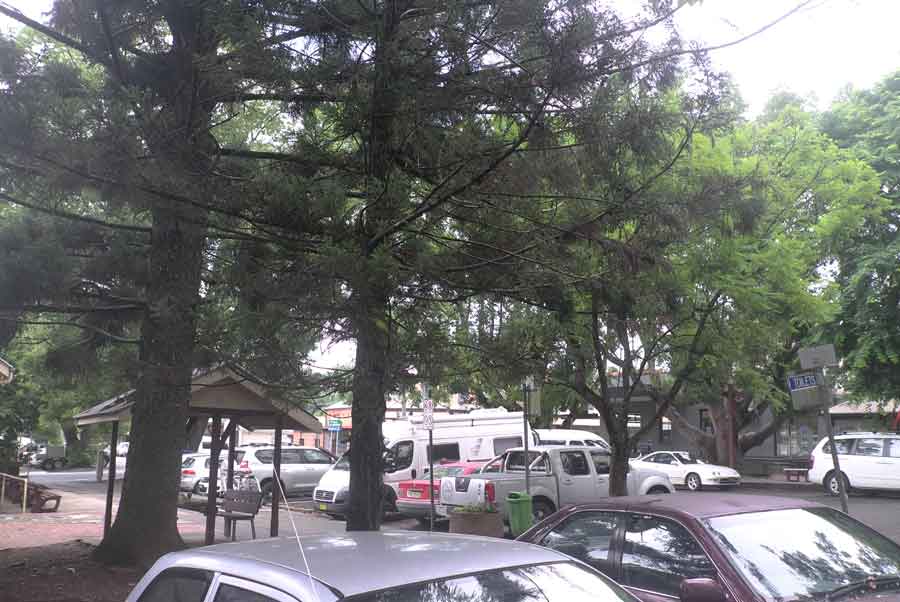
The street is the only shaded cafe strip in town where cars should go 10 km/h but 40 km/h is recommended. A giant car park come turning circle where motorists sit with their packs of dogs and blow exhaust fumes into each others' lungs.


The large camphors are caged in planter boxes. (bollards) The roots lifting the pavers have been lovingly smeared over with tar. Like many other mature trees (crammed in cement) in Bellingen they do not look healthy. Their branches are mutilated so not to interfere with dangling power lines and property.

On the opposite side of the cafe strip the toilet block is also set among large trees. Their root network is abused as an overcrowded car park. ‘Access’ to the amenities means dodging a lot of SUVs.


Chopping the giant weeds would liberate Church St. for more fossil fuel vehicles. More neatly paved impervious spaces for cars. A car-centric tabula rasa. In a town where nothing goes without fossil fuel mobility this is the most likely outcome. After the $836,175 chop all motorists, shade hugging or biodiversity loving will be able to park there at ease. Should anything crack though the cement - a good spray will help.


Walkable, car-free and livable environments are as yet unthinkable in this cultural artifact. People-centred public lounge rooms with street furniture, designed to ‘human scale’ with endemic tree shade coverage optimised and impervious surfaces eliminated to stem the uncanny anthropogenic heatwaves are in the realm of dreaming.


Sources and inspirations:
Brett J. Stubbs,  Saviour to Scourge: a history of the introduction and spread of the camphor tree (Cinnamomum camphora) in eastern Australia , 2012 (pdf) (flipbook)

"No saturation in the accumulation of alien species worldwide" Nature Communications 8, Article number: 14435 (2017) doi:10.1038/ncomms14435
http://www.nature.com/articles/ncomms14435

Heritage trees are on the chopping block, The Bellingen Shire Courier-Sun, 13.02.2017

Bellingen Town Centre Beautification, create.bellingen.nsw.gov.au

Henri Lefebvre's The Production of Space, Donald Nicholson-Smith trans., Oxford: Basil Blackwell. Originally published 1974. 1991, (pdf)

John Urry, Consuming Places (1995), (pdf)

Global movements and funding cuts a threat to biosecurity in Australia, abc 02.2017

Review of Australia's Intergovernmental Agreement on Biosecurity, IGAB, 12.2016 (pdf)

 The Cars and Trucks That Ate Bellingen 

Updates:
"Suitable replacement trees" will morphe into more car parking: “Affiliated works included formalising car parking and planting of replacement trees which occurred by way of community input via a working party." Bellingen Courier, 13.03.2017

25.1.17

Cacti and Succulents of the Bellingen Area


On a walk through Bellingen one can encounter cacti and succulents in cafes, shops, markets and community gardens. The spiny exotic plants are everywhere. They seem to be an expression of the fashionable Bellingen lifestyle. They are trendy and convenient as they require no care.

Residents and businesses rejecting their local environment make a clear statement with their decor: Wish I was somewhere else - far away from here.

The must-have plants are easy to name as 'cactus' or 'spiky plant', even for the botanically naive person.


The pots grace the outdoor lounges of hipsters. For years now ‘spiky plants’ have showcased Sydney’s real estate. That Mediterranean-style feeling seems to sell. Interior gardens, green walls, rooftop/balconies and outdoor living rooms sprout a mono-culture of spiky things in planter rows. It is the botanic message of the ‘for sale sign’ or 'money dwells here'.


Dispersal by plant segment makes it a dream for the horticultural industry and customers. Once the thing has outgrown its pot it is time to 'set it free.' In the garden they become a serial drain blocker. On larger blocks the fossil fuel maintenance team tends to throw the cut offs into the edge of the bush.

Forgotten are the Prickly Pear Cacti hedges from South America that quickly overran many thousand acres of farmland. Today still mother of millions are poisoning cattle and succulents are poisoning children.

While some attempt to control weeds, others are disseminating invasive plants throughout the Valley. Limiting the trade in potentially invasive species is outright unthinkable.


Despite of being set in a rich Gumbaynggirr landscape of biodiversity both businesses and residents choose to populated the landscape with introduced and invasive cacti, succulents, agaves, bromeliads and bamboo, among other weeds.

While deforestation, rapid land clearing, shave the land of native vegetation and biodiversity, the Big Quarry exports more coal then ever before.


It almost seems that people have resigned themselves to climate inaction and are preparing their air conditioned dwellings for Death Valley like (56.7 °C) temperatures extremes. Ornamental flora from the desert of central Mexico or Arizona seems to be the appropriate setting for anticipating the climate catastrophe on the most arid continent.


Update:
"Bellingen registers its hottest day on record. Temperatures soared into the 40s as Bellingen went past its previous best to a top of 48.9 degrees just after 5pm according to Bellingen Weather’s station... in 60 years it has never been that hot." Bellingen Courier. 13.02.2017
NSW smashes February statewide heat records two days in a row SMH, 13.02.2017

18.1.17

Healthy Riverbanks Booklet: The Turtle, The Cattle and The Indian Myna


After the mass kill event in 2015 of the critically endangered Bellinger River Snapping Turtle, various authorities have now resorted to making information and activities available to property owners and other stakeholders in the catchment area.

The Bellinger River System Landholder Booklet (pdf) is also available in the dead tree version.

It seems that the introduced Indian Myna (pdf) is symbiotic with the cattle business and roads as they spread along with the precooked ungulates standing mostly without shade in severe heatwave conditions.

Meanwhile the drought continues...